Condo Insurance Washington: Protect Your Unit and Personal Property

Condo insurance in Washington protects more than just your unit-it covers your personal belongings and shields you from liability claims if someone gets injured on your property. Many condo owners mistakenly believe their HOA’s master policy covers everything, which leaves dangerous gaps in their protection.

We at Secord Agency – A Trucordia Business help condo owners understand exactly what they need to cover and how to find policies that fit their situation. This guide walks you through what condo insurance covers, how it differs from homeowners insurance, and how to select the right policy for your investment.

What Your Condo Insurance Actually Covers

Your HO-6 condo policy covers the interior of your unit-the drywall inward-along with your personal belongings, liability exposure, and additional living expenses if you need temporary housing after a covered loss. Water damage accounts for roughly 53 percent of condo claims in Washington, making it the top loss driver, so understanding what your policy protects against matters far more than general reassurance. The master policy your HOA carries handles the building exterior, roof, common areas, and shared liability, but it stops at your unit’s walls.

Infographic showing key Washington condo insurance statistics: water damage share of claims, master-policy cost increases, and leak-detection discounts.

This means you own everything inside: kitchen cabinets, bathroom fixtures, flooring, paint, and any upgrades you installed beyond what the builder originally provided. Many owners underestimate this responsibility and face thousands in out-of-pocket costs after a fire or water event.

Your Personal Property Needs Real Protection

Your HO-6 dwelling coverage rebuilds interior damage to your unit, while personal property coverage reimburses stolen or damaged belongings-furniture, electronics, clothing, and everything else you own. The catch is that standard policies typically pay actual cash value, meaning depreciation reduces what you receive; a five-year-old television worth $800 new might only net $300. If you own jewelry, art, or collectibles, request endorsements for replacement cost coverage and higher sublimits, since standard policies often cap jewelry at $1,500 to $2,500 total. Appraisals for items worth more than $5,000 protect you during claims and speed up settlements considerably when you provide copies to your agent. Your liability coverage, starting around $100,000 on most policies, protects you if someone is injured inside your unit and sues-a guest slips on your bathroom floor or your guest’s child sustains an injury. Medical payments coverage, typically $1,000 to $5,000, pays medical bills for injuries on your property regardless of fault, which often prevents lawsuits before they start. If you have significant assets, add an umbrella policy starting at $1 million; Washington average premises-liability settlements reached about $68,000 in 2022, according to state data, so higher limits make financial sense.

Loss Assessment Coverage Protects Against Special Assessments

Loss assessment coverage is the most overlooked protection in Washington condo ownership. When the HOA master policy’s limits are exceeded or claims exhaust reserves, the association bills unit owners for their share of the deductible or shortfall-sometimes $10,000 to $50,000 per unit. Your HO-6 loss assessment coverage, ideally set at $50,000 or higher, pays these special assessments so you aren’t wiped out by one catastrophic event. Additional living expense coverage pays your hotel, meals, and other costs if you must vacate during repairs after a covered loss; most policies include this but often set limits too low at $10,000 to $20,000. If you live in a building where major water damage could displace residents for weeks, request higher limits.

Coordinate with Your HOA to Avoid Coverage Gaps

Washington’s Washington Condominium Act requires associations to maintain master-policy coverage at no less than 80 percent of replacement cost, but this doesn’t mean your unit is fully covered-it protects the structure only. Coordinate with your HOA to obtain a copy of the master policy and the Certificate of Insurance issued at renewal; knowing the master deductible, coverage limits, and what’s included prevents dangerous assumptions. Your individual HO-6 policy fills the gaps that the master policy leaves, but only if you understand what those gaps actually are. The next section explains how condo insurance differs fundamentally from homeowners insurance and why this distinction shapes your coverage strategy.

How Condo Insurance Differs from Homeowners Insurance

The fundamental difference between condo insurance and homeowners insurance lies in what you actually own and what the HOA owns on your behalf. When you buy a house, you own the entire structure-roof, walls, foundation, everything. When you buy a condo, you own only the airspace inside your unit’s walls, while the HOA owns the building envelope, common areas, elevators, and shared systems. This ownership split means homeowners insurance covers the entire dwelling, while condo insurance covers only your interior and personal belongings. The HOA’s master policy handles the building structure and shared liability, but it deliberately excludes your unit’s interior improvements and your personal property.

What the Master Policy Actually Covers

The HOA’s master policy covers the exterior and all interior finishes, such as doors, windows, siding, shower/tub, vanity/cabinets, paint, and baseboards/trim, but it deliberately excludes your unit’s interior improvements beyond original finishes and your personal property. A kitchen fire that damages your cabinets, countertops, and appliances falls on you, not the HOA. Water damage from a burst pipe in your walls becomes your responsibility if the master policy covers only the building’s structural elements. Washington’s master policies typically fall into three categories: bare walls (association covers only structural shell), single entity (association covers original builder fixtures), or all-inclusive (association covers built-in appliances and upgrades). Your dwelling coverage limit must match your master policy type-if you have a bare-walls policy, you need higher dwelling limits to cover kitchen and bathroom finishes; if all-inclusive, you need less.

Hub-and-spoke chart explaining bare walls, single entity, and all-inclusive HOA master policy types and how they affect your HO-6 limits. - Condo insurance Washington

Why Most Owners Underestimate Their Coverage Needs

Most condo owners never request a copy of the master policy from their HOA, which means they guess at what they need to insure. This guessing costs money through either over-insurance or, more dangerously, under-insurance that leaves massive gaps. Relying solely on the master policy leaves you catastrophically exposed because it protects the structure only, not your interior or belongings.

Cost Differences Reflect Your Reduced Risk

National data suggest condo premiums run two to three times lower than homeowners premiums because you insure far less property-no roof, no foundation, no exterior maintenance. However, Washington condo premiums have risen sharply since 2019, with master-policy costs climbing roughly 8 percent annually as of 2023. Your individual HO-6 policy typically costs $400 to $600 per year in Washington, though location, building age, and your claims history drive significant variation.

The Hidden Financial Risk: Loss Assessment Gaps

The real financial risk in condos comes from loss assessment coverage gaps and insufficient master-policy deductibles. If your HOA carries a $50,000 deductible on the master policy and a major claim exhausts reserves, the association bills each unit owner for their share-potentially $5,000 to $25,000 per unit depending on building size. Standard loss assessment coverage tops out at $1,000 to $5,000 on many policies, which covers almost nothing. Loss assessment limits of at least $50,000 for Washington condos add minimal premium cost but shield you from devastating special assessments. Your homeowners-insured neighbor pays one deductible; you potentially face two-your HO-6 deductible and your share of the master deductible if a claim affects common areas. This dual-deductible reality makes loss assessment coverage non-negotiable, not optional.

Understanding these differences shapes how you approach finding the right policy. The next section walks you through assessing your specific coverage needs and comparing quotes from multiple carriers to build protection that actually matches your situation.

Finding the Right Condo Insurance Policy for Washington

Gather Your Documents First

Start by collecting three documents before you request a single quote: your HOA’s master policy, the Certificate of Insurance issued at renewal, and your building’s governing documents or CC&Rs. These tell you exactly what the master policy covers, what deductible applies, and whether your building is bare walls, single entity, or all-inclusive. Without this information, any quote you receive is essentially a guess. Next, inventory your personal property-furniture, electronics, clothing, jewelry, art-and calculate what it would cost to replace everything at today’s prices, not what you paid years ago. Most owners underestimate this figure by 30 to 50 percent because items in closets, storage, and less-visible areas slip from memory. A detailed inventory also speeds claims processing dramatically if you ever need to file one.

Calculate Your Dwelling and Liability Limits

Your dwelling coverage amount depends entirely on your master policy type; bare-walls policies require higher dwelling limits because you cover kitchen and bathroom finishes, while all-inclusive policies mean lower limits since the association already covers those items. Request quotes with multiple dwelling amounts-typically $25,000 to $100,000 depending on your unit size and finishes-and loss assessment coverage starting at $50,000 minimum. Liability coverage should match your assets; if you have $500,000 in savings and investments, $100,000 in liability leaves you vulnerable, so request $300,000 to $500,000 as a baseline, then add a $1 million umbrella policy if you have significant net worth.

Compare Quotes from Multiple Carriers

Comparing quotes requires more than price alone. Contact at least three carriers and request identical coverage limits, deductibles, and endorsements so you can actually compare apples to apples. Major insurers offering condo policies in Washington include Allstate, Amica, Chubb, Farmers, Liberty Mutual, Nationwide, State Farm, Travelers, and USAA, though availability varies by zip code and building characteristics. Ask each carrier specifically about water backup coverage, replacement-cost endorsements for personal property, and any discounts for bundling auto or installing leak-detection systems-insurers offer up to 5 percent premium credits for monitored leak detection, which also reduces water damage claims. When you receive quotes, verify that loss assessment coverage is included and at sufficient limits; many standard quotes default to $1,000 to $5,000, which is dangerously low.

Checklist of what to confirm when comparing Washington condo insurance quotes. - Condo insurance Washington

Work with an Independent Agent

An independent agent who represents multiple carriers rather than one company can shop options and identify the best combination of price, coverage, and service for your specific situation. An independent agent also reviews your master policy alongside your HO-6 to spot coordination gaps that most owners miss entirely. Request a free policy review before you commit; a quality agent invests 30 to 45 minutes understanding your building, your unit’s upgrades, and your assets before recommending coverage. Once you select a policy, review it annually or whenever your master policy renews, since changes to HOA coverage or deductibles should trigger adjustments to your personal limits.

Final Thoughts

Protecting your condo investment in Washington requires understanding what your HOA’s master policy covers and what gaps your personal HO-6 policy must fill. The master policy protects the building structure and common areas, but it deliberately excludes your unit’s interior, personal belongings, and your individual liability exposure. Water damage claims, which account for 53 percent of condo losses in Washington, underscore why comprehensive personal property coverage matters far more than general reassurance.

Your action plan starts with three concrete steps: request your HOA’s master policy and Certificate of Insurance from your property manager, inventory your personal belongings at replacement cost, and secure loss assessment coverage of at least $50,000 to shield yourself from special assessments when master-policy deductibles are triggered. These steps take a few hours but prevent thousands in unexpected costs after a loss. When you shop for condo insurance Washington coverage, compare quotes from multiple carriers using identical limits and endorsements so you can actually compare prices fairly.

Request water backup coverage, replacement-cost endorsements for high-value items, and any available discounts for leak-detection systems or bundled policies. An independent agent who represents multiple carriers can review your master policy alongside your personal coverage to spot coordination gaps that most owners miss. Contact us at Secord Agency – A Trucordia Business for a free policy review to ensure your condo insurance protection matches your actual situation and assets.

Homeowners Insurance Overview Seattle: What You Need to Know

Homeowners insurance in Seattle protects your most valuable asset, but understanding your coverage options can feel overwhelming. We at Secord Agency – A Trucordia Business have helped countless Seattle homeowners navigate their policies and find the right protection for their needs.

This homeowners insurance overview Seattle covers the coverage types you need to know about, the factors that impact your rates, and how to select a policy that actually fits your situation.

What Does Your Homeowners Policy Actually Cover

Dwelling Coverage and Structural Protection

Your standard homeowners policy in Seattle covers four essential areas, and understanding what’s protected prevents costly surprises when you file a claim. Dwelling coverage pays to repair or rebuild your home’s structure at current replacement costs, not the market value you paid-this matters because rebuilding a Seattle home typically costs significantly more than the purchase price. Wind and hail account for the largest share of homeowners claims, so your dwelling coverage must reflect actual rebuilding expenses in today’s market. For a 2,500-square-foot Seattle home, expect dwelling costs around $1,600 annually for basic coverage, though this varies by ZIP code, construction materials, and home age.

Personal Property and Liability Protection

Personal property coverage protects your furnishings, electronics, and belongings inside the home, usually set at 50 to 70% of your dwelling limit. Most policies apply actual cash value to personal property, meaning your $1,200 television receives payment at depreciated value, not replacement cost-you’ll need a scheduled personal property endorsement to cover high-value items like jewelry or art at agreed values. Liability protection shields you when someone is injured on your property or you accidentally damage someone else’s property, with standard limits starting at $100,000 for bodily injury and property damage combined. Medical payments coverage typically covers at least $1,000 in medical expenses for guests injured at your home, regardless of fault. Most Seattle homeowners underestimate liability exposure and should carry at least $300,000 in coverage; a $1 million umbrella policy costs only $150 to $300 annually and provides critical protection if a serious injury occurs on your property.

What Your Policy Excludes

Your standard policy does not cover flood damage from rising groundwater or overflowing bodies of water, and with spring snowmelt and heavy rain common in Washington, you need separate flood insurance-the National Flood Insurance Program takes up to 30 days to activate, so don’t wait until storm season arrives. Earthquake coverage is also excluded and requires a separate endorsement or standalone policy, despite the Pacific Northwest’s significant seismic risk. Water backup from municipal sewers or sump pump failure is typically excluded or heavily capped, yet accounts for substantial damage in older Seattle homes; add a water backup endorsement to protect against this common loss.

Common Claims and Prevention Strategies

Water damage and freezing are significant concerns in Washington, so insulate exterior pipes, install frost-free hose bibs, and use heat tape in crawlspaces to prevent burst pipes during winter. Fire and electrical hazards cause substantial losses, with the National Fire Protection Association noting that 30% of home fires start from faulty wiring and 44% from unattended cooking-these losses are covered, but prevention through electrical inspections and kitchen safety habits keeps premiums lower.

Chart showing that unattended cooking accounts for 44% of home fires and faulty wiring accounts for 30%, per the National Fire Protection Association. - Homeowners insurance overview Seattle

Dog bite liability is a hidden risk: about 4.5 million incidents occur annually in the US, and many insurers exclude or restrict coverage for certain breeds like Pit Bulls, Rottweilers, and Chow Chows, so verify breed coverage in writing with your carrier.

Moving Forward With Your Coverage

Understanding these coverage boundaries means you can add endorsements strategically and avoid gaps that leave you exposed. The factors that shape your rates-from your home’s age and location to your claims history-play an equally important role in determining what you pay and what protection you actually receive.

What Drives Your Seattle Insurance Rate

Home Age, Size, and Construction Materials Shape Your Premium

Your home’s age, size, and construction materials form the foundation of how insurers price your policy, and these factors matter far more than most homeowners realize. A 1955 Seattle home like the one quoted at $1,600 annually carries different risk than a newly constructed property because older homes often have outdated electrical wiring, plumbing systems prone to freezing, and roofing materials nearing end-of-life. Insurers charge more for homes built before 1980 because they’re statistically linked to higher fire and water damage claims, particularly when the electrical system hasn’t been updated.

Hub-and-spoke diagram of key rate drivers for Seattle homeowners insurance. - Homeowners insurance overview Seattle

A 2,500-square-foot home costs substantially more to insure than a 1,500-square-foot home simply because there’s more structure to rebuild and more personal property to protect.

Construction materials shift your rate significantly: homes with wood siding and composition roofs pay more than those with brick exteriors and impact-resistant roofing, which can withstand the wind and hail damage that affects Washington homeowners claims according to the Insurance Information Institute. If you’ve upgraded your roof to hail and wind-resistant materials, inform your insurer immediately because many carriers offer discounts of 10 to 15% for this type of protective investment.

Location and Natural Disaster Exposure

Your ZIP code and exposure to natural disaster risk create the second major pricing lever, and this is where Seattle homeowners face real cost variation. Spring snowmelt and heavy rainfall put your property at flood risk, yet standard policies exclude flood damage entirely, forcing you to purchase separate coverage through the National Flood Insurance Program at an additional $400 to $1,200 annually depending on your flood zone. Earthquake risk in the Pacific Northwest adds another $300 to $800 per year for endorsement coverage. Wind and hail storms hit Seattle regularly, making storm-resistant construction a genuine money saver.

Claims History and Credit Score Impact Rates

Your claims history and credit score round out the pricing equation: insurers view past claims as predictors of future losses, so a homeowner with two claims in five years pays substantially more than one with a clean record. Credit scores influence rates because studies show a correlation between credit management and insurance claim frequency. PEMCO, the cheapest homeowners insurer in Washington at around $1,550 annually for $600,000 dwelling coverage, explicitly rewards claim-free history and offers educator discounts. Other carriers like Allstate and State Farm charge significantly more in Washington, with State Farm averaging $2,348 for comparable coverage.

Shopping Multiple Carriers Reveals Your True Cost

Shopping three to five carriers simultaneously is the only way to see how your specific home profile affects pricing across the market, since the same 2,500-square-foot home can cost $1,600 with one carrier and $3,000 with another based purely on underwriting criteria and risk appetite. An independent agency like Secord Agency-a Trucordia business based in Seattle’s Wallingford neighborhood-can shop multiple carriers at once to compare how different insurers rate your property and identify the best value for your coverage needs. The variation across carriers means that comparing quotes from at least three providers before you commit to a policy protects you from overpaying and helps you understand which coverage options matter most for your specific situation.

How to Choose the Right Homeowners Insurance Policy

Calculate Your Home’s True Replacement Cost

Start by calculating your home’s true replacement cost, not its market value or what you paid for it years ago. Contact three local contractors and ask what it would cost to rebuild your home from the ground up using current materials and labor rates. Most Seattle homeowners discover their dwelling limit is too low because they anchor to outdated purchase prices or tax assessments.

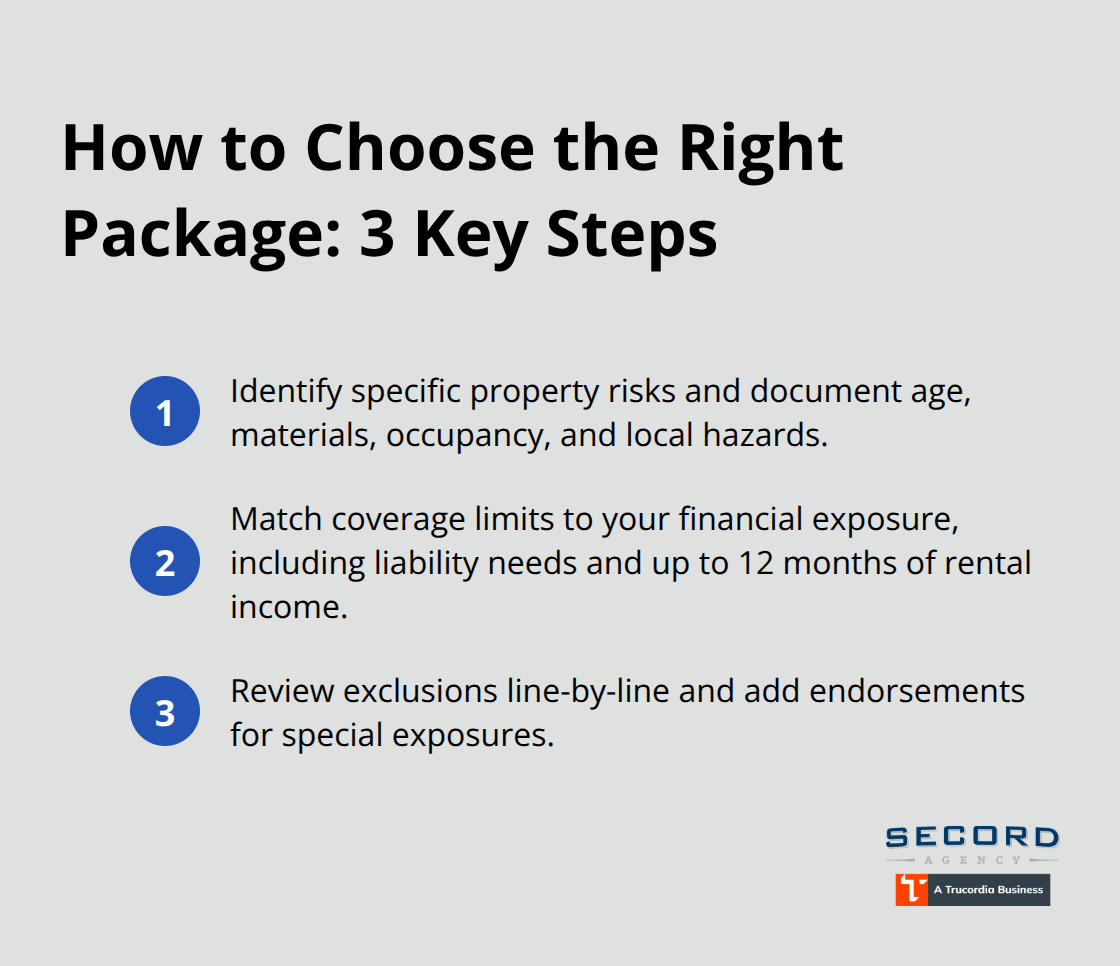
Compact list of four steps to select a homeowners insurance policy in Seattle.

Once you have that number, add 10 to 15 percent as a buffer for cost inflation and unforeseen structural issues that contractors find during reconstruction.

Assess Your Personal Property and Liability Needs

Your personal property limit should reflect what you actually own-count your furniture, electronics, clothing, and appliances, then add scheduled coverage riders for jewelry, art, or collectibles worth more than $2,500 each. Liability limits demand serious attention: standard $100,000 coverage is dangerously low for a Seattle homeowner. A single lawsuit from a guest who slips on your icy driveway or a dog bite incident can easily exceed that amount. Carry at least $300,000 in liability protection, and an umbrella policy costs only $150 to $300 annually-one of the smartest investments you can make. Write down these numbers and use them as your baseline when requesting quotes.

Compare Quotes Across Multiple Carriers

Request quotes from PEMCO, Allstate, USAA (if you qualify as military or federal employee), State Farm, and Farmers using the exact same dwelling limit, deductible, and coverage options across all five carriers. When comparing quotes, pay attention to what’s excluded: some carriers cap water backup coverage at $5,000 while others offer $25,000, and flood or earthquake endorsements vary dramatically in cost and sub-limits. Request quotes that include water backup, sewer backup, and earthquake coverage so you’re comparing apples to apples.

Optimize Your Deductible and Coverage Details

Deductible selection directly impacts your monthly cost-raising your deductible from $500 to $1,000 typically saves 15 to 25 percent on premiums. Try the highest deductible you can afford to pay out of pocket if a loss occurs, since you’re self-insuring that amount anyway. An independent agency can shop all these carriers simultaneously and highlight which offers the best combination of price and coverage for your specific situation, saving you hours of phone calls and ensuring you don’t miss critical endorsements or discounts.

Final Thoughts

Your homeowners insurance overview Seattle protects your most valuable asset when you match your coverage limits to actual rebuilding costs, not outdated purchase prices or market value. Wind and hail cause the majority of Washington claims, so your dwelling limit must reflect current construction expenses in your area, and a $1 million umbrella policy costs only $150 to $300 annually for critical liability protection that standard coverage cannot provide. Water damage from freezing pipes and excluded flood risk demand separate attention through endorsements or standalone policies before spring arrives, since the National Flood Insurance Program takes up to 30 days to activate.

The same 2,500-square-foot home costs $1,600 with one insurer and $3,000 with another, which means comparing quotes across multiple carriers reveals your true cost and prevents overpaying for identical coverage. PEMCO offers the lowest average premiums in Washington at around $1,550 for $600,000 dwelling coverage, but the cheapest option may not fit your specific situation if it excludes water backup or earthquake coverage you need. Raising your deductible to $1,000 saves 15 to 25 percent on premiums, and you should review your policy annually after home improvements or life changes to confirm your dwelling limit still reflects current rebuilding costs.

We at Secord Agency, a Trucordia business based in Seattle’s Wallingford neighborhood, shop multiple carriers simultaneously to find you competitive rates paired with coverage tailored to your actual needs. Our independent agency approach means we compare how different insurers rate your specific property and identify the best combination of price and protection for Seattle’s unique risks. Contact us today to get quotes that account for your home’s true replacement cost.

Washington Homeowners Insurance Quotes: Quick Local Estimates

Getting Washington homeowners insurance quotes shouldn’t feel overwhelming. Your home is likely your biggest investment, and finding the right coverage at the right price matters.

We at Secord Agency – A Trucordia Business help Washington homeowners navigate their insurance options every day. This guide walks you through what affects your rates, how to compare quotes effectively, and why working with a local agent makes a real difference.

What Drives Your Washington Home Insurance Rate

Replacement Cost Sets Your Premium Foundation

Your home’s replacement cost is the single biggest factor determining your premium, and most Washington homeowners underestimate this number significantly. The average Washington home costs over $600,000 to replace, according to Zillow data, yet many policies are written with dwelling coverage far below that figure. When repair and replacement costs spike-as they have due to material shortages and labor constraints following COVID-19-your premium follows. Washington premiums jumped 16.6% in 2023 and 21.7% in 2024, according to the Washington State Office of the Insurance Commissioner, with elevated construction costs cited as the primary driver.

Your home’s market value and its rebuild cost are completely different numbers. A $500,000 home might cost $650,000 to rebuild from scratch. Before getting quotes, measure your home’s square footage, note your roof material, and research local construction costs in your ZIP code. To estimate your replacement cost, multiply your home’s square footage by average building costs per square foot in your area. This gives you a realistic replacement cost figure to share with agents, ensuring your quotes reflect actual coverage needs rather than guesswork.

Location Determines Your Rate More Than Almost Any Other Factor

Your ZIP code influences your rate because it reflects local disaster exposure, crime rates, and claims history. In 2022, Newsweek reported Washington had the highest per-capita burglary rate in the nation, pushing theft risk premiums upward statewide. Weather compounds this-the Pacific Northwest’s windstorms cause significant roof and structural damage annually, with coastal areas and properties near the Cascades facing elevated wind exposure.

Key location-driven risk factors for Washington homeowners - Washington homeowners insurance quotes

Eastern Washington faces intense hail and tornado risk, while western regions deal with wildfire threat and saturation from heavy rainfall. Earthquake risk adds another layer, particularly for properties near the Cascadia Subduction Zone. When you request quotes, the agent will ask for your exact address because rates vary dramatically within cities. A Seattle home and a Spokane home of identical construction and value can have premiums differing by hundreds of dollars annually.

Home Age and Construction Type Amplify Location Risk

Wood-frame homes in high-wind zones cost more to insure than brick structures in stable neighborhoods. Safety features like updated electrical systems, reinforced roofs, and functioning sprinklers reduce your rate substantially because they lower claim frequency. If your home was built before 1980, expect higher premiums unless you’ve upgraded the roof, plumbing, or electrical system recently.

These factors (age, materials, and safety upgrades) work together to shape your final quote. An older wood-frame home in a coastal zone will carry a much steeper premium than a newer brick home inland. Conversely, a pre-1980 home with recent major upgrades can compete on price with newer construction. Understanding what your specific property brings to the table helps you anticipate quote ranges and identify which improvements deliver the fastest premium reductions.

What Happens When You Compare Quotes

Getting multiple quotes reveals how different carriers weight these factors. One insurer might prioritize your home’s age heavily, while another focuses on location risk. This variation means shopping around isn’t optional-it’s how you find the rate that matches your property’s actual risk profile. The quotes you receive will show you exactly which factors matter most to each carrier, giving you concrete data to work with as you evaluate your options.

Getting the Right Information Before You Quote

Gathering the right details before contacting insurers saves hours of back-and-forth and produces quotes that actually reflect your coverage needs. Start with your home’s basic specifications: square footage, year built, number of stories, roof material, and foundation type. Next, document your safety features-updated electrical panel, newer roof, functioning sprinklers, deadbolts, and alarm systems all lower premiums. Include any recent renovations, especially roof replacements or major structural work, since these reduce claim risk substantially. You’ll also need your claims history from the past five years, your credit score (which factors into rates in Washington), and details about any prior lapses in coverage. Gather your property tax assessment if you have it, as it often reflects replacement cost estimates. The Washington State Office of the Insurance Commissioner maintains resources explaining how insurers rate policies, which helps you understand what information matters most. When you request quotes online or call agents, having these details prepared means you’ll receive accurate estimates rather than rough ballpark figures that change once underwriters review your complete application.

Three Quotes Reveal Your True Market Position

Three quotes minimum gives you a genuine market picture; two quotes might be coincidence, but three shows you where rates cluster and which carriers view your property differently. According to U.S. News rankings, PEMCO averages about $1,550 annually for a $600,000 dwelling in Washington, while other major carriers like USAA, Allstate, and State Farm range from $2,012 to $2,348 for identical coverage. This $800 annual spread matters, but the real value emerges when you examine what each quote includes.

Example homeowner premiums in Washington and the spread between carriers

Coverage Details Matter More Than Price Alone

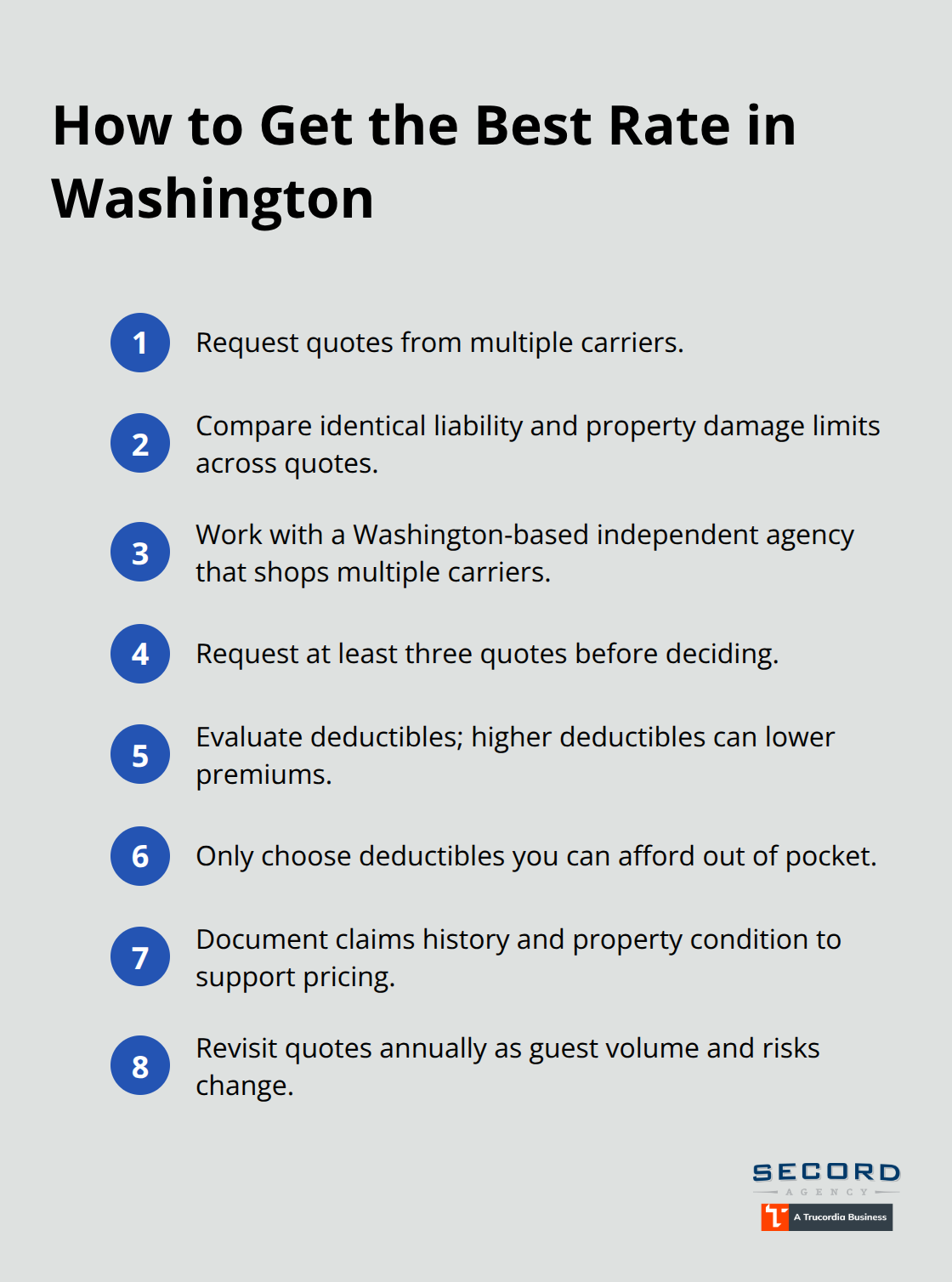
One carrier offers replacement cost coverage on personal property while another charges extra; another includes water backup protection standard while competitors exclude it. Deductible choices dramatically shift your quote-raising your deductible from $500 to $1,000 typically reduces annual premiums by 15 to 25 percent. Understanding coverage gaps matters more than chasing the lowest number.

Typical premium reduction when increasing deductible from $500 to $1,000 - Washington homeowners insurance quotes

Standard homeowners policies exclude flood and earthquake damage entirely, yet Washington faces both risks. If you live in a flood-prone area, you need inland flood coverage or a separate policy; if you’re near the Cascadia Subduction Zone, earthquake endorsements become essential. Compare quotes side-by-side using the same deductible and coverage limits across all carriers so you’re genuinely comparing apples to apples, then evaluate which insurer’s additional features and discount options align with your actual risk profile.

Local Agents Help You Navigate These Choices

An independent agent shops multiple carriers simultaneously, presenting you with options that match your specific property and budget. This approach eliminates the need to contact five insurers individually and wait for callbacks. The agent explains what each quote covers, identifies which exclusions matter for your situation, and recommends endorsements based on Washington-specific risks like wildfire or earthquake exposure. This personalized guidance transforms a stack of confusing quotes into a clear decision framework.

Why Your Local Agent Beats Shopping Solo

Independent agents fundamentally change how you approach Washington homeowners insurance because they handle the carrier legwork you’d otherwise manage alone. An independent agency shops multiple carriers simultaneously, which means you receive competitive quotes without contacting five separate insurers and waiting days for callbacks. This efficiency matters when you’re trying to renew coverage before a deadline or need quotes quickly after a life change. PEMCO, USAA, Allstate, State Farm, and Farmers each price risk differently, and an agent familiar with how each carrier weights factors like your home’s age, location, and construction type can predict which companies will offer the best rates for your specific property. Rather than submitting identical information to multiple insurers and comparing quotes yourself, an agent pre-screens carriers based on your situation, eliminating quotes that won’t be competitive before they reach your inbox.

Earthquake and Wildfire Advice Prevents Coverage Gaps

Washington’s specific risks demand knowledge most homeowners lack. Eastern Washington faces intense hail exposure that drives certain carriers to charge premiums 20 to 30 percent higher than western regions, yet many homeowners don’t know this variation exists until quotes arrive. Coastal properties near the Cascadia Subduction Zone need earthquake endorsements, which aren’t included in standard policies and require separate underwriting. Western Washington’s wildfires mean some carriers restrict coverage in fire-prone ZIP codes or exclude wildfire damage unless you add specific endorsements. A local agent knows which carriers maintain appetite in your specific area, which ones have tightened underwriting, and which offer the most comprehensive wildfire or earthquake protection at reasonable rates. This knowledge prevents you from spending hours receiving quotes only to discover the best price comes from a carrier that doesn’t cover your actual risks, or worse, from learning after a loss that a critical exclusion leaves you underprotected.

Claims Support When Disasters Strike

Your relationship with an agent becomes invaluable the moment you file a claim. When a windstorm damages your roof or a water backup floods your basement, you’re stressed and need someone advocating on your behalf immediately. An independent agent files claims alongside you, helps you gather required documentation, and follows up with the carrier to ensure timely processing. An agent familiar with your specific insurer’s claims process knows which adjusters work fastest, which documentation prevents delays, and whether your carrier typically settles quickly or requires additional evidence. After your claim closes, that same agent reviews your policy to identify gaps exposed by the loss and recommends coverage adjustments before renewal, ensuring similar losses don’t leave you underprotected next time.

Ongoing Policy Reviews Adapt to Your Changing Needs

Life changes demand policy adjustments that most homeowners miss on their own. You complete a kitchen renovation, add a deck, or install a new roof-each improvement affects your replacement cost and may qualify you for premium discounts. An agent tracks these changes and recommends coverage updates before renewal, preventing you from paying for outdated limits or missing discounts you’ve earned. Home values in Washington continue to climb, which means your coverage limits need periodic review to stay aligned with actual replacement costs. An agent handles this monitoring automatically, alerting you when inflation or local construction cost increases suggest higher dwelling limits, rather than leaving you to notice the gap years later during a claim.

Final Thoughts

Accurate Washington homeowners insurance quotes require preparation, comparison, and guidance tailored to your specific property. Understanding what drives your rates-replacement cost, location risk, and home characteristics-forms the foundation, and requesting quotes from multiple carriers reveals how different insurers price your risk. This comparison process identifies which carrier fills the coverage gaps you actually need, whether earthquake protection near the Cascadia Subduction Zone or wildfire endorsements in fire-prone areas.

An independent agent transforms this process by shopping multiple carriers simultaneously, presenting genuinely competitive options, and explaining which exclusions matter for your situation. When disaster strikes, that agent becomes your advocate-filing claims alongside you, gathering documentation, and ensuring your carrier processes your loss fairly and quickly. Your policy adapts as your home appreciates, as you complete renovations, or as local construction costs climb, and an agent monitors these changes to recommend adjustments before renewal.

We at Secord Agency – A Trucordia Business understand Washington homeowners’ specific risks and coverage needs. Contact us today to receive competitive Washington homeowners insurance quotes from multiple carriers, paired with personalized advice based on your property’s actual risk profile and your family’s protection priorities.