Specialty Vehicle Insurance WA: Protecting Unique Rides
Your classic car, custom build, or exotic vehicle isn’t like other cars on the road. Standard auto insurance policies don’t account for the unique value and modifications that make your ride special.
Specialty vehicle insurance in WA is designed specifically for owners who want real protection. At Secord Agency – A Trucordia Business, we help you find coverage that matches what your vehicle is actually worth.
What Qualifies as a Specialty Vehicle in Washington
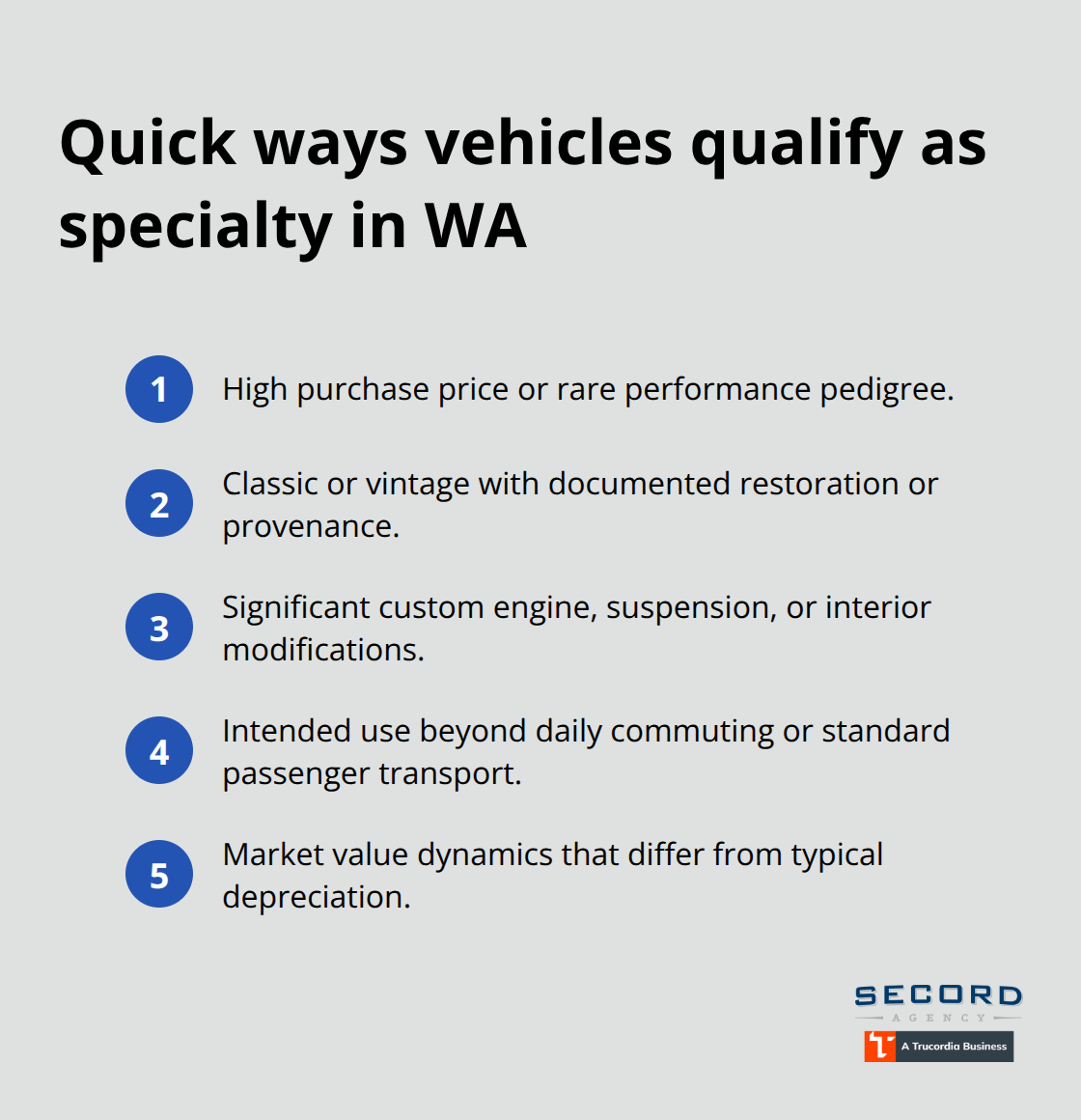
Washington roads host vehicles that demand more than off-the-shelf coverage. A specialty vehicle isn’t defined by a single characteristic-it’s determined by its value, rarity, or modifications that make standard policies inadequate.
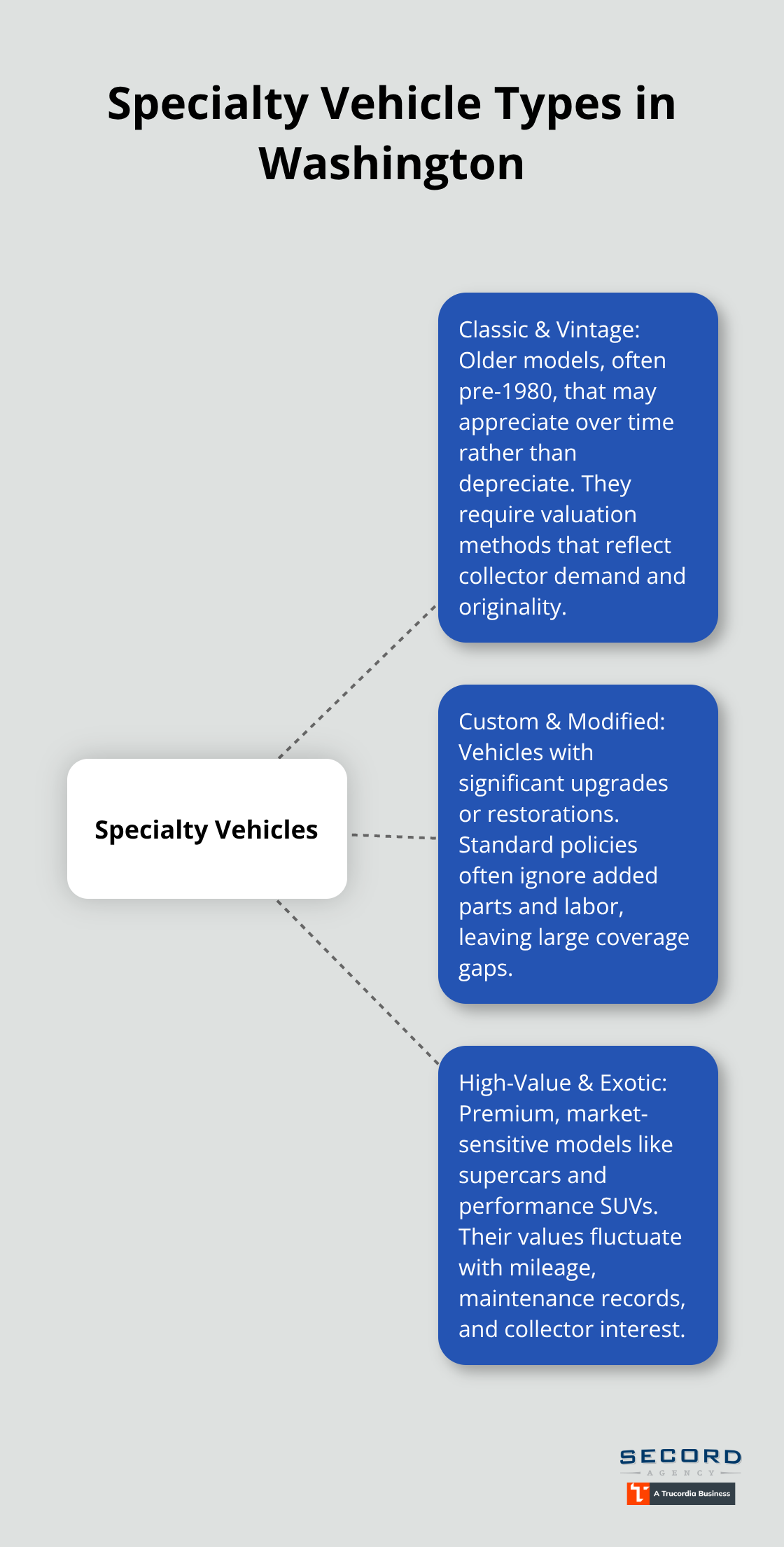
Classic and Vintage Cars
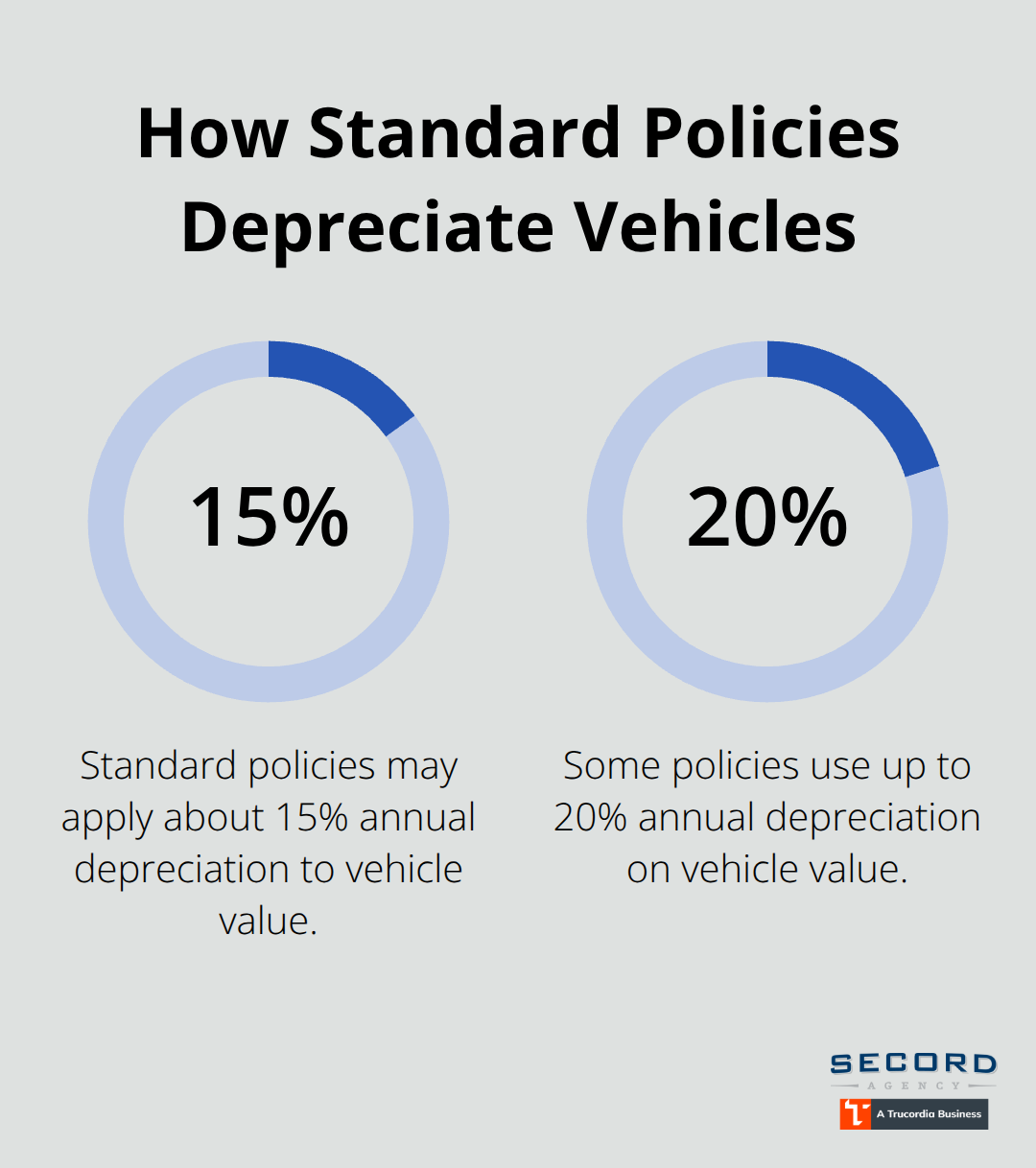
Classic cars built before 1980 qualify immediately, especially if they’ve appreciated significantly since manufacture. A 1967 Chevrolet Corvette Stingray that cost $4,000 new might be worth $60,000 to $150,000 today, depending on condition and originality. Vintage vehicles lose value differently than modern cars, which is why standard policies that depreciate your car by 15-20% annually make no sense for a classic that appreciates yearly.
Custom and Modified Vehicles
When you invest $15,000 in a custom paint job, $8,000 in upgraded suspension, or $12,000 in engine modifications, standard insurance typically covers only the base vehicle value. That means your $25,000 investment in customization disappears from your coverage the moment you file a claim. Custom builds represent years of work and significant financial commitment that generic policies simply don’t recognize.
High-Value and Exotic Vehicles
High-value and exotic vehicles round out the specialty category-think Porsche 911 Turbos, Range Rover SVRs, or collector-grade supercars. These vehicles command premium pricing and require agents who understand their market values, which fluctuate based on model year, mileage, maintenance records, and collector demand rather than standard depreciation schedules. Your exotic car’s worth shifts with market conditions that traditional valuation methods miss entirely.
Understanding where your vehicle fits matters because it determines what protection you actually need. The next section explains why standard auto insurance falls short for each of these specialty vehicle types.
Why Standard Auto Insurance Falls Short for Specialty Vehicles
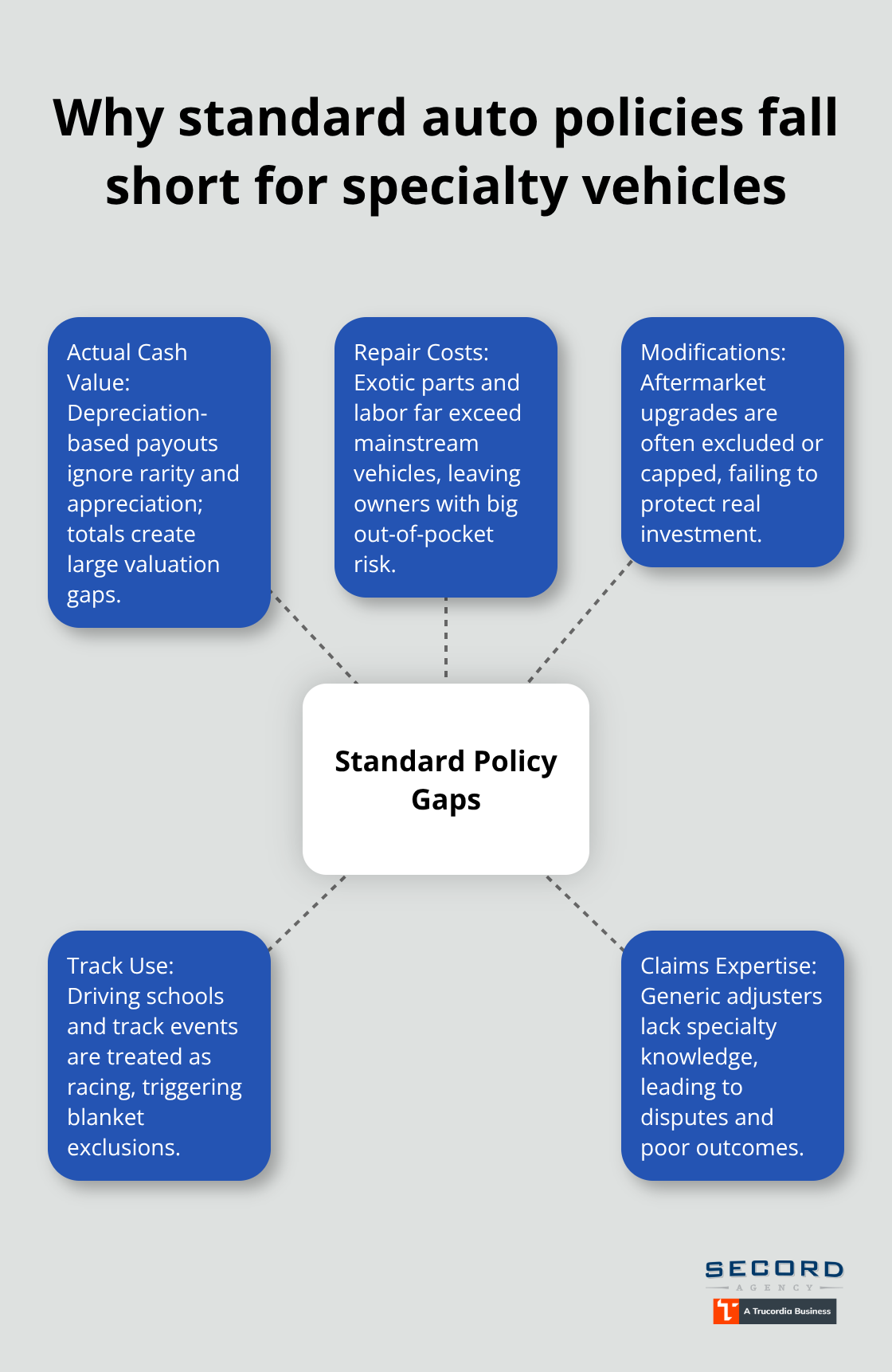
Standard auto insurance policies operate on a one-size-fits-all depreciation model that fails specialty vehicle owners. Most policies cap payouts based on actual cash value, which means insurers calculate what your vehicle is worth by subtracting 15-20% depreciation annually from its purchase price. For a classic 1970 Dodge Challenger, this math is backwards-your car gains value every year, not loses it. When you file a claim, you receive whatever the insurer’s formula says your car is worth, not what it actually sells for at auction or to collectors.
The Actual Cash Value Problem
This gap between what you get paid and what your vehicle costs to replace or repair represents the first major failure of standard coverage. Insurers use depreciation schedules designed for ordinary sedans and SUVs, not vehicles that appreciate over time. A collector car worth $80,000 today might get valued at $45,000 under standard depreciation formulas, leaving you with a massive shortfall when damage occurs. Your investment in a specialty vehicle demands valuation methods that reflect real market conditions, not arbitrary depreciation percentages.
Custom Modifications Disappear from Coverage
Custom modifications vanish from standard policies the moment you add them. Install a $12,000 turbocharged engine, $8,000 custom interior, or $15,000 paint job, and standard auto insurance treats these as aftermarket parts with minimal or zero coverage. If someone rear-ends your modified truck, the insurer pays to fix the base vehicle-not your $35,000 in customizations. Many policies explicitly exclude coverage for custom equipment unless you pay extra endorsement fees, and even then, coverage caps remain frustratingly low.
Mileage Restrictions Limit Your Freedom
Mileage restrictions also plague standard policies; most insurers limit classic cars to 5,000-7,500 miles annually. This makes no sense if you actually drive your vehicle to car shows, weekend cruises, or collector meets. Exceed that arbitrary mileage limit and your claim gets denied entirely. Your specialty vehicle shouldn’t sit in a garage to maintain coverage-it should be protected whether you drive it monthly or weekly.
Agreed Value Coverage Changes Everything
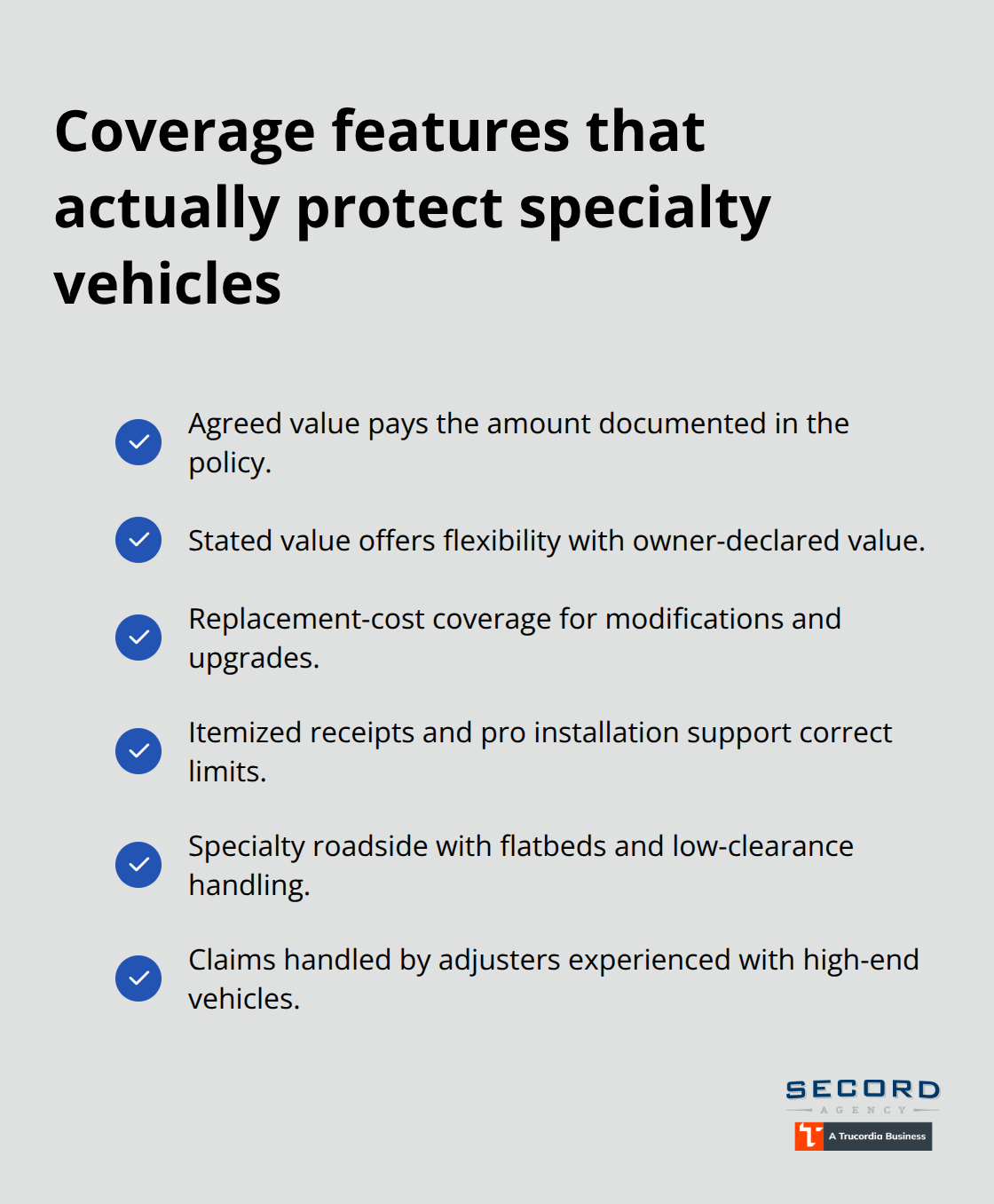
Specialty vehicles demand agreed value coverage, where you and your insurer agree upfront on what your vehicle is worth. This approach eliminates valuation disputes and guarantees full replacement cost when damage occurs. Agreed value coverage protects your actual investment and reflects real market values for classics, customs, and exotics. When you work with an independent insurance agent who understands specialty vehicles, they can help you secure this protection instead of forcing you into standard depreciation schedules.
How to Get Specialty Vehicle Insurance in Washington
Finding specialty vehicle insurance in Washington requires a different approach than shopping for standard auto coverage. Independent insurance agents who work with multiple carriers can access policies designed specifically for classics, customs, and exotic vehicles-something you won’t find at large national insurers locked into standard depreciation models. When you contact an independent agent, you’ll need to bring documentation of your vehicle’s current market value, any recent appraisals, and detailed records of modifications or restoration work.
Gather Documentation That Proves Your Vehicle’s Worth
For a classic car, you’ll want to collect maintenance records, service history, and professional appraisals showing appreciated value rather than depreciation. For custom builds, you’ll compile receipts and photographs documenting each modification-that $12,000 engine swap, $8,000 paint job, and $6,000 interior upgrade all need documented proof. Exotic vehicle owners should provide market comparables showing what similar models sold for recently, since these values fluctuate based on collector demand and market conditions rather than standard depreciation schedules.
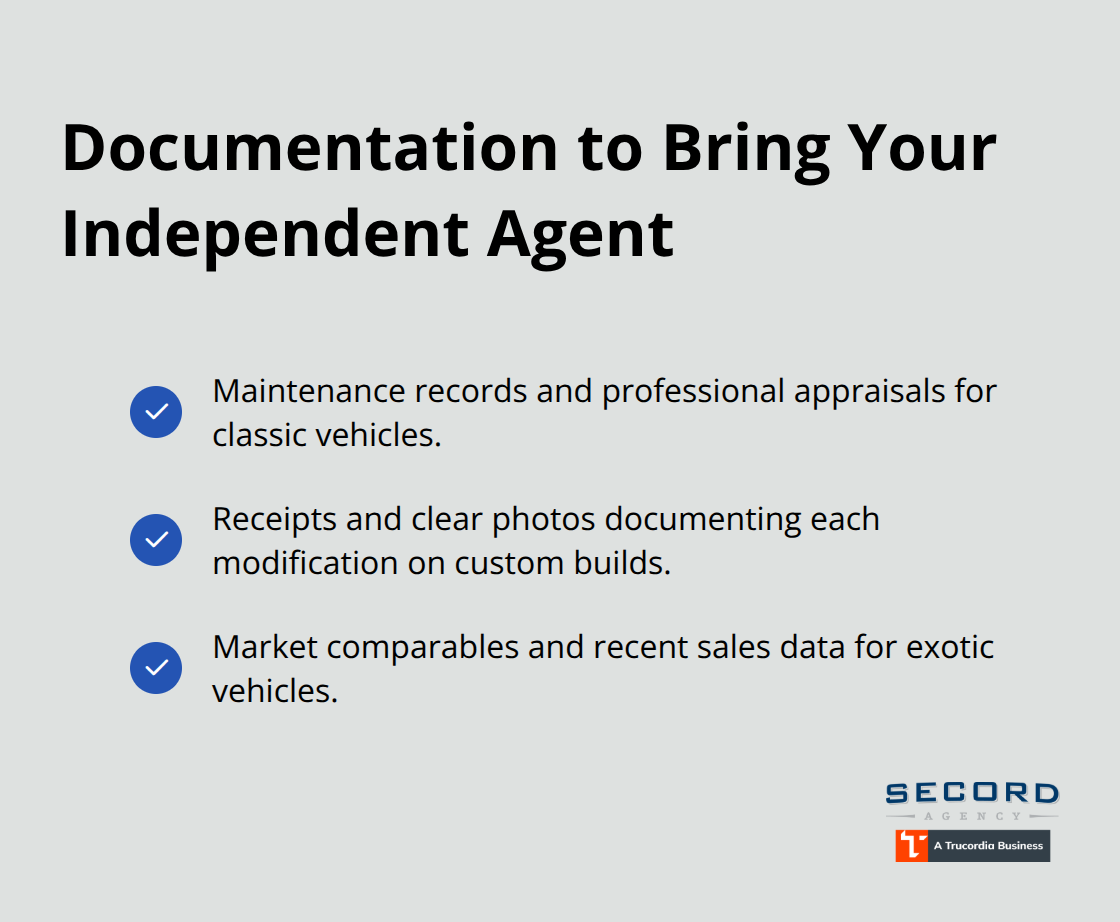
Documentation transforms vague coverage discussions into concrete protection. Your independent agent uses this information to negotiate agreed value coverage with carriers who understand specialty vehicles, guaranteeing full replacement cost if damage occurs. Many specialty vehicle insurers also offer stated value or agreed value options that eliminate the valuation disputes standard policies create.
Work with Carriers That Understand Specialty Vehicles
Independent agents access specialty vehicle policies that national insurers simply don’t offer. These carriers recognize that classics appreciate, customs represent significant financial investment, and exotics demand market-based valuation rather than depreciation formulas. An independent agent shops multiple carriers to find coverage matching your actual needs, not generic templates.
Conduct Annual Policy Reviews to Stay Protected
Once you secure coverage, you’ll want to review your policy each year to confirm your coverage limits reflect current replacement costs. Your classic car’s market value changes yearly, custom modifications may appreciate, and exotic vehicle prices shift with collector demand. This proactive approach prevents the devastating scenario where your vehicle’s actual worth exceeds your coverage limits, leaving you personally responsible for repair costs.
Final Thoughts
Your specialty vehicle deserves protection that matches its actual value and unique characteristics. Standard auto insurance policies fail to account for the appreciation of classic cars, the investment in custom modifications, or the market-based pricing of exotic vehicles. Specialty vehicle insurance in WA fills this gap with agreed value coverage, unlimited mileage, and recognition of your vehicle’s true worth.
We at Secord Agency work with Washington vehicle owners to protect their unique rides through tailored coverage that reflects what their cars actually cost to replace or repair. As an independent insurance agency, we shop multiple carriers to find specialty vehicle policies that standard insurers won’t offer. Whether you own a 1967 Corvette that appreciated to $100,000, a custom truck with $35,000 in modifications, or a Porsche 911 Turbo, we understand the valuation methods and coverage options that matter.
Contact us for a quote on your specialty vehicle and learn how tailored coverage protects your investment. Our team works with you to document everything that makes your vehicle special, then negotiates coverage that guarantees full replacement cost if damage occurs. We’re based in Seattle’s Wallingford neighborhood and ready to help you find the protection your unique ride deserves.