Autonomous Vehicle Insurance Washington: What Washington Drivers Need to Know

Autonomous vehicles are moving from science fiction to Washington roads faster than most drivers realize. The technology is here, the regulations are evolving, and insurance companies are scrambling to catch up.

At Secord Agency – A Trucordia Business, we’re breaking down what autonomous vehicle insurance in Washington actually means for you right now.

What Autonomous Vehicles Are Actually Operating in Washington Right Now

Three companies actively test autonomous vehicles on Washington roads today: Waymo LLC, NVIDIA Corporation, and Zoox, Inc. These aren’t theoretical projects or distant possibilities-they operate real vehicles on real streets under Washington’s self-certification pilot program, which took effect October 1, 2022.

List of companies currently testing autonomous vehicles on Washington roads - Autonomous vehicle insurance Washington

The vehicles meet SAE Level 4 or 5 automation standards, meaning they perform all driving tasks within their designed operating conditions without human intervention. This matters because Washington’s regulatory framework treats the automated driving system itself as the driver when it operates, fundamentally changing how liability and insurance work in a collision. Testers must carry umbrella liability insurance of at least $5,000,000 per occurrence, which signals how seriously the state views the risks these vehicles present. Every year by February 1st, these operators submit collision reports to Washington’s Department of Licensing, creating a public record of incidents that informs policy decisions.

How Companies Get Permission to Test

Before any company tests on public roads, they must self-certify with the state and provide proof of that $5 million umbrella liability policy. Operators must also give law enforcement 14 to 60 days advance written notice before testing periods begin. The notices must include specific vehicle details-make, model, color, license plate-so officers know what they’re looking at when an autonomous vehicle passes them on the road. Operators report moving violations and collisions to the Department of Licensing, and the state publishes this information publicly. This transparency requirement means you can actually track what happens with autonomous vehicles in your area rather than guessing.

What the Rules Require of Autonomous Vehicles

Washington’s framework requires vehicles to reach a safe condition if the automated system fails, and they must comply with all Washington motor vehicle laws relevant to their operational design. The regulations also mandate that operators communicate with law enforcement agencies in jurisdictions where testing occurs, enabling data sharing and coordination. These requirements create accountability and ensure that autonomous vehicles operate under strict safety parameters rather than in a regulatory vacuum.

What’s Coming Next in State Law

SB 5594, currently in the legislative process, would centralize all autonomous vehicle regulation under the Washington Department of Licensing and preempt local city prohibitions. This approach would standardize requirements statewide rather than allow jurisdictions to create patchwork rules. The bill treats the automated driving system as the driver or operator for traffic law compliance when engaged, shifting liability considerations in ways that affect how insurance coverage applies. Understanding these regulatory changes now helps you prepare for how autonomous vehicles will operate in Washington and what coverage you may need as this technology becomes more common on your roads.

Insurance Coverage and Liability in Autonomous Vehicle Accidents

Washington’s regulatory framework makes one thing crystal clear: when an automated driving system operates, that system becomes the legal driver. This creates a fundamental shift in liability compared to traditional accidents. In a collision involving a Level 4 or 5 autonomous vehicle where the ADS is engaged, fault determination hinges on whether the automated system performed its driving tasks within its operational design limits when the crash occurred. This distinction matters enormously for insurance claims because it potentially shifts liability away from the vehicle owner toward the company operating the autonomous system or the vehicle manufacturer. Testers currently operating on Washington roads carry umbrella liability policies of at least $5,000,000 per occurrence, which reflects the state’s assessment of potential damages from autonomous vehicle incidents. If you’re hit by an autonomous vehicle, your claim would likely be filed against that operator’s insurance policy rather than against a traditional driver’s personal auto policy.

What Your Current Coverage Protects

Your existing Washington auto insurance policy covers you if another vehicle strikes you, assuming the other party carries the required liability coverage. Washington requires every vehicle on the road to carry minimum liability limits of $25,000 per person for bodily injury, $50,000 per accident for multiple people, and $10,000 for property damage. Autonomous vehicle operators testing on public roads must meet these minimums plus carry that $5 million umbrella policy. If you drive a traditional vehicle and collide with an autonomous vehicle, your comprehensive or collision coverage pays for your vehicle’s damage regardless of fault, minus your deductible.

Minimum liability limits and key protections for Washington drivers and AV testers

However, if the autonomous vehicle operator bears clear liability, your insurance company pursues a subrogation claim against their policy to recover those costs. The key point: your current policy protects you in autonomous vehicle accidents the same way it protects you in accidents with human drivers, provided you carry the coverage. If you only carry liability coverage and an autonomous vehicle causes a collision where you bear fault, your policy covers the other party’s damages but not your own vehicle repairs.

How Autonomous Vehicle Accidents Differ from Traditional Claims

Autonomous vehicle accidents introduce complexity that traditional accident claims don’t present. When an ADS operates, investigators must determine whether the system performed within its operational design limits and whether any software or hardware failure contributed to the crash. This analysis requires technical expertise that goes beyond standard accident investigation. Insurance companies must examine system logs, software versions, and safety records to establish fault-a process that takes longer than traditional claims. The operator’s insurance must cover bodily injury, death, and property damage resulting from the autonomous vehicle’s operation, but determining what “operation” caused the accident requires deeper technical analysis than a fender-bender between two human drivers. Your insurance company may need to hire specialized experts to evaluate autonomous vehicle incidents, which could affect claim timelines and outcomes.

What Changes as Autonomous Vehicles Expand on Washington Roads

As autonomous vehicles become more common on Washington roads beyond the current three testing companies, insurance companies will adjust how they price coverage and what they cover. SB 5594 would standardize autonomous vehicle regulation statewide, which could lead to standardized insurance requirements across Washington rather than jurisdiction-by-jurisdiction variation. Insurance companies are still developing underwriting models for autonomous vehicle risk because accident data remains limited. The annual collision reports that operators submit to the Department of Licensing by February 1st each year create a growing public record that insurers will use to assess risk. Currently, that data is sparse because only three companies operate autonomous vehicles on Washington roads. As more operators enter the market and testing expands, insurers will have better information to price premiums accurately. You should expect that comprehensive coverage will become more valuable as autonomous vehicles increase, since collision claims involving autonomous vehicles may differ from traditional accident claims in terms of fault determination and repair complexity.

Preparing Your Coverage Now

Contact an independent insurance agent who shops multiple carriers to review your current coverage limits now, before autonomous vehicle adoption accelerates. An agent can identify gaps in your protection and recommend adjustments that make sense for your situation. Washington offers flexibility in how you meet financial responsibility requirements-auto insurance, self-insurance (if you own at least 26 vehicles), a certificate of deposit of at least $60,000, or a liability bond of at least $60,000. Most individual drivers rely on auto insurance, but understanding all options helps you make informed decisions.

Options to satisfy Washington’s financial responsibility requirements - Autonomous vehicle insurance Washington

Your agent can also explain how your specific policy handles autonomous vehicle incidents and what additional coverage might protect you as this technology becomes more prevalent on Washington roads.

What You Should Do Right Now About Autonomous Vehicle Insurance

Schedule a policy review with an independent insurance agent who shops multiple carriers rather than selling policies for a single company. An agent examining your current coverage can identify whether your liability limits keep pace with autonomous vehicle risks on Washington roads. Washington’s minimum liability requirement of $25,000 per person and $50,000 per accident made sense when vehicles traveled slower and crashes caused less damage, but autonomous vehicle operators carry $5 million umbrella policies because the state recognizes that modern vehicle incidents can create catastrophic losses. Your $25,000 minimum coverage becomes inadequate fast if an autonomous vehicle causes a serious multi-vehicle collision. Request that your agent explain how your collision and comprehensive coverage apply if an autonomous vehicle hits you, and ask specifically whether your deductibles and limits align with the potential damages autonomous vehicle accidents could create.

Increase your liability limits now

Most Washington drivers carrying only the state minimum liability limits should increase to at least $100,000 per person and $300,000 per accident, which costs significantly less than the jump in protection provides. If you own assets worth protecting or drive regularly in congested areas where autonomous vehicles currently test, increase to $250,000 per person and $500,000 per accident. Comprehensive coverage becomes increasingly valuable as autonomous vehicles expand on Washington roads, since autonomous vehicle accidents may involve complex fault determination that takes longer to resolve than traditional claims. Your agent can run quotes showing how much additional premium each coverage increase costs, allowing you to make decisions based on actual numbers rather than guesses.

Understand autonomous vehicle accident complexity

The three companies currently testing autonomous vehicles on Washington roads file annual collision reports with the Department of Licensing every February 1st, creating a growing public record of incidents that insurers will use to adjust pricing and coverage terms as data accumulates. Autonomous vehicle accidents introduce complexity that traditional accident claims do not present. When an automated driving system operates, investigators must determine whether the system performed within its operational design limits and whether any software or hardware failure contributed to the crash. This analysis requires technical expertise that goes beyond standard accident investigation, and insurance companies must examine system logs, software versions, and safety records to establish fault.

Contact the right resources

Contact the Washington Department of Licensing at autonomousvehicles@dol.wa.gov to request the latest self-certification data on autonomous vehicle operators in your area, which tells you which companies test near your home or workplace. The department publishes annual reports summarizing autonomous vehicle testing activity, providing transparency into how these vehicles operate in Washington. Review your current policy documents to understand your deductibles, coverage limits, and any exclusions that might apply to autonomous vehicle incidents, since many policies written before 2022 may contain language that does not address autonomous vehicle scenarios. Ask your insurance agent whether your policy covers rental vehicles or rideshare services, since autonomous vehicle fleets will eventually enter those markets and you may need explicit coverage if you use those services.

Prepare documentation for future claims

Document your vehicle’s current condition with photos and maintenance records, establishing a baseline that helps with damage claims if an autonomous vehicle causes a collision before your next policy renewal. An independent agent can also track how SB 5594 progresses through the legislature, since standardized state regulation could shift insurance requirements in ways that affect your coverage needs. Secord Agency, a Trucordia business based in Seattle’s Wallingford neighborhood, shops multiple carriers to deliver tailored coverage that matches individual situations rather than pushing cookie-cutter policies.

Final Thoughts

Washington’s autonomous vehicle insurance landscape shifts faster than most drivers expect. Three companies already operate Level 4 and 5 autonomous vehicles on your roads under strict state oversight, and they carry $5 million umbrella liability policies that reflect serious risks. The regulatory framework treats the automated driving system as the driver when it operates, fundamentally changing how liability works in collisions.

Your current auto insurance protects you in autonomous vehicle accidents the same way it protects you from human drivers, but your liability limits may not keep pace with the potential damages these vehicles can cause. Increasing your coverage now costs far less than facing inadequate protection when an autonomous vehicle causes a serious collision. Annual collision reports filed by operators create a growing public record that insurers will use to adjust pricing and coverage as autonomous vehicle incidents become more common.

We at Secord Agency help you navigate this transition by reviewing your current coverage and identifying gaps before autonomous vehicle adoption accelerates on Washington roads. As an independent agency, we shop multiple carriers to find tailored autonomous vehicle insurance in Washington that matches your actual situation rather than pushing generic policies. Contact us to schedule a policy review and prepare your coverage for Washington’s autonomous vehicle future.

Flood Insurance Homeowners Washington: A Practical Guide to Coverage

Floods cause more property damage than any other natural disaster in the United States, yet most homeowners don’t realize their standard insurance won’t cover it. If you live in Washington, understanding flood insurance for homeowners is essential-especially since the state experiences significant flooding in certain regions.

We at Secord Agency – A Trucordia Business help homeowners navigate these coverage gaps. This guide walks you through your options and shows you exactly how to protect your home.

Why Your Standard Homeowners Policy Won’t Protect Your Home From Floods

Standard Policies Explicitly Exclude Flood Damage

Standard homeowners insurance policies contain explicit flood exclusions, which means your insurer will deny any claim related to flood damage-no matter how catastrophic the loss. This isn’t a loophole or a misunderstanding; it’s written directly into the policy language. The distinction matters because floods are defined specifically as overflow from bodies of water, heavy rainfall, dam failures, or rapid snowmelt. Water that backs up through your sewers, leaks from your plumbing, or seeps through your basement walls from ground saturation doesn’t technically qualify as flood damage under standard policies, though these scenarios often occur during flood events and cause similar destruction.

The Federal Government Created NFIP Because Private Insurers Refused

Washington homeowners must purchase separate flood insurance to close this gap, and the National Flood Insurance Program (NFIP) exists precisely because private insurers refused to offer flood coverage at any price. The federal government created NFIP in 1968 when private insurance companies simply would not underwrite flood risk. NFIP policies are available through licensed agents across Washington and offer two distinct coverage types: building coverage protects your home’s structure and foundation along with permanently installed systems like electrical wiring, plumbing, HVAC equipment, and built-in appliances, while contents coverage protects your personal belongings such as furniture, clothing, electronics, and portable appliances.

How NFIP Rates Work in Washington

Rates are standardized across all carriers, meaning you won’t find cheaper NFIP premiums by shopping around-the price depends entirely on your flood zone designation and replacement cost. In low to moderate risk areas, annual NFIP premiums average just under $1,100, but homes in high-risk zones can exceed $1,600 yearly. Washington’s flood risk extends beyond obvious coastal areas; nearly one-third of all NFIP claims nationwide from 2014 to 2024 came from properties outside officially designated high-risk zones, demonstrating that flooding threatens homes across the state regardless of their perceived vulnerability.

Key differences between NFIP and private flood insurance in Washington - Flood insurance homeowners Washington

Private Flood Insurance Offers Another Path

Private flood insurance has emerged as an alternative for some homeowners, typically costing between $600 and $2,800 annually depending on coverage limits and property specifics. These policies can offer higher building limits than NFIP’s $500,000 cap for commercial properties, though residential limits vary by insurer. Understanding your flood zone and comparing both NFIP and private options will help you determine which coverage best fits your Washington home’s specific risk profile and budget.

What Coverage Do You Actually Get From NFIP and Private Flood Insurance

Building and Contents Coverage Explained

NFIP building coverage protects your home’s structure, foundation, electrical systems, plumbing, HVAC equipment, water heaters, and permanently installed appliances like refrigerators and stoves. Contents coverage shields personal belongings including furniture, clothing, electronics, and portable appliances. The critical limitation: NFIP caps building coverage at $250,000 for residential properties and contents at $100,000, which falls short for many Washington homes. If your home’s replacement cost exceeds these limits, you’ll face an uninsured gap. Private flood policies typically offer higher limits, and some insurers provide building limits exceeding $500,000. However, private policies come with varied terms and conditions, so comparing specific coverage details matters more than chasing the lowest price.

What NFIP and Private Policies Don’t Cover

Neither NFIP nor private flood insurance covers vehicle damage-you need comprehensive auto coverage for that protection. Both exclude mold and mildew damage unless you purchase specific endorsements, a common oversight that leaves homeowners exposed after water intrusion occurs. This gap means you should review your policy language carefully and ask your agent whether endorsements make sense for your situation.

How Your Deductible Affects Your Costs

Your deductible choice directly impacts your out-of-pocket costs after a flood. NFIP offers deductible options of $1,000, $2,500, $5,000, or $10,000; selecting a higher deductible lowers your annual premium, sometimes by hundreds of dollars. NFIP policies cost just over $1,100 per year on average, and you could reduce that with a higher deductible. The trade-off requires honest assessment: if you have emergency savings exceeding your deductible, a higher deductible makes financial sense. If unexpected expenses would strain your finances, the lower premium isn’t worth the risk. Private insurers offer similar flexibility, and some allow deductibles as low as $500. One actionable step: use the NFIP’s quote tool to run scenarios with different deductibles and compare total five-year costs, not just annual premiums.

Elevation Reduces Your Premiums Substantially

Building elevation-raising your home’s lowest floor above the base flood elevation-reduces premiums substantially. FEMA data shows each foot of elevation can lower your premium by hundreds of dollars annually, making elevation certificates valuable investments if you’re considering this mitigation strategy. Homeowners who elevate utilities (HVAC and electrical panels) or install flood vents also qualify for premium reductions. These physical improvements transform your property’s flood risk profile and can pay for themselves through premium savings over time.

Next Steps: Comparing Your Options

The combination of coverage limits, deductibles, and mitigation steps creates multiple pathways to protect your Washington property. Your specific risk level, home value, and financial situation determine which approach works best. We at Secord Agency – A Trucordia Business shop multiple carriers to help you identify coverage that matches both your needs and budget, then guide you through the application process. Understanding these coverage options positions you to make informed decisions before you need to file a claim.

Getting Flood Insurance in Washington

Identify Your Flood Zone First

Your flood zone determines everything about your coverage and cost. Washington has designated flood zones mapped by FEMA flood zone maps, and your property falls into one of these categories: high-risk areas (Special Flood Hazard Areas where lenders require flood insurance), moderate-risk zones, or low-risk areas. Use NFIP’s interactive “What is My Flood Zone?” map to find your specific designation, or contact a local agent who can pull this information immediately. Your flood zone drives your premium more than any other factor-a home in a high-risk coastal area will cost significantly more than an identical property in a low-risk zone.

Washington’s geography creates pockets of serious flood exposure. The state experienced notable flooding events in December that left many renters and homeowners scrambling because they lacked adequate coverage. Don’t assume your location is safe just because it hasn’t flooded recently-nearly 40% of flood insurance claims nationally occur outside designated high-risk areas, meaning your Washington neighborhood could face unexpected water damage regardless of historical patterns.

Share of U.S. flood insurance claims filed beyond designated high-risk zones - Flood insurance homeowners Washington

Gather Your Home Information and Coverage Needs

Once you know your zone, collect your home’s replacement cost estimate and decide whether you need building coverage, contents coverage, or both. Building coverage protects your structure and permanently installed systems, while contents coverage shields your personal belongings. This foundation makes everything that follows straightforward.

Core elements to assemble a personalized flood insurance strategy in Washington

Your replacement cost estimate helps you select appropriate limits that actually match your property’s value, preventing underinsurance that could leave you exposed after a flood event.

Compare NFIP and Private Flood Insurance Options

Finding the right carrier requires comparing both NFIP options and private flood insurance since they offer different advantages. Washington has approximately 50 NFIP-participating insurers, so you’ll have genuine choices even within the federal program-use the NFIP’s “Find a Flood Insurance Provider” tool to see carriers operating in your area. Because NFIP rates are standardized, you won’t save money by shopping rates, but private insurers do compete aggressively on price and coverage limits.

Request quotes from at least three carriers and specifically ask whether each offers the endorsements you need (mold coverage and sewer backup protection are common gaps). When you compare policies, look beyond the annual premium and examine what each policy actually covers. Private policies sometimes offer higher limits than NFIP’s $250,000 building cap for residential properties, which matters if your home’s replacement cost exceeds that threshold.

Document Damage and File Your Claim Properly

When a flood occurs, act immediately-contact your insurer before making permanent repairs, document all damage with photos and video, and avoid discarding damaged items until your adjuster assesses them. Photograph high-water marks on walls, list all damaged items with descriptions, and save receipts for any temporary repairs or emergency supplies you purchase.

File your proof of loss within 60 days for commercial properties and follow your policy’s timeline for residential claims. If your insurer denies or underpays your claim, you have the right to appeal and can request advances for urgent recovery needs while the full claim processes. Your adjuster will assess the damage and determine what your policy covers, but you control the documentation that supports your claim’s value.

Final Thoughts

Flood insurance for homeowners in Washington isn’t optional if you want genuine financial protection. Standard homeowners policies won’t cover flood damage, and waiting until after a flood event to purchase coverage leaves you completely exposed. The average NFIP claim from 2020 to 2024 exceeded $82,000, and just one inch of floodwater causes roughly $25,000 in damage-these represent real losses that devastate unprepared homeowners across Washington.

Acting now delivers concrete advantages over waiting. Your flood insurance homeowners Washington premium depends on your flood zone and replacement cost, not on when you purchase the policy, but NFIP policies typically begin coverage 30 days after purchase (surplus line policies start immediately). Homeowners who implement elevation improvements can reduce premiums by hundreds of dollars annually, and these mitigation steps take time to plan and execute. Starting now means you’ll benefit from premium reductions sooner rather than later.

Your next step is identifying your specific flood zone using FEMA’s interactive maps, then contacting an agent who can explain your coverage options. We at Secord Agency – A Trucordia Business shop multiple carriers to help you find flood insurance that matches your actual risk and budget, and our team handles the comparison work so you can make informed decisions without getting lost in policy language. Contact us today to discuss your flood protection strategy.

Seattle Personal Umbrella Policy: Protecting You with Extra Limits

Your homeowner’s and auto insurance policies have limits. Once you exceed those limits in a lawsuit, you’re personally liable for the rest. A Seattle personal umbrella policy fills that gap with extra protection.

We at Secord Agency – A Trucordia Business help Seattle residents understand when umbrella coverage makes sense and how much protection they actually need.

How Umbrella Insurance Actually Works

The Layering Structure

An umbrella policy sits directly above your existing auto and homeowners coverage, activating only after those underlying limits are exhausted. Your primary policies pay first, and once they hit their limit, your umbrella coverage kicks in to cover additional damages up to its limit. You cannot buy umbrella insurance without maintaining minimum underlying coverage-Washington typically requires at least $250,000 per person and $500,000 per accident in auto liability, plus $300,000 in homeowners liability.

Affordable Protection for Your Assets

Most insurers charge roughly $150–$350 annually for $1 million in umbrella coverage, making it one of the most cost-effective protections available. Each additional $1 million of coverage typically costs only $75–$150 per year, so jumping from $1 million to $2 million protection remains surprisingly affordable. This pricing structure exists because umbrella policies rarely pay out; they only activate after your base policies are exhausted, which happens in fewer than 1% of claims.

Quick view of common umbrella insurance costs and how the coverage triggers in Seattle, Washington. - Seattle personal umbrella policy

What Your Umbrella Actually Covers

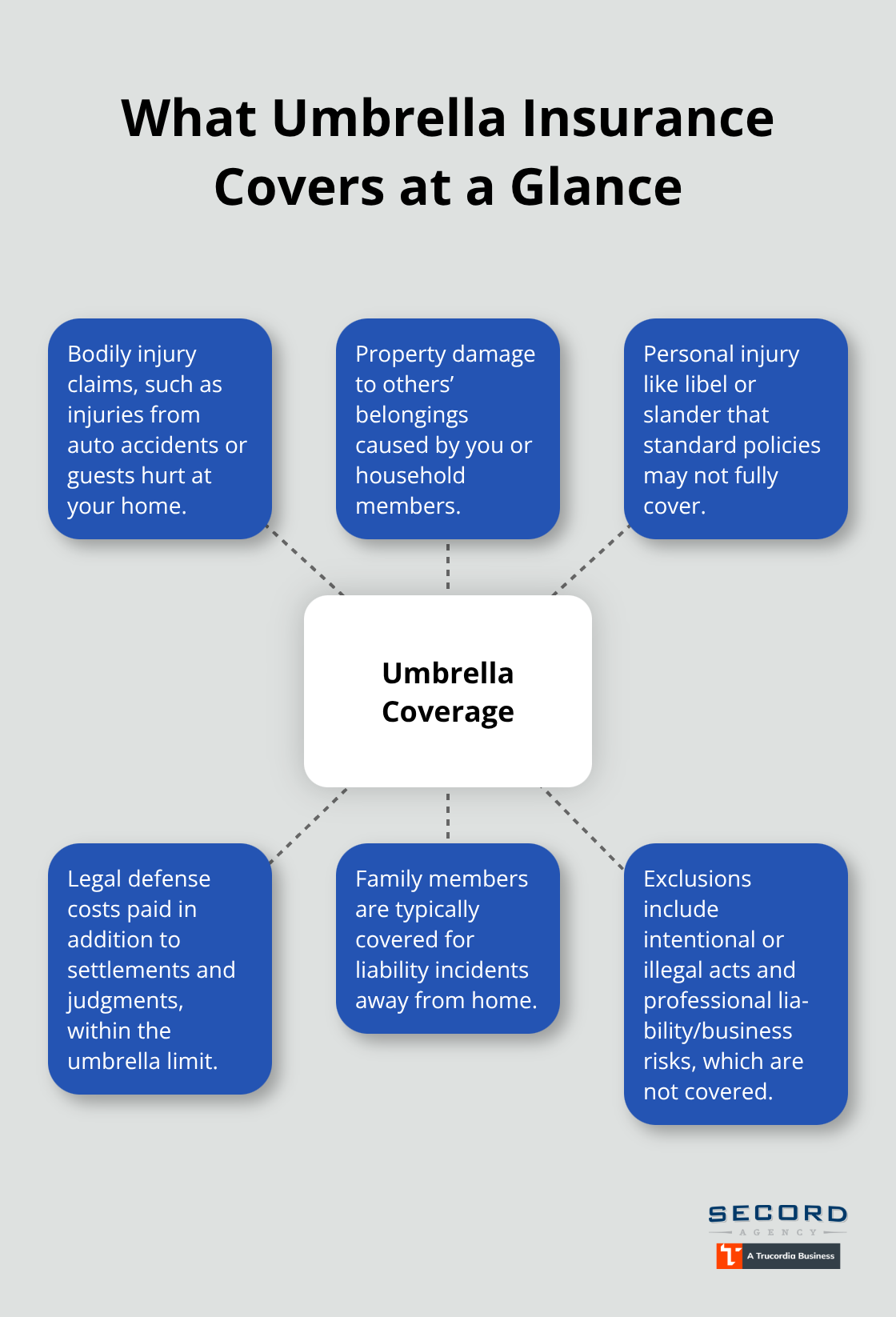
Your umbrella policy covers personal injury claims like defamation and malicious prosecution-areas where standard homeowners policies often leave gaps. It also protects against injuries caused by household members, including your dog, which means a serious dog bite claim reaches your umbrella limit rather than capping at your homeowners liability. The coverage itself extends beyond simple bodily injury and property damage to fill critical protection gaps.

Why Seattle Residents Face Real Exposure

Washington median home prices around $520,000 in 2024 mean most Seattle residents carry substantial assets at risk. A single judgment in a serious accident reaches $400,000 to $600,000; auto judgments in multi-vehicle crashes frequently exceed $500,000. Legal defense costs alone in serious lawsuits run $50,000 to $150,000 before any settlement is reached, which drains your underlying policy limits before the case even concludes.

Bundling Unlocks Hidden Savings

Bundling your auto and homeowners policies with the same carrier qualifies you for multi-policy discounts of 10–15%, which often offsets or exceeds the umbrella premium entirely. This means your extra protection costs little to nothing when you consolidate coverage. Understanding what triggers umbrella claims-and how quickly they happen-shows why this gap protection matters far more than most Seattle residents realize.

Why Seattle’s Assets Face Real Catastrophic Exposure

High Property Values Create Substantial Liability Risk

Seattle’s real estate market generates genuine exposure that most residents underestimate. Washington’s median home price reached $520,000 in 2024, and property values in desirable Seattle neighborhoods often exceed $600,000 to $800,000. When you own significant assets, a single lawsuit threatens everything you’ve built. Home liability judgments typically range from $400,000 to $600,000 when cases proceed to judgment, according to industry data. Auto judgments in serious multi-vehicle crashes frequently exceed $500,000, sometimes reaching into the millions.

The Coverage Gap That Exposes Your Wealth

Your standard homeowners policy caps at $300,000 in liability, and most auto policies max out at $250,000 to $500,000 per accident. The gap between what you’re protected for and what courts actually award creates real financial danger. A guest slipping on your icy Seattle driveway, a dog bite, or a teenage driver causing a multi-vehicle accident can exhaust your primary coverage in weeks.

Legal Defense Costs Drain Your Limits Fast

Legal defense costs amplify this exposure dramatically. A serious lawsuit defense runs $50,000 to $150,000 before any settlement is reached, which means your underlying policy limits get drained before you even reach trial. The Insurance Information Institute reports that average settlements for serious personal injury cases typically range from $24,000 to $55,100, but catastrophic cases far exceed these averages. Defense expenses alone consume a substantial portion of your coverage before damages are even addressed.

Three key ways legal expenses and settlements reduce your available liability coverage before damages are paid.

What Happens When Your Coverage Runs Out

Without umbrella protection, you face personal liability for amounts beyond your policy limits, potentially forcing asset sales or wage garnishment to satisfy judgments. This isn’t theoretical risk for Seattle residents with substantial net worth-it’s a concrete financial exposure that umbrella coverage directly addresses. The question isn’t whether you’ll face a claim, but whether your current limits will cover it when one arrives.

Real Claims That Drain Your Primary Coverage

Multi-Vehicle Collisions Exhaust Coverage Fast

A multi-vehicle highway collision on I-5 near Seattle shows how quickly umbrella coverage becomes necessary. Your teenage driver rear-ends a sedan, which then strikes two additional vehicles, injuring four people across three cars. Medical bills alone reach $380,000 for spinal injuries and ongoing physical therapy. Your auto policy maxes out at $250,000 per accident, leaving a $130,000 gap before anyone’s legal fees are paid. Defense costs run another $75,000, which pulls from your underlying limit and shrinks what’s available for actual damages. The injured parties’ attorneys pursue a judgment that reaches $520,000 total-a realistic figure for multi-vehicle crashes with serious injuries. Without umbrella protection, you’re personally liable for $270,000 after your policy exhausts. With a $1 million umbrella policy costing roughly $200–$300 annually, that protection costs less than a monthly car payment and covers the entire exposure.

Slip and Fall Accidents on Your Property

Slip and fall accidents on your property create similarly devastating claims. A guest slips on ice during a Seattle winter and fractures her hip, requiring surgery and six months of assisted living care. Her medical expenses total $240,000, but her pain-and-suffering claim reaches $450,000 when her attorney calculates lifetime mobility limitations. Your homeowners policy covers $300,000 in liability, leaving a $150,000 shortfall.

Examples of real-world liability claims in Seattle and how an umbrella policy fills the coverage gaps. - Seattle personal umbrella policy

Legal defense costs add another $90,000, and your underlying coverage evaporates before damages are addressed. The financial exposure extends far beyond what most Seattle residents anticipate when they review their homeowners limits.

Dog Bite Claims and Permanent Injury Settlements

Dog bite claims follow the same pattern of rapid coverage exhaustion. A neighborhood child suffers facial lacerations requiring reconstructive surgery, with medical costs at $85,000 and a settlement demand of $380,000 for permanent scarring. Your homeowners liability limit covers only $300,000, forcing your umbrella to absorb $165,000 in additional exposure. These scenarios aren’t outlier situations; they’re the exact claims umbrella policies handle routinely. A $1 million umbrella covers all three scenarios completely while costing approximately $250 per year when bundled with your auto and home policies through the same carrier.

Final Thoughts

Seattle residents with substantial assets face real financial exposure from a single lawsuit. Your homeowners and auto policies cap at $300,000 and $250,000 to $500,000 respectively, but judgments regularly exceed $500,000 in serious cases. A Seattle personal umbrella policy fills this gap affordably, costing roughly $200–$300 annually for $1 million in coverage when bundled with your existing policies. Legal defense costs alone drain $50,000 to $150,000 before settlement, and serious injury judgments reach $400,000 to $600,000.

Without umbrella protection, you face personal liability for amounts beyond your policy limits, potentially forcing asset sales or wage garnishment to satisfy judgments. With umbrella coverage, you transfer that risk to your insurer for less than the cost of a monthly car payment. This protection matters far more for Seattle residents who own homes valued at $520,000 or higher and carry retirement savings that courts can pursue.

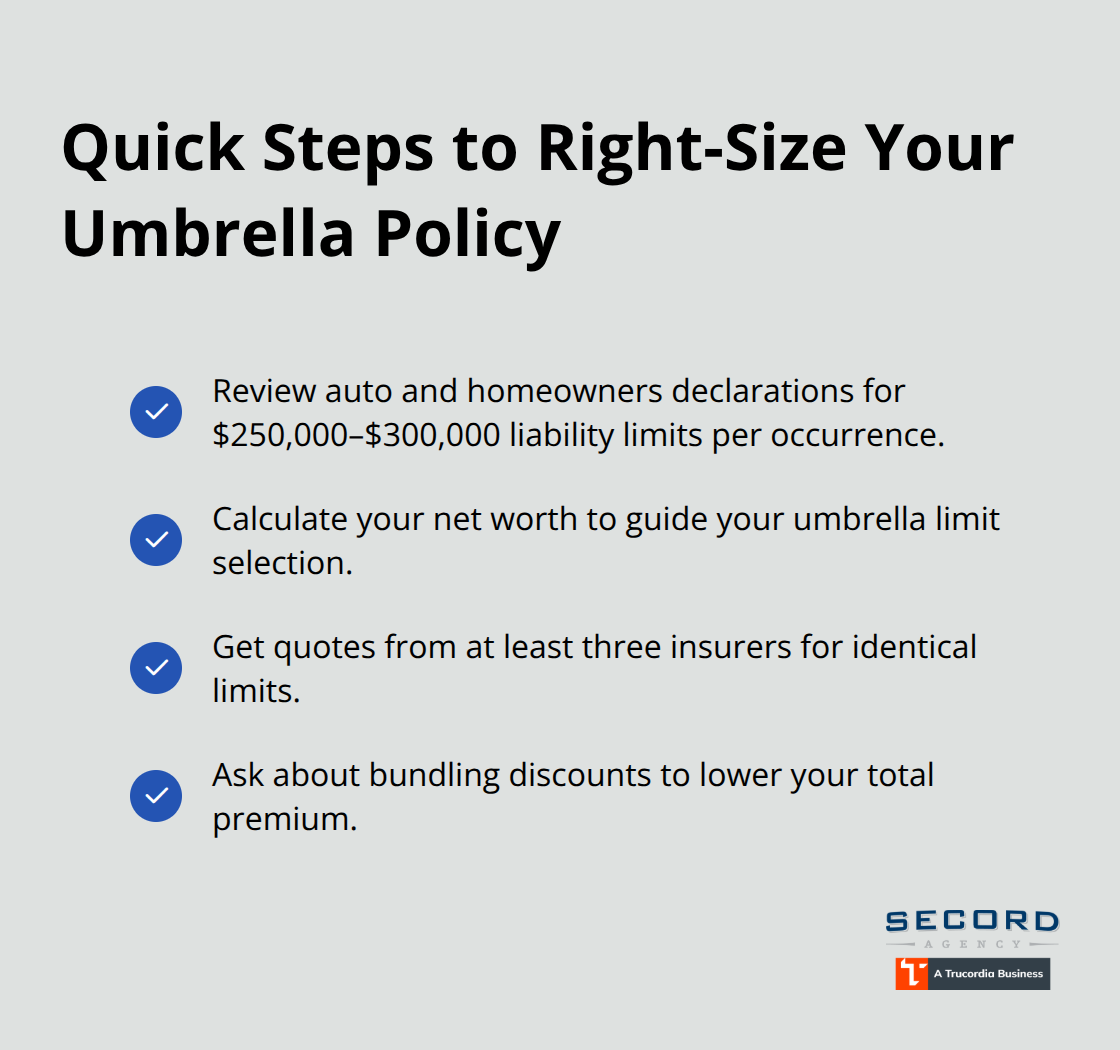
Start by gathering your auto and homeowners declarations to confirm your current liability limits. Then contact Secord Agency to discuss your exposure and receive quotes from multiple carriers. We’ll explain exactly what your umbrella covers, what it doesn’t, and how bundling discounts reduce your total premium.