Property manager insurance WA: Protecting Managers And Properties
Property managers in Washington face real liability risks every day. From tenant injuries to property damage claims, one incident can cost thousands in legal fees and settlements.
At Secord Agency – A Trucordia Business, we’ve seen how the right property manager insurance WA coverage protects both your business and your assets when problems arise.
What Liability Risks Do Washington Property Managers Actually Face?
Fair-Housing Violations and Tester Audits
Property managers in Washington operate in one of the nation’s most tenant-protective legal environments, and that reality creates specific exposure patterns you need to understand. Fair-housing violations represent the most common claim trigger in Washington-testers actively audit screening practices, and blanket policy denials trigger disparate-impact complaints that carry both defense costs and settlement exposure. A Port Angeles case illustrates this: a property manager applied a blanket felony-denial policy, and HUD filed a disparate-impact complaint under the Fair Housing Act, forcing expensive litigation and regulatory response. These claims often cost $30,000 to $55,000 in combined attorney fees and settlements before resolution.
Deposit Handling and Habitability Failures
Deposit-handling disputes rank second among Washington property-manager claims. Washington’s strict timing rules and interest requirements create technical violations that escalate into claims quickly. Habitability failures-including delayed maintenance, pest infestations, and heating defects-drive bodily-injury exposure and regulatory penalties under Seattle and Tacoma ordinances that impose escalating fines for code violations. Security-deposit scams are rising sharply in Washington markets; Spokane recorded a 27% spike in rental-deposit fraud during 2022 alone.
Eviction Errors and On-Property Injuries
Eviction-procedure errors under Washington’s just-cause rules expose managers to wrongful-eviction claims that can cost $30,000 to $55,000 in combined attorney fees and settlements. On-property injuries from negligent maintenance or inadequate security create general liability exposure that standard E&O policies often exclude entirely-a gap that forces managers to carry separate general liability coverage. National premises-liability claims have risen roughly 35% over the past five years according to the Insurance Information Institute, and Washington’s strict habitability standards under RCW 59.18 combined with aggressive fair-housing enforcement mean claims arrive faster and cost more to defend.
Cyber Threats and Data Breaches
Cyber risk has become critical as ransomware attacks on real estate services rose 62% year over year. Tenant personal data and rent-payment information stored in property-management systems make you a target for data breaches that trigger notification costs, regulatory fines under Washington’s data-breach law, and tenant lawsuits. The state’s median home price rose about 113% from 2013 to 2023 while Puget Sound apartment vacancies stayed below 4%, concentrating capital value in fewer units and raising the financial stakes when incidents occur.
Legal Requirements and Coverage Costs
Washington law does not mandate standalone property-manager insurance, but RCW 18.85 and RCW 59.18 effectively require E&O coverage or a $50,000 surety bond when you handle client funds and deposits. This legal framework means underinsurance or coverage gaps expose your business to direct liability that insurance won’t cover. The financial impact of a single undefended claim-legal defense costs alone often exceed $50,000 before any settlement-can eliminate annual profit margins for smaller firms. Comprehensive property-manager insurance in Washington costs roughly $2,000 to $3,000 per $1 million in revenue for a clean claims history, a fraction of what one significant claim will cost you out-of-pocket. Understanding which specific coverages address these risks helps you build protection that actually matches your exposure.
Building the Right Coverage Stack for Washington Property Managers
General Liability and E&O: A Foundation That Works Together
General liability insurance and errors-and-omissions coverage function as your foundation when you pair them strategically, not when you treat them as separate decisions. General liability covers bodily injuries and property damage claims that arise from your daily operations-a tenant trips on a staircase you negligently maintained, or a visitor sustains injury due to inadequate security. E&O insurance protects against professional mistakes: wrongful evictions, privacy violations, deposit-handling errors, and hiring unlicensed contractors. Most Washington property managers make a critical error by choosing one or the other. A standard E&O form typically excludes bodily injury entirely, leaving on-property injury claims undefended. You need both policies working together, with combined defense costs and damages coverage, not just settlement limits.
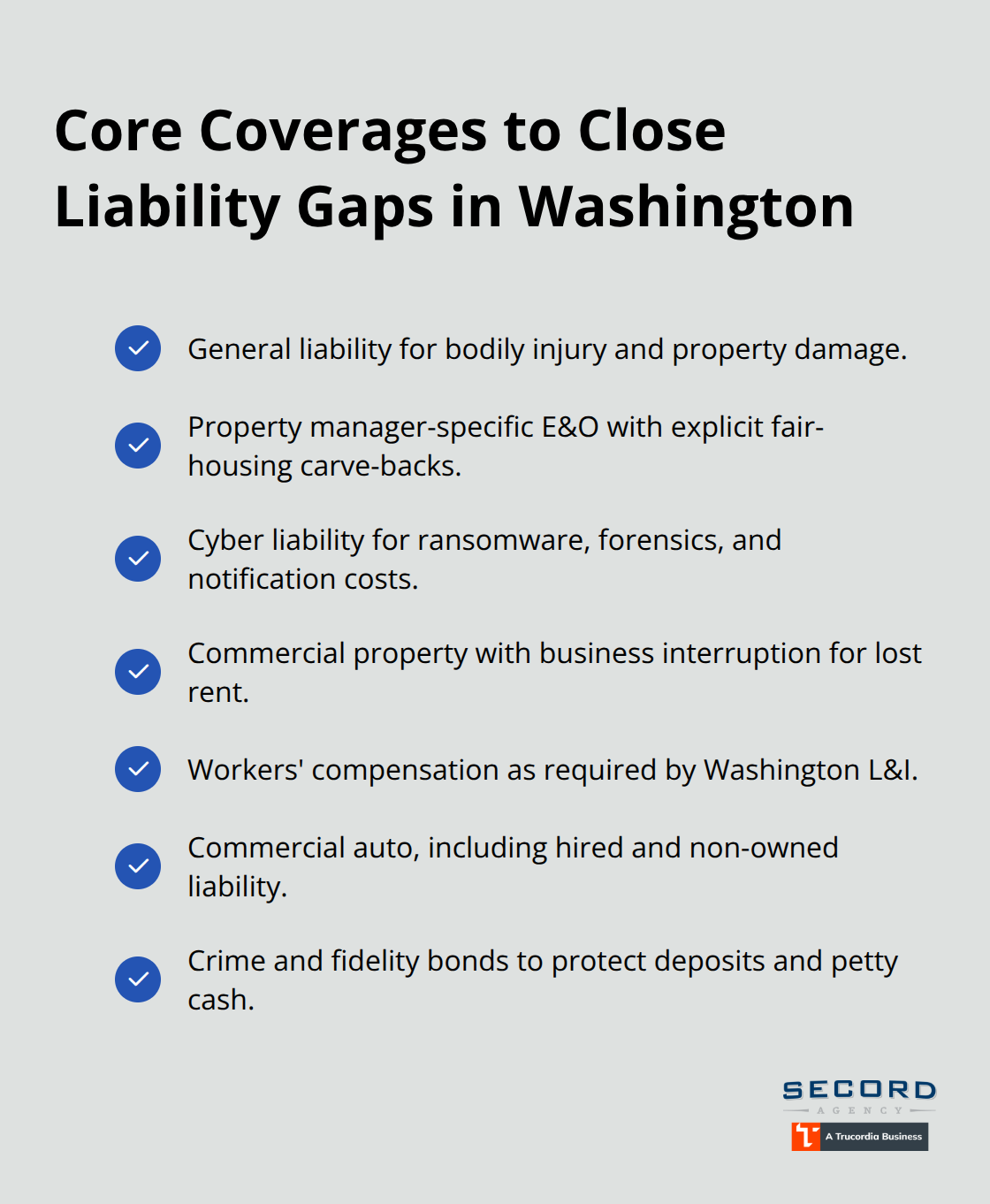
For Washington specifically, your general liability should sit at minimum 1 million per occurrence and 2 million aggregate for smaller portfolios; high-foot-traffic Seattle Class A buildings commonly carry 2 million per occurrence and 4 million aggregate. Pair this with a PM-specific E&O policy that explicitly carves fair-housing claims back into coverage-testers audit screening practices constantly in Washington, and blanket denial policies trigger disparate-impact complaints that cost $30,000 to $55,000 in combined attorney fees and settlements before resolution.
Fair-Housing Coverage and Deposit Protection
Your E&O form must address the specific exposures that Washington’s regulatory environment creates. This approach matters because fair-housing testers operate continuously across Washington markets, and a single blanket screening policy can trigger a disparate-impact complaint that consumes $30,000 to $55,000 in combined legal fees and settlements.
Property Coverage and Employment Protections
Commercial property insurance or a Business Owners Policy protects owned buildings, personal property, and income loss from fire, wind, and other covered perils. Include replacement-cost coverage and inflation-guard endorsements so you can actually restore a building after a loss. Add ordinance-and-law endorsements to cover costs of bringing damaged structures up to current code, a requirement that frequently exceeds initial repair estimates in Seattle and Tacoma.
Workers’ compensation is required by Washington L&I for any employees; premiums vary by classification code, and non-compliance triggers penalties that dwarf the cost of coverage itself. If your team uses company vehicles or personal vehicles for work, commercial auto insurance is essential-Washington ranks among the top ten states for collision frequency, and hired-and-non-owned auto liability covers accidents involving employee personal vehicles used for business purposes.
Cyber Liability and Crime Protection
Cyber liability deserves serious attention because ransomware attacks on real estate services rose 62% year over year. Coverage funds forensics, breach notifications, credit monitoring, and regulatory fines under Washington’s data-breach law. Crime and fidelity bonds protect deposits and petty cash from theft, making this coverage a practical safeguard against internal and external fraud.
The total package typically costs roughly $2,000 to $3,000 per $1 million in revenue for a clean claims history, a fraction of what defending a single significant claim costs out-of-pocket. When you shop carriers, prioritize independent agencies that specialize in property management and can shop multiple carriers to match your specific exposure profile rather than forcing you into one-size-fits-all programs. The right carrier selection determines whether your coverage actually protects you when claims arrive, which is why the next section examines how to evaluate carriers and endorsements that address Washington’s specific regulatory landscape.
How Insurance Claims Actually Pay Off in Washington Property Management
Tenant Injuries and Medical Liability
When a tenant fractures their ankle on a negligently maintained staircase, the medical bills alone run $15,000 to $40,000 depending on injury severity and required surgery. Without general liability coverage, that bill lands directly on your business. A Seattle property manager faced exactly this scenario in 2023 when a visitor slipped on ice in a common area the manager failed to treat; general liability covered the $28,000 in medical expenses plus $18,000 in legal defense costs, protecting the firm’s operating capital entirely. The alternative-paying out-of-pocket-would have eliminated that manager’s annual profit margin in a single incident.
On-property injuries create constant exposure because Washington’s strict habitability standards under RCW 59.18 mean maintenance delays create liability faster than managers anticipate. A Tacoma property manager’s failure to address a heating system defect resulted in tenant illness claims totaling $32,000 in combined medical costs and settlement; the manager’s general liability policy covered both defense and damages, leaving the business intact. The Insurance Information Institute reports that national premises-liability claims have risen roughly 35% over the past five years, and Washington’s enforcement environment accelerates that trend.
Property Damage and Business Interruption
Property damage and regulatory violations create a second category of claims that destroy unprepared firms. A subfreezing pipe burst in Spokane Valley caused $1.8 million in structural repairs plus $240,000 in displaced rent losses while units sat uninhabitable; commercial property insurance with business-interruption coverage funded both the reconstruction and the lost revenue during the extended rebuild timeline. Without that coverage, the property manager would have absorbed the entire rental loss out-of-pocket.
Fair-Housing Violations and Deposit Disputes
Fair-housing violations carry distinct financial weight because testers operate continuously across Washington markets, and a blanket felony-denial policy triggered a HUD disparate-impact complaint that cost the Port Angeles manager $55,000 in combined attorney fees and settlement before resolution-money that E&O coverage with explicit fair-housing carve-backs protected completely. Deposit-handling errors appear deceptively minor until they escalate into regulatory fines; a Seattle manager’s failure to return a security deposit with proper interest calculations within the required 30-day window resulted in a tenant lawsuit that cost $12,000 in combined legal fees and damages, covered entirely by E&O insurance. Spokane recorded a 27% spike in rental-deposit fraud during 2022, underscoring how quickly these claims multiply across a portfolio.
Cyber Attacks and Data Breach Costs
Cyber liability coverage becomes equally essential when ransomware attacks strike. A ransomware attack on a Seattle portfolio’s management systems triggered forensic costs of $190,000, ransom demands of $98,000, and two years of tenant credit monitoring totaling an additional $47,000, all covered by cyber liability while operations resumed within six days. Without that coverage, the manager would have faced $335,000 in uninsured losses while tenants demanded compensation.
These real-world costs illustrate why comprehensive property-manager insurance in Washington costs roughly $2,000 to $3,000 per million dollars in revenue for a clean claims history-a fraction of defending even one significant claim entirely out-of-pocket.
Final Thoughts
Property manager insurance WA protects your business from the specific liability exposures that Washington’s regulatory environment creates. Fair-housing testers audit screening practices constantly, deposit-handling errors escalate into regulatory fines, and on-property injuries from maintenance failures arrive faster than managers anticipate. The real cost of remaining uninsured isn’t theoretical-it’s the $30,000 to $55,000 in combined attorney fees and settlements that a single fair-housing violation can consume, or the $1.8 million in structural repairs plus $240,000 in displaced rent losses that a pipe burst creates.
The right coverage stack pairs general liability with E&O insurance that explicitly carves fair-housing claims back into protection, adds cyber liability to defend against ransomware attacks that rose 62% year over year, and includes commercial property coverage with business-interruption endorsements so you can actually restore buildings and recover lost rent after losses. Workers’ compensation, commercial auto insurance, and crime-and-fidelity bonds close the remaining gaps that leave managers exposed. This layered approach works because each policy addresses exposures that the others exclude, creating seamless defense across the full range of claims that Washington property managers face.
We at Secord Agency – A Trucordia Business work as an independent agency that shops multiple carriers to deliver tailored commercial coverage matched to your specific exposure profile. Our team pairs competitive rates with fast, local, advocate-led service, simplifying quotes and claims while providing personalized advice and ongoing policy reviews to protect your business across Washington. Visit Secord Agency to discuss how comprehensive property manager insurance protects both your assets and your livelihood.