Vacation rental liability WA: Reducing Risk In Short-Term Rentals
Running a vacation rental in Washington comes with real financial exposure. Guest injuries, property damage, and regulatory violations can quickly become expensive problems that standard homeowners insurance won’t cover.
At Secord Agency – A Trucordia Business, we’ve helped property owners navigate vacation rental liability in WA by identifying gaps in their coverage and implementing practical risk controls. This guide walks you through the specific threats you face, the insurance options available, and the concrete steps you can take to protect your investment.
Liability Exposure in Washington Vacation Rentals
Guest injuries and property damage create immediate financial threats that standard homeowners insurance will not cover. A single guest injury claim can exceed $100,000 in medical costs and legal defense, while water damage-which costs the U.S. billions annually-can trigger liability that surpasses your personal assets. Washington’s legal framework treats most guests as licensees rather than tenants, but this distinction blurs dangerously when a guest stays 30 days or longer. At that point, the Washington Residential Tenancy Act kicks in, and you must follow formal eviction procedures or face wrongful eviction claims. A single extended stay gone wrong shifts from a property dispute into a full legal proceeding. Standard homeowners policies explicitly exclude short-term rental activity, leaving you personally liable for guest-caused damage. If a guest slips in the bathroom, suffers harm from a faulty railing, or gets injured on your property, your homeowners policy will not cover defense costs or judgments. A burst pipe or failed appliance discovered mid-stay can make your property uninhabitable while liability claims accumulate.
Washington’s Insurance Mandate and Coverage Gaps
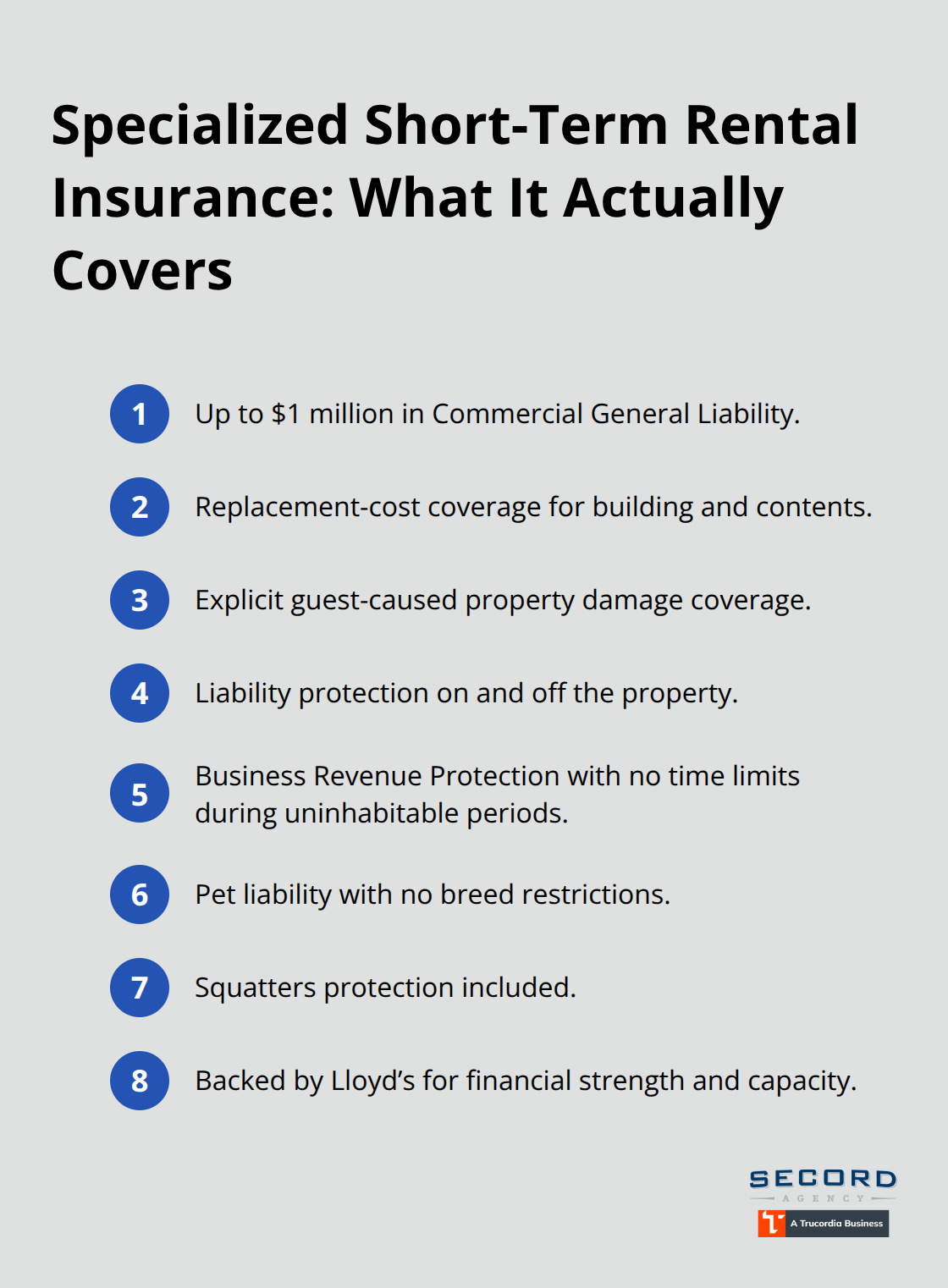
Washington requires operators to maintain primary liability insurance or use a platform that provides equal coverage. However, Airbnb Host Protection Insurance does not cover damage to your own property during a guest stay, nor does it reimburse lost rental income if the property becomes uninhabitable. The policy also excludes intentional damage and violations of Airbnb’s terms. Specialized short-term rental insurance products (such as those endorsed by Vrbo) offer up to $1 million in Commercial General Liability, replacement-cost coverage for building and contents, guest-caused property damage coverage, liability both on and off the property, and Business Revenue Protection that covers loss of rental income during uninhabitable periods with no time limits. Lloyd’s backing provides financial strength and capacity for these specialized policies. The cost difference between inadequate coverage and comprehensive short-term rental insurance remains small relative to potential exposure.
Regulatory Violations Create Escalating Penalties
Washington defines a short-term rental as lodging offered for fewer than 30 consecutive nights. Most Washington jurisdictions require STR hosts to register the property and obtain a license or business permit, sometimes followed by an inspection before guests arrive. Zoning laws determine where STRs are allowed; many localities restrict or prohibit them outright or cap the number of permitted properties. A first safety or regulatory violation brings a warning letter, but subsequent violations become a class 2 civil infraction. Seattle-specific regulatory risks include license requirements and nuisance complaints around noise, parties, and parking that lead to fines and civil liability. Property owners who operate without proper licensing or fail to post required safety information-floor plans with fire exits, emergency contacts, occupancy limits, and operator contact details-face escalating compliance costs and liability exposure. The short-term rental market is projected to reach $362.4 billion globally by 2033, which means regulators are tightening enforcement across all jurisdictions.
How Compliance and Coverage Must Align
Proper insurance and regulatory compliance work together. You cannot rely on coverage alone to protect yourself if you violate local zoning or licensing rules. Conversely, compliance without adequate insurance leaves you exposed to catastrophic claims. Secord Agency, an independent insurance agency based in Seattle’s Wallingford neighborhood, shops multiple carriers to tailor vacation rental coverage for Washington hosts. The foundation of protection starts with understanding that compliance and coverage must move in tandem-and identifying which specific risks your current policy actually covers requires a detailed review of your existing homeowners or commercial policy against your state and local obligations.
What Insurance Actually Covers Your Vacation Rental
Standard Homeowners Policies Exclude Short-Term Rentals
Your standard homeowners policy will reject your claim the moment you tell the insurer you operate a short-term rental. This is not a gray area. Major carriers explicitly exclude short-term rental activity from homeowners coverage, meaning a guest who slips on your stairs or causes water damage through negligence leaves you personally liable for medical bills, legal defense, and property repairs. If a guest causes $40,000 in water damage and your property sits empty for two months during repairs, your homeowners insurer will deny the claim outright.
Platform Coverage Falls Short of Real Exposure
Airbnb’s Host Protection Insurance provides hosts with $1 million in coverage in the rare event you are found legally responsible for third-party bodily injury and property damage claims, but it does not reimburse damage to your own building or contents, does not cover lost rental income when your property becomes uninhabitable, and explicitly excludes intentional damage plus violations of Airbnb’s terms. You absorb the full cost when platform coverage stops. Guests staying 14 to 30 nights-the fastest-growing segment in the global short-term rental market-require extended-stay screening and robust utility monitoring to prevent hazards like mold or electrical failures. Standard platform policies frequently do not cover these scenarios.
Specialized Short-Term Rental Insurance Closes the Gaps
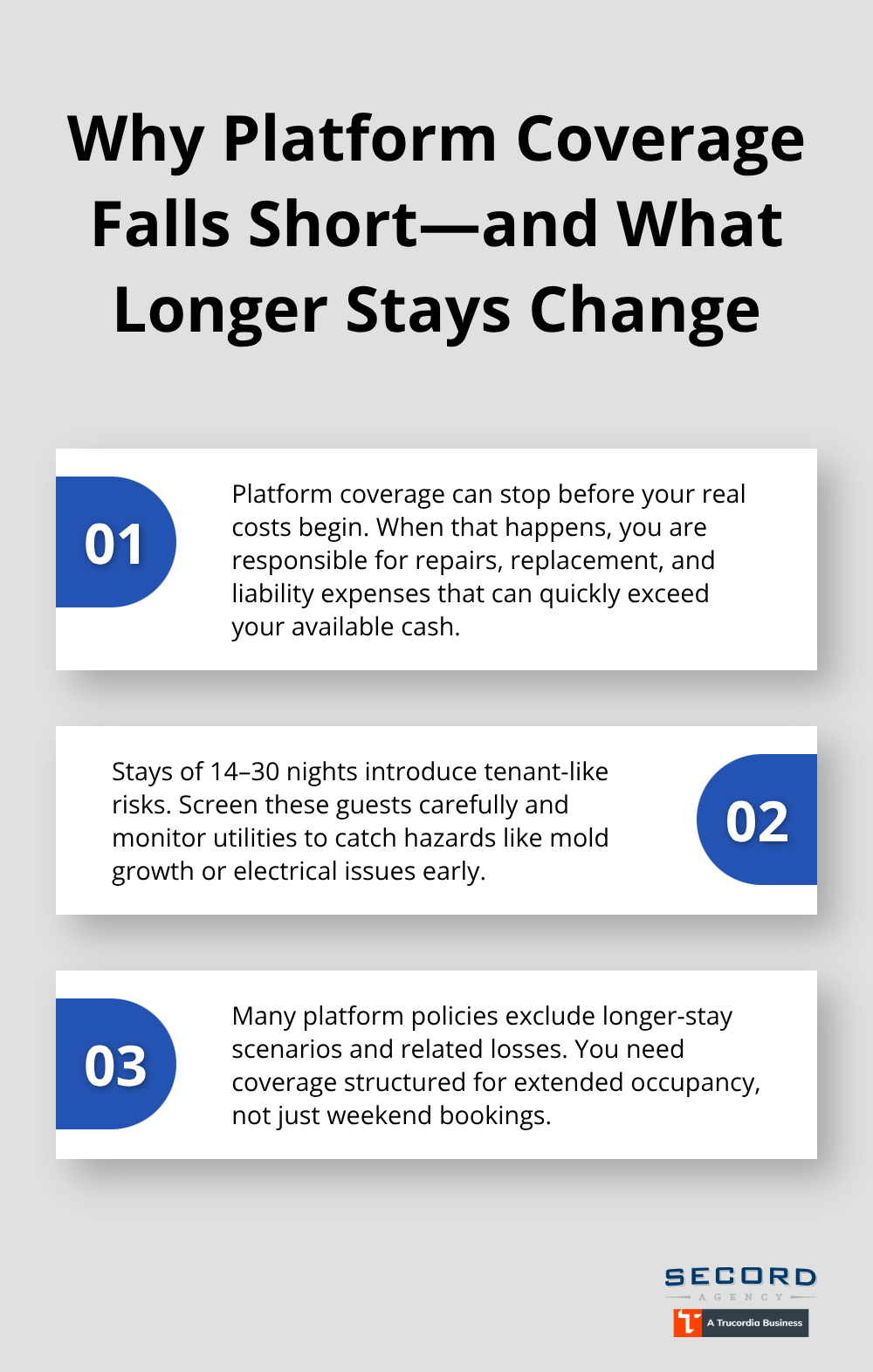
Specialized short-term rental insurance from carriers like Proper Insurance, which Vrbo endorses as its preferred provider, operates in an entirely different category. These policies deliver up to $1 million in Commercial General Liability, actual replacement-cost coverage for your building and contents, explicit guest-caused property damage protection, liability coverage both on and off your property, and Business Revenue Protection that reimburses lost rental income during uninhabitable periods with no arbitrary time limits. Proper Insurance also covers pet liability without breed restrictions and includes squatters protection, addressing real scenarios that plague Washington vacation rental operators. Lloyd’s backs these policies, providing the financial capacity and stability that matters when you file a six-figure claim. The cost difference between inadequate platform coverage and comprehensive short-term rental insurance typically runs $40 to $80 per month-a negligible expense against potential exposure that could exceed $200,000.
Multi-Platform Operations Require Unified Coverage
Washington’s regulatory requirement mandates primary liability insurance of at least $1 million for any short-term rental operator. This means you cannot legally operate without it, and your platform’s coverage does not satisfy this obligation if it contains gaps or exclusions. When you cross into longer stays approaching 30 days, Washington’s Residential Tenancy Act activates, transforming your guest into a potential tenant with formal eviction rights. At that threshold, your insurance must reflect tenant-related liability, not just transient guest exposure.
Many vacation rental operators in Washington operate across multiple platforms-Airbnb, Vrbo, and Booking.com simultaneously-creating inconsistent coverage gaps if each platform’s insurance differs in scope. Proper Insurance and similar specialized carriers eliminate this fragmentation by covering your property under one comprehensive policy regardless of which platform books the guest. This unified approach prevents the scenario where a Vrbo guest’s injury claim exceeds Airbnb’s coverage limits, leaving you liable for the difference.
Evaluating Policies and Compliance Requirements
When evaluating policies, demand written clarity on whether coverage applies to extended stays, whether Business Revenue Protection includes your full nightly rate or a percentage, and whether pet liability excludes any breeds or species. Ask your carrier whether they require proof of compliance with local licensing and zoning rules before they pay a claim-some carriers will deny coverage if you operated without required permits. An independent agent who shops multiple carriers can identify which policies actually match your operational model and local obligations, rather than accepting whatever platform coverage exists by default. Your liability exposure in Washington is too large to rely on incomplete protection, and the right policy structure determines whether a major claim bankrupts you or your insurer covers it.
Risk Reduction Strategies for Vacation Rental Owners
Monthly Maintenance and Documented Inspections
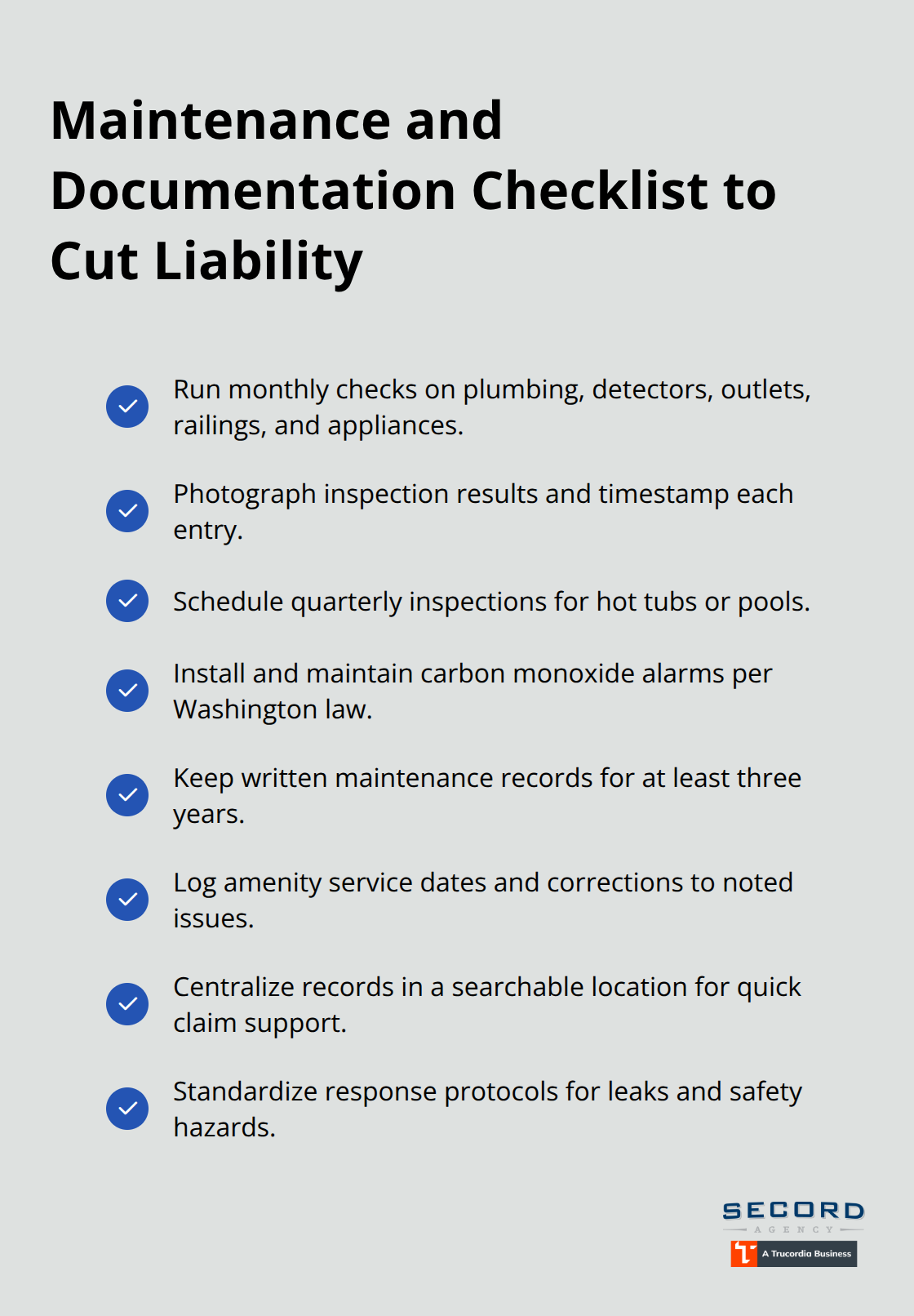
Comprehensive maintenance schedules and documented inspections form the backbone of effective liability reduction. Monthly maintenance routines cover critical systems: plumbing, smoke and carbon monoxide detectors, electrical outlets, railings, and appliance functionality. Photograph every inspection result and date each entry so you have a timestamped record if a guest later claims a pre-existing hazard caused injury. Quarterly inspections of hot tubs or pools reduce liability exposure significantly, since amenity-related injuries frequently exceed $100,000 in claims. Washington law requires you to post carbon monoxide alarms and maintain them properly; failure to do so creates strict liability that no insurance will cover. Document maintenance completion in writing and store records for at least three years. This approach transforms vague negligence claims into a clear timeline showing you invested in property safety.
When a guest sustains an injury, your documented maintenance records become powerful evidence that hazardous conditions did not exist on your watch. Most property owners who face major liability claims lack this documentation entirely, forcing them to defend against allegations with no proof of prior diligence.
House Rules, Guest Screening, and Move-In Documentation
Clear house rules and rapid documentation of guest interactions prevent disputes from escalating into legal proceedings. Post occupancy limits, noise restrictions, parking rules, and prohibited activities directly inside the rental unit and include them prominently in your listing description. Screenshot every guest message in your platform’s messaging system and photograph any damages immediately upon discovery, saving these files with dates and timestamps to a secure location. Require guests to complete a move-in inspection checklist that identifies existing wear and documents the property condition before they settle in. This single step eliminates disputes over pre-existing damage versus guest-caused harm. When conflicts arise, your documented record of guest communications, house rule acknowledgments, and timestamped photos shifts the burden away from your word against theirs. Extended-stay guests approaching the 30-day threshold warrant additional screening and a written agreement clarifying their status under Washington law. If a guest remains beyond 30 days, they transition into tenant protections that require formal eviction procedures, so screen carefully before accepting long-term bookings.
Emergency Response and Security Measures
Implement an after-hours response protocol so guests can report emergencies without delay; slow response times to water leaks or safety hazards increase your liability exposure and damage claims. Security cameras in common areas (with clear disclosure to guests) deter property damage and provide evidence if disputes occur. Many Washington vacation rental operators cross-list properties on multiple platforms simultaneously, creating inconsistent safety standards and messaging gaps. Standardize your house rules across all platforms and maintain a centralized property management system that logs all guest interactions, maintenance activities, and incident reports in one searchable location. This unified approach prevents the scenario where one platform’s guest violates rules you failed to communicate clearly on another platform, leaving you liable for damages you could have prevented with consistent messaging and enforcement.
Final Thoughts
Vacation rental liability in WA demands a three-part strategy: comprehensive insurance, strict regulatory compliance, and documented operational discipline. A single guest injury or property damage event costs $100,000 or more, and standard homeowners policies will not cover it. Specialized short-term rental insurance fills the gaps that platform coverage leaves open, protecting your building, contents, lost income, and liability exposure across all your listings regardless of which platform books the guest.
Compliance and coverage must move together. Posting required safety information, maintaining licenses and permits, and following local zoning rules are not optional steps you can skip if you have insurance. Monthly maintenance documentation, clear house rules, and timestamped guest communications transform vague negligence allegations into defensible facts that regulators and insurers respect. When disputes arise, your records prove you invested in safety and followed procedures, shifting the burden away from your credibility alone.
The cost of comprehensive protection remains small relative to the exposure. Specialized short-term rental insurance typically costs $40 to $80 per month more than inadequate platform coverage, yet it covers scenarios that could bankrupt you: water damage, extended-stay tenant disputes, lost rental income during repairs, and liability claims that exceed platform limits. We at Secord Agency – A Trucordia Business help Washington vacation rental operators identify coverage gaps and implement practical risk controls tailored to your specific property and local obligations, so contact us for a policy review and let us shop multiple carriers to build the protection your investment actually needs.