
Condo insurance Washington state: Tailored Condo Coverage And How It Works
Condo insurance in Washington state works differently than standard homeowners coverage, and most condo owners don’t realize how exposed they are until it’s too late. Your HOA’s master policy covers the building structure, but it leaves significant gaps in protection for your unit’s interior and personal belongings.
We at Secord Agency – A Trucordia Business help condo owners navigate these coverage gaps and find policies tailored to Washington’s unique risks. This guide walks you through the coverage types you need and how to select the right policy for your situation.
How Condo Insurance Differs From What You Think You Have
Most condo owners in Washington assume their HOA’s master policy protects them completely. It doesn’t. The master policy covers the building’s exterior structure and common areas, but stops at your unit’s interior walls. This creates a dangerous gap that leaves your personal belongings, interior improvements, and liability exposure unprotected.
An HO-6 condo insurance policy fills these gaps by covering your unit’s interior finishes, personal property inside your home, and liability if someone gets injured in your unit. The distinction matters because Washington condos represent about 25% of the state’s multifamily households according to 2023 U.S. Census data, yet many owners operate without adequate individual coverage. Your master policy’s deductible is also separate from your HO-6 deductible, and master deductibles in Washington commonly range from $10,000 to $50,000. If water damage hits your building and the master policy deductible is $25,000, you’re responsible for that amount unless you have specific loss assessment coverage on your HO-6 policy.
The Real Cost of Underestimating Your Coverage Needs
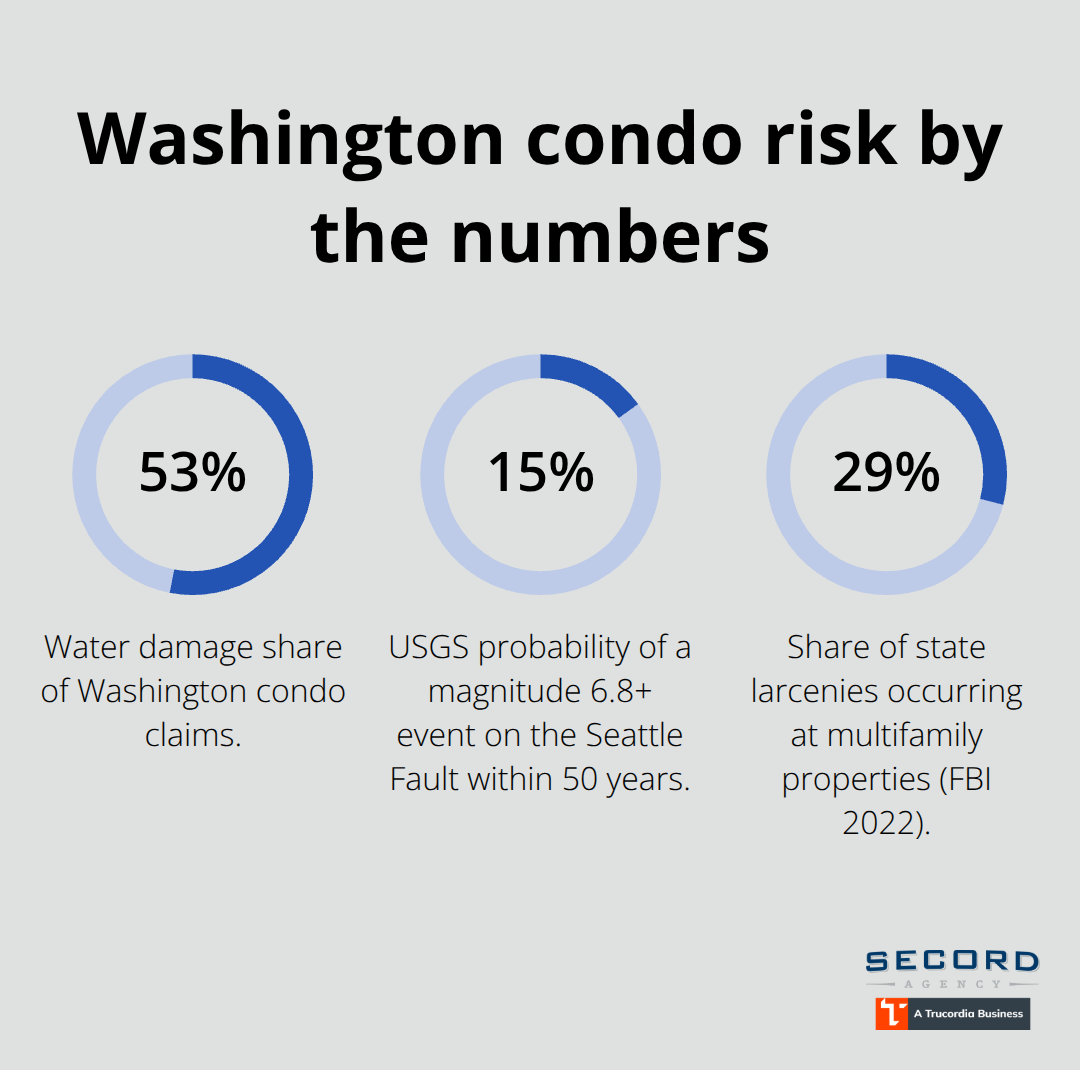
Water damage accounts for roughly 53% of all condo claims in Washington, making it the single largest claim driver. If a burst pipe damages your unit’s flooring, cabinets, and personal belongings, your master policy won’t cover any of it. Your HO-6 policy must include water backup endorsement coverage to protect against sump pump failures and clogged drains, since standard policies exclude these scenarios.
Fire and smoke damage ranks as the second major risk, with unattended cooking causing most residential fires in multifamily buildings. Beyond these common perils, Washington’s earthquake risk demands serious attention. The USGS estimates a 15% probability of a magnitude 6.8 or greater event on the Seattle Fault within 50 years. Standard HO-6 policies exclude earthquake damage entirely, so you need a separate earthquake endorsement with deductibles typically between 10% and 20% of your insured value.
Flood coverage represents another critical gap. If your unit sits in a FEMA flood zone, the National Flood Insurance Program covers building damage, but only if your HOA purchases it for the master policy. You’ll need your own NFIP or private flood policy for your personal property and interior improvements.
Building Type Matters More Than You Realize
A 30-story steel-and-concrete tower in downtown Seattle insures far more cheaply than a 1980s wood-frame building because concrete resists water and fire better than wood. Construction type directly influences your HO-6 premium and what deductibles insurers will offer.
If your building is bare walls coverage under the master policy, you must insure your unit’s cabinets, appliances, flooring, and fixtures yourself-a significant additional cost. Single entity or all-inclusive master policies shift some of this burden to the HOA, reducing your individual building property coverage needs. Request your HOA’s Certificate of Insurance to confirm exactly what the master policy covers.
Premium Costs and Loss Assessment Protection
The average condo insurance premium in Washington runs roughly $350 to $700 per year for a 1,000-square-foot urban unit, though this varies dramatically based on building age, claims history, and your deductible choices. Increasing your deductible from $500 to $1,000 typically saves 8% to 12% on your annual premium.
Loss assessment coverage is essential and frequently overlooked-most carriers offer $50,000 or higher limits for roughly $20 per year, protecting you from special assessments if the master policy doesn’t fully cover a major repair. This endorsement shields you from unexpected out-of-pocket costs when the HOA faces a significant claim. Understanding these cost factors helps you make informed decisions about which coverage levels actually fit your situation and budget. The next step involves examining your specific HOA’s master policy to determine exactly what gaps your individual HO-6 policy must fill.
What Your HO-6 Policy Actually Covers
Your HO-6 policy consists of four essential components, and understanding exactly what each one protects is the difference between a manageable claim and financial disaster.
Dwelling Coverage Protects Your Interior
Dwelling coverage protects the interior structure of your unit-walls, flooring, cabinets, appliances, and fixtures you install or upgrade. This protection matters because the master policy stops at your unit’s exterior walls, leaving everything inside your responsibility. If your building has bare walls coverage under the master policy, your dwelling coverage limit must be substantial enough to replace all interior finishes from the studs outward.
You should base your dwelling limit on a replacement cost estimate specific to your square footage, finish quality, and local labor rates. Construction costs rose approximately 8.6% in 2022 according to Rider Levett Bucknall, so outdated estimates leave you dramatically underinsured. Request your HOA’s Certificate of Insurance to confirm the exact master policy structure, then work with an agent to calculate appropriate dwelling limits.
Personal Property Coverage Protects Your Belongings
Personal property coverage protects your belongings-furniture, electronics, clothing, and everything else you own inside the unit. Standard policies include sub-limits for high-value items like jewelry capped at $2,500 and artwork at $1,000, which proves inadequate for most owners. FBI data from 2022 shows multifamily properties account for roughly 29% of all state larcenies, making scheduled personal property endorsements essential if you own jewelry, firearms, or art worth more than these sub-limits.
You should request a replacement cost endorsement rather than actual cash value, which depreciates items significantly and leaves you paying the difference out of pocket. This endorsement costs more upfront but protects your actual replacement expenses when a loss occurs.
Liability Coverage Protects You From Claims
Liability coverage protects you if someone injures themselves in your unit or if you accidentally damage someone else’s property. A baseline limit of $300,000 is common in Washington, but this proves dangerously low if you have meaningful assets or future earning potential. Injury liability claims averaged approximately $26,000–$28,000 in 2022, meaning even a single serious injury claim can exceed your basic limit and threaten your savings and future income.
Consider an umbrella liability policy to protect substantial assets and future earnings. This additional layer costs far less than you might expect and provides critical protection beyond your HO-6 limits.
Loss Assessment Coverage Shields You From Special Assessments
Loss assessment coverage is the endorsement most condo owners ignore until they face a special assessment from their HOA. When the master policy doesn’t fully cover a major loss or the deductible is high-and Washington master deductibles commonly reach $25,000 to $50,000-the HOA charges unit owners a special assessment to cover the gap. Loss assessment coverage typically costs only about $20 per year for $50,000 in protection, yet it shields you from unexpected bills that can run thousands of dollars.
Data shows condo owners with $50,000 or higher loss assessment endorsements avoid out-of-pocket surprises approximately 73% more often than those with only a $1,000 baseline. This endorsement is non-negotiable in Washington’s high-risk environment. Once you understand what your HO-6 covers, the next critical step involves comparing actual quotes from multiple carriers to find the right balance between coverage and cost for your specific situation.
Choosing Your Coverage Before You Compare Quotes
Start With Your HOA’s Certificate of Insurance
Your HOA’s Certificate of Insurance reveals exactly what the master policy covers and exposes the coverage gaps your HO-6 must fill. This single document specifies whether your building operates under bare walls, single entity, or all-inclusive coverage-a distinction that fundamentally changes your dwelling coverage needs. If the master policy is bare walls, you’re responsible for everything from the studs inward, meaning your dwelling limit must cover cabinets, flooring, appliances, and fixtures. If it’s single entity or all-inclusive, your individual dwelling needs drop significantly. Request this certificate from your HOA president or property manager before shopping anywhere.
Calculate Your Actual Replacement Costs
A 1,000-square-foot Seattle condo with upgraded finishes costs substantially more to rebuild than a basic unit, and construction costs continue climbing. Use an online replacement cost estimator specific to your square footage, finish quality, and local labor rates, then add 10% to account for inflation. This figure becomes your dwelling coverage target. For personal property, conduct a realistic inventory of what you actually own. High-value items like jewelry, art, or firearms need scheduled endorsements because standard sub-limits ($2,500 for jewelry, $1,000 for artwork) leave you dramatically underinsured. Photograph valuable items and gather receipts or appraisals before shopping-this documentation accelerates claims and prevents disputes over replacement costs.
Prioritize Loss Assessment and Deductible Strategy
Set your loss assessment coverage to at least $50,000, not the bare minimum $1,000 that many policies default to. Washington master deductibles commonly reach $25,000 to $50,000, and a $50,000 loss assessment endorsement costs only about $20 annually yet shields you from special assessments that otherwise drain thousands from your bank account. Increasing your deductible from $500 to $1,000 typically saves 8% to 12% on your annual premium, but only do this if you have sufficient emergency savings to cover that deductible out of pocket. Many agents push deductible increases to lower your premium, but this strategy backfires if you can’t afford the deductible when a loss occurs.
Shop Multiple Carriers and Compare Strategically
More than 20 carriers write HO-6 policies in Washington, yet most condo owners accept the first quote they receive. Allstate, Amica, Chubb, Farmers, Liberty Mutual, Nationwide, State Farm, Travelers, and USAA all compete aggressively for condo business, and their rates vary wildly for identical coverage. When comparing quotes, ignore the premium and focus first on whether each carrier includes water backup endorsement, earthquake endorsement availability, and loss assessment limits-these three items matter far more than saving $50 annually on the base rate. Ask each carrier about claims-free discounts, bundling discounts with auto insurance, and credits for protective devices like centrally monitored fire alarms or sprinkler systems-these discounts often deliver more savings than raising your deductible.
Work With a Condo-Focused Insurance Broker
A condo-focused insurance broker understands Washington’s specific risks including earthquake and flood exposure and handles renewal processes 120 days before expiration to prevent coverage lapses. Look for brokers with the CIRMS designation or equivalent condo expertise, and interview at least two firms before deciding. A quality broker places a minimum of 20 association accounts annually and accesses quotes from carriers that don’t sell directly to consumers, often negotiating better rates than you’ll find independently. An independent insurance agency that shops multiple carriers can deliver tailored condo coverage paired with fast, local, advocate-led service and personalized policy reviews.
Final Thoughts
Condo insurance in Washington state requires a fundamentally different approach than standard homeowners coverage because your master policy leaves critical gaps that only an HO-6 policy can fill. The three non-negotiable priorities are dwelling coverage sized to your actual replacement costs, loss assessment protection at $50,000 or higher, and water backup endorsement coverage given that water damage drives 53% of all condo claims in Washington. Earthquake endorsement availability matters equally given the USGS estimate of a 15% probability of a magnitude 6.8 or greater event on the Seattle Fault within 50 years.
Your next step involves requesting your HOA’s Certificate of Insurance to confirm whether your building operates under bare walls, single entity, or all-inclusive coverage, then calculating your actual replacement costs based on square footage, finish quality, and current labor rates. Once you know these numbers, obtain quotes from at least three carriers and compare based on coverage features rather than price alone. More than 20 carriers write HO-6 policies in Washington, and their rates vary dramatically for identical protection.
Local guidance matters because Washington’s specific risks including earthquake exposure, flood zones, and wildfire smoke require endorsements and coverage limits that generic online quotes often miss. An independent insurance agency that understands condo coverage complexities and shops multiple carriers delivers tailored protection paired with personalized policy reviews. Contact us at Secord Agency – A Trucordia Business for a personalized review of your current coverage and a competitive quote that reflects your specific situation.