Umbrella insurance Seattle residents: Extra Coverage When You Need It
Your homeowners and auto insurance policies have limits. When a lawsuit or major accident pushes past those limits, you’re personally liable for the difference.
Umbrella insurance for Seattle residents fills that gap. It kicks in when your standard coverage maxes out, protecting your assets and future earnings from catastrophic claims.
How Umbrella Insurance Actually Works
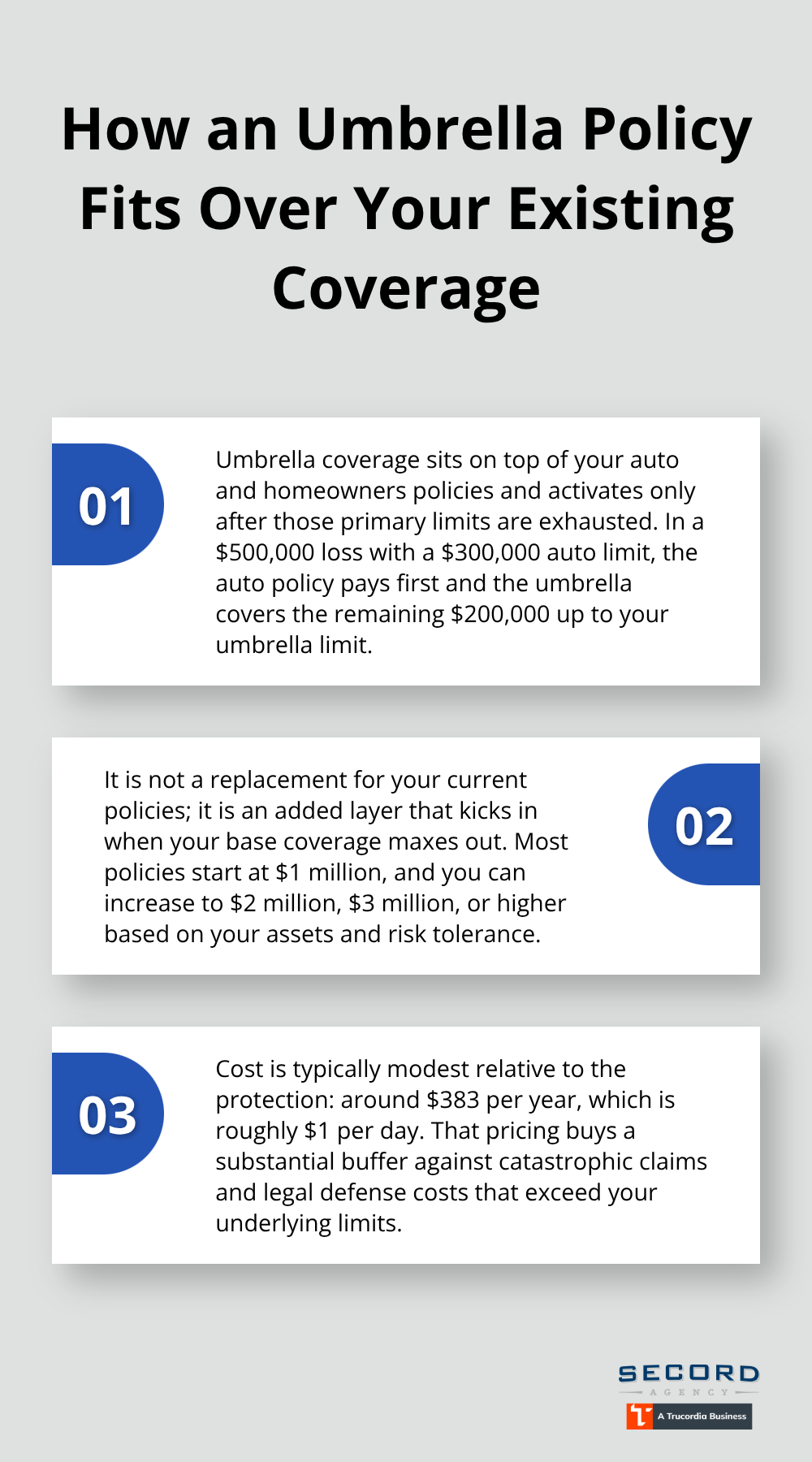
Umbrella insurance sits on top of your existing auto and homeowners policies and activates only after those underlying limits are exhausted. Here’s how it works: if you cause a car accident with $500,000 in injuries and your auto bodily injury limit is $300,000, your auto policy pays the first $300,000. The umbrella policy then covers the remaining $200,000 up to your umbrella limit. This isn’t a replacement for your current coverage-it’s an additional layer of protection that kicks in when your primary policies max out. Most umbrella policies start at $1 million in coverage, though you can upgrade to $2 million, $3 million, or higher depending on your assets and risk tolerance. According to ACE Private Risk Services, a typical $1 million umbrella policy costs about $383 per year, making it roughly $1 per day for substantial protection.
What Umbrella Insurance Actually Covers
Your umbrella policy protects against high-cost claims including bodily injury from serious auto accidents, injuries that happen on your property, dog bites, and personal injury claims like slander, libel, or false arrest. It covers defense costs and damages when these incidents exceed your underlying policy limits. One important detail: a lapse in your underlying policies voids umbrella coverage entirely, so you must maintain continuous coverage on your auto and homeowners policies. Washington state generally requires underlying auto bodily injury limits of $250,000 per person and $500,000 per accident, plus homeowners liability of at least $300,000, to qualify for umbrella protection. The coverage applies worldwide with no geographic restrictions, meaning you’re protected whether the incident happens in Seattle or during travel abroad.
When Umbrella Coverage Makes Financial Sense
Your net worth drives this decision. Umbrella coverage becomes economically sensible when net worth exceeds about $500,000, since potential liability losses can quickly outpace the premium costs. If your net worth is over $1 million, upgrading to $2 million in coverage becomes practical; for net worth over $2 million, a $3 million limit is often recommended. High-risk scenarios in Washington that justify umbrella coverage include owning rental properties, having teenage drivers, hosting gatherings, maintaining social media visibility, or serving on nonprofit boards. An independent agent can review your specific exposure and obtain competitive quotes from multiple insurers to find the right balance between coverage and cost-something we at Secord Agency specialize in as we shop multiple carriers for our clients across Washington.
Why Seattle Residents Face Real Liability Gaps
Seattle’s real estate market has pushed average home values to $865,273, making property values a serious consideration for liability planning. That wealth sits exposed when standard homeowners and auto policies cap out. A single catastrophic event can wipe away years of financial progress.
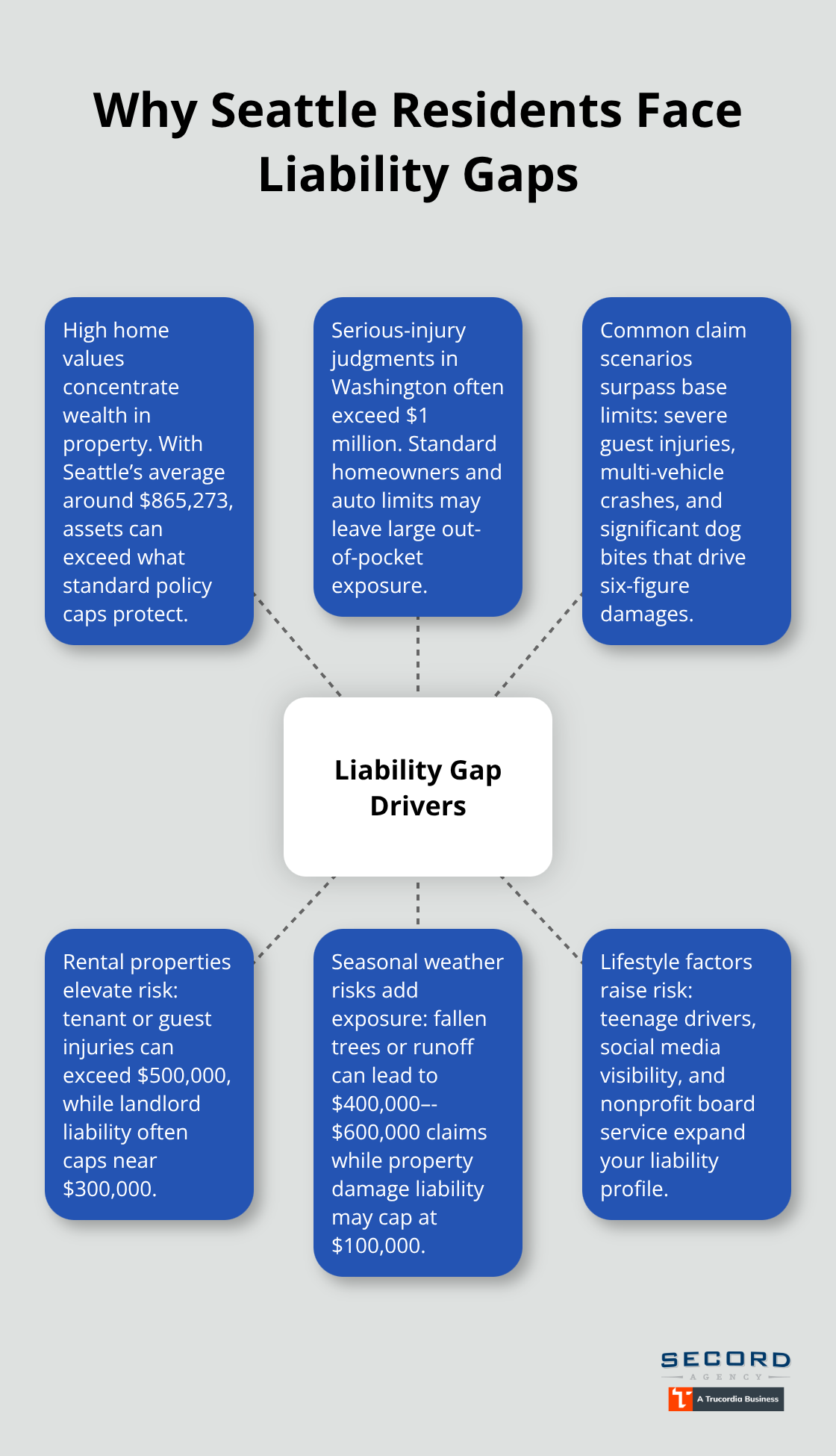
Consider a scenario that happens regularly in Washington: you host a gathering at your home, a guest falls and suffers a severe head injury requiring ongoing care, and medical costs balloon to $1.2 million. Your homeowners liability limit of $300,000 covers initial expenses, but you’re personally responsible for the remaining $900,000. Without umbrella coverage, that gap comes directly from your savings, retirement accounts, and future earnings. Courts in Washington regularly award judgments exceeding $1 million for serious injuries, and your standard policies simply don’t protect against the full exposure.
Rental Properties and Landlord Exposure
Seattle’s rental market has created a specific liability trap for property owners. If you rent out even one unit and a tenant or their guest suffers an injury on your property, the lawsuit names you personally. A slip-and-fall claim on rental property stairs can easily exceed $500,000 in medical damages plus legal fees. Your homeowners policy’s landlord liability coverage typically maxes at $300,000, leaving substantial exposure.
Rental property owners in Washington should treat umbrella coverage as mandatory, not optional, since tenant injury claims represent some of the highest-dollar liability scenarios. The economic math is straightforward: umbrella costs roughly $383 annually for $1 million in coverage according to ACE Private Risk Services, while a single serious injury claim can cost you hundreds of thousands out-of-pocket.
Weather Events and Seasonal Liability Risks
Washington’s wet winters create specific liability patterns that standard coverage doesn’t adequately address. Heavy rain causes property damage to neighboring homes, and you’re liable if water from your property damages a neighbor’s foundation or basement. Winter storms drop trees across property lines, creating injury and damage claims. These weather-related incidents happen frequently enough that they’re not edge cases-they’re predictable seasonal exposures.
A fallen tree that injures a neighbor or damages their home can generate claims of $400,000 to $600,000 easily. Standard homeowners policies cap property damage liability at $100,000 in many cases, leaving you exposed to significant personal liability. An independent agent can assess your specific property risks, drainage patterns, and tree exposure to determine whether umbrella coverage aligns with your actual vulnerability.
Finding the Right Coverage for Your Situation
Your actual exposure depends on factors unique to your property and lifestyle. Teenage drivers, social media visibility, nonprofit board service, and property characteristics all shift your liability risk upward. An independent agent reviews your declarations pages, verifies your minimum limits, and obtains competitive quotes from multiple insurers to match umbrella limits to your real exposure rather than treating coverage as one-size-fits-all.
The next step involves understanding exactly which situations your umbrella policy covers and which ones fall outside protection.
What Umbrella Insurance Actually Covers
Auto Accidents and Catastrophic Injury Claims
A serious car accident happens in seconds. You’re at-fault for a multi-vehicle collision on I-5 where injuries are severe and medical costs spiral to $1.2 million. Your auto policy’s bodily injury limit of $300,000 exhausts immediately, and the umbrella policy covers the remaining $900,000 up to your limit. Washington State courts regularly award judgments exceeding $1 million for catastrophic injuries, and the Insurance Information Institute reports that serious injury claims average $847,000 when multiple people are involved. Your umbrella activates immediately after your auto limits max out, covering both damages and your legal defense costs.
Injuries on Your Property and Rental Units
The same protection applies when someone is injured on your property. A guest at your home slips on wet stairs and suffers a spinal injury requiring surgery and ongoing physical therapy, with total costs reaching $950,000. Your homeowners liability limit of $300,000 pays initial expenses, but the umbrella covers the $650,000 gap. Injuries on rental properties can generate significant claims when tenants suffer severe falls on exterior stairs or other hazardous conditions on the property.
Dog Bites and Personal Injury Claims
Dog bite claims also exceed standard limits regularly. A serious dog attack causes facial scarring and psychological trauma, generating $500,000+ in damages, especially if the victim requires reconstructive surgery. Your homeowners policy typically caps dog bite liability at $300,000, and umbrella coverage steps in for the remainder plus legal fees. Personal injury claims beyond physical harm also qualify for umbrella protection. If someone accuses you of libel or slander and wins a judgment, or if you face a false accusation of unlawful detention, umbrella coverage handles damages that exceed your homeowners policy limits.
What Umbrella Insurance Does Not Cover
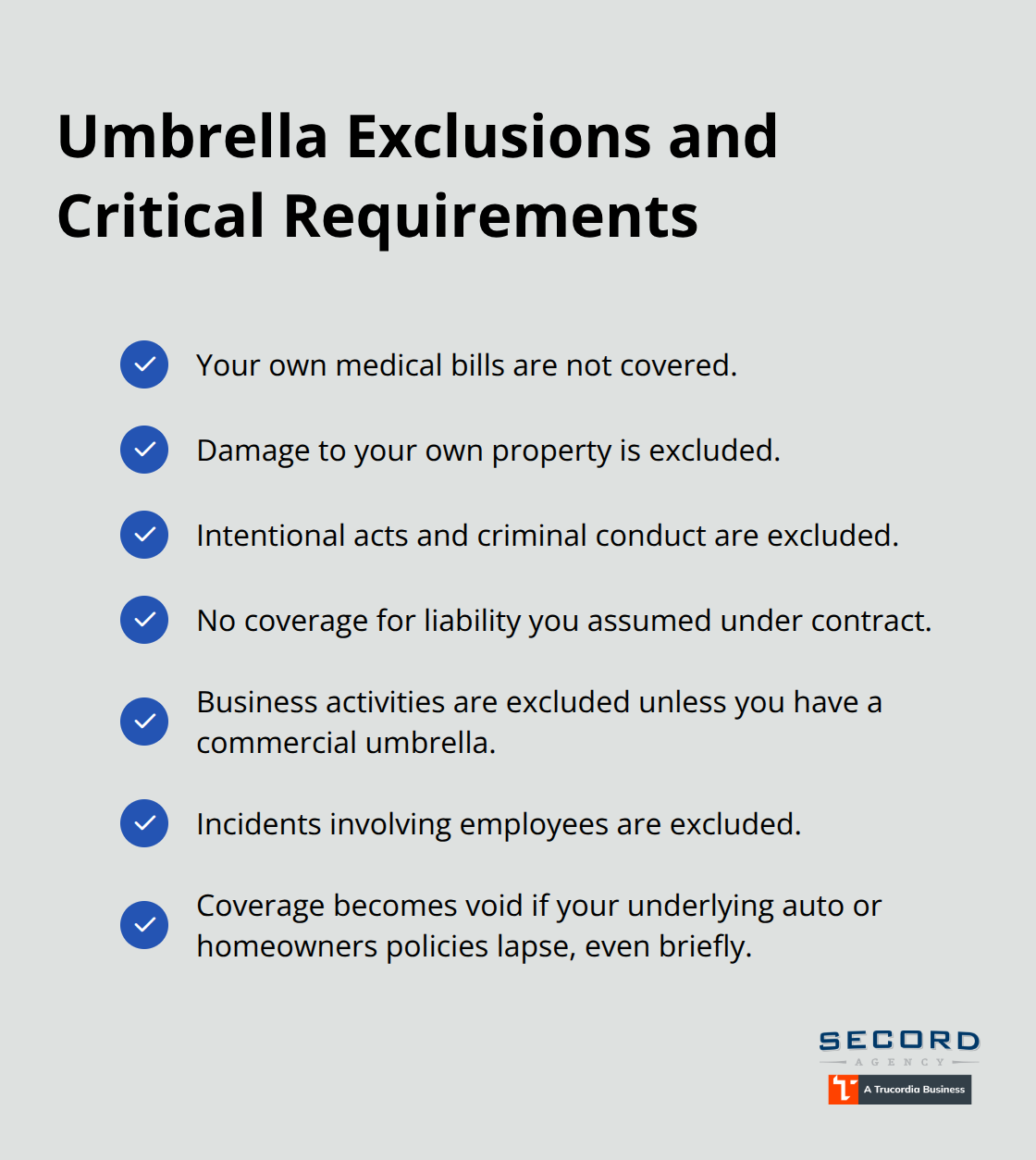
Umbrella insurance explicitly excludes your own medical bills, damage to your own property, intentional acts, and criminal conduct. You also cannot claim coverage for liability you assumed under contract, business activities (unless you purchase commercial umbrella), or incidents involving employees. A critical detail: if your underlying auto or homeowners policy lapses even briefly, your umbrella coverage becomes void instantly. Washington State requires maintaining continuous coverage to keep umbrella active, meaning a gap of even one day eliminates protection. This is why working with an independent agent who monitors your policy renewal dates and coverage limits prevents catastrophic gaps.
Worldwide Protection for Travel and Out-of-State Property
The worldwide coverage aspect matters for Seattle residents who travel or own property outside Washington-your umbrella protects you against liability claims regardless of geographic location, whether in Europe or during a cross-country road trip. An independent agent can review your declarations pages and verify that underlying limits remain adequate and continuous, since umbrella protection depends entirely on that foundation.
Final Thoughts
Umbrella insurance for Seattle residents costs roughly $1 per day while protecting hundreds of thousands of dollars in assets. A single serious accident, injury on your property, or dog bite claim can exceed your standard policy limits by hundreds of thousands of dollars, and that gap comes directly from your savings and retirement accounts. For anyone with net worth exceeding $500,000, the annual premium of around $383 for $1 million in coverage represents genuine financial protection against scenarios that happen regularly in Washington.
Seattle’s high property values, rental market exposure, and weather-related liability risks create specific vulnerabilities that standard homeowners and auto policies don’t adequately address. Courts in Washington award judgments exceeding $1 million frequently enough that umbrella coverage aligns with realistic exposure rather than worst-case thinking. The coverage activates only after your underlying policies exhaust their limits, meaning you maintain your existing protection while adding a critical second layer.
Your actual assets, property characteristics, and lifestyle factors determine whether umbrella coverage makes sense for your situation. Teenage drivers, rental properties, social media visibility, and hosting gatherings all shift your liability exposure upward. Contact Secord Agency for a personalized umbrella quote and a comprehensive review of your liability exposure across all your policies.