
Washington condo insurance guidance: Navigating Your Condo Coverage Options
Condo ownership in Washington comes with unique insurance challenges that many owners overlook. Your HOA’s master policy covers the building structure, but significant gaps remain in your personal protection.
At Secord Agency – A Trucordia Business, we’ve helped countless condo owners understand what they’re actually covered for and where they’re exposed. This Washington condo insurance guidance walks you through the coverage options you need to protect your investment.
What Your Master Policy Actually Covers
Understanding Your Master Policy Format
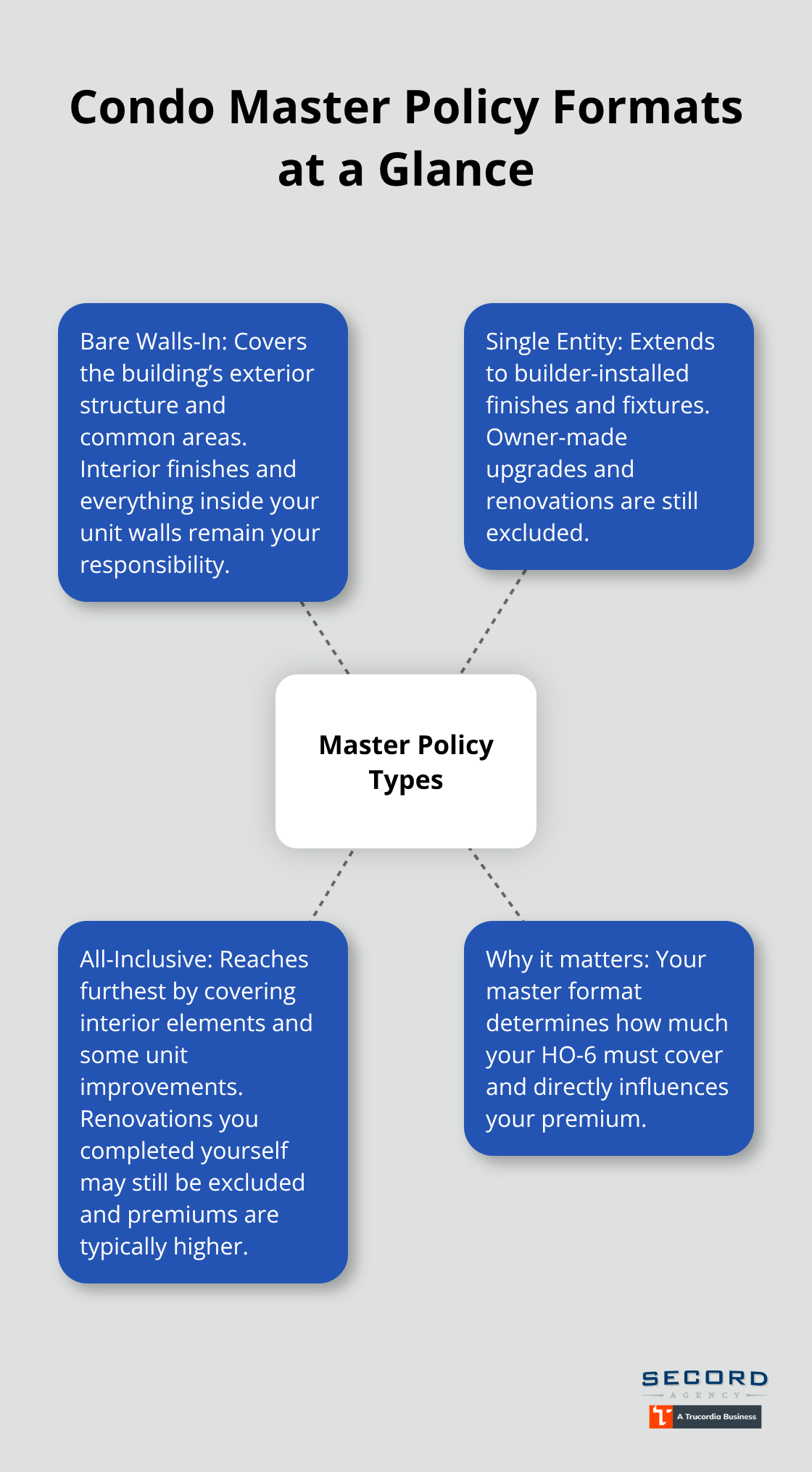
Your HOA’s master policy covers the building structure and common elements, but the scope depends on which of three formats your association chose. About 53% of Washington condo claims involve water damage, so understanding what’s protected matters significantly. If your building has a Bare Walls-In policy, the association covers the exterior framing and common areas like lobbies and hallways, but you pay for everything inside your unit walls, including appliances, cabinetry, and flooring. A Single Entity policy, popular in Seattle and Bellevue, adds builder-installed finishings and fixtures to the association’s coverage while still leaving owner upgrades to you. An All-Inclusive policy extends furthest, covering interior elements and some unit improvements, though these policies cost more and may exclude renovations you’ve completed yourself.
Meeting the 80% Requirement
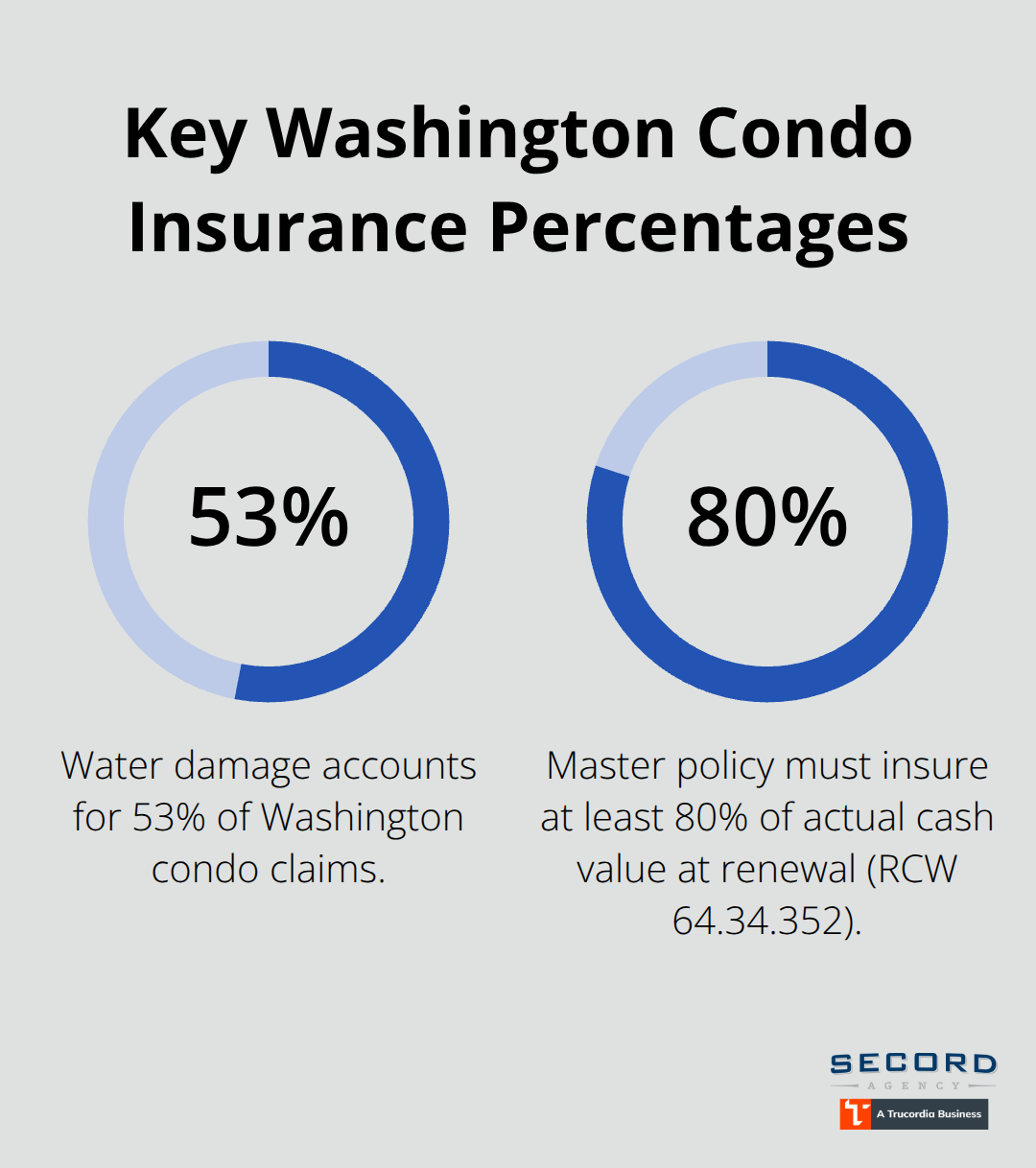
The master policy must cover at least 80% of the actual cash value at renewal, enforced under RCW 64.34.352. Associations verify this through independent appraisals every three years to avoid coinsurance penalties that could force you to pay part of a large loss out of pocket. This requirement protects you from discovering after a major claim that your building was underinsured.
Liability Coverage Limits
General liability coverage starts around $1 million per occurrence with $2 million aggregate, protecting the association and you as a unit owner against slip-and-fall claims or injuries in common areas. Many boards add a $5 million to $25 million umbrella when amenities like pools or rooftop decks increase exposure.
How Your HO-6 Policy Fills the Gaps
Your individual HO-6 policy fills the gaps the master policy leaves open. Personal property coverage reimburses you for belongings inside your unit at replacement cost if you select that option rather than actual cash value, which depreciates items and leaves gaps on valuables like jewelry or electronics. Liability coverage on your HO-6 protects you personally if someone is injured inside your unit or sues you for property damage, separate from the association’s liability limits. Loss assessment coverage is critical because if the master policy limit is exhausted or a loss falls outside what it covers, the association can charge unit owners a special assessment, and your loss assessment rider reimburses that cost up to your coverage limit, typically $1,000 to $5,000. Additional living expense coverage pays for temporary housing if your unit becomes unlivable after a covered loss, and premises medical payments reimburse medical bills for guests injured on your property regardless of fault.
Coordinating Your Policies
The master policy is primary and your HO-6 is secondary, meaning the association’s coverage pays first, but coordination matters. If water damage stems from a building defect, the master policy covers it, but if it results from your negligence, your HO-6 steps in. Contact your HOA president or property manager to confirm which master policy format applies to your building so you can align your personal coverage accordingly. This coordination becomes especially important when you consider the specific risks that affect Washington condo owners and how your individual coverage must adapt to those threats.
How Condo Insurance Differs From Standard Homeowners Coverage
Ownership Structure Changes Everything
A standard homeowners policy assumes you own the entire structure and land, so it covers the full dwelling, roof, foundation, and everything attached to the building. Condo insurance works completely differently because you own only the airspace inside your unit walls. This split ownership means a homeowners policy would leave you severely underinsured on a condo purchase. The master policy covers the building shell and common elements, but it explicitly excludes your personal unit’s interior finishes, appliances, cabinetry, flooring, and any upgrades you’ve made.
Premium Variations Reflect Coverage Differences
Condo premiums vary dramatically based on what your master policy covers. If your association has a Bare Walls-In policy, your HO-6 must cover significantly more interior elements, pushing your premium higher than an owner in an All-Inclusive master policy building. Two condo owners in different Seattle buildings could pay vastly different premiums for seemingly identical units, simply because one association chose broader master coverage than the other.
Shared Building Responsibility Creates Unique Exposure
Your association’s board controls the master policy decisions, deductibles, and claim handling, which directly affects your out-of-pocket costs when damage occurs. The biggest difference between condo and homeowners liability coverage is that a homeowner needs coverage for their entire property. If your building sustains a major loss and the association’s deductible is $25,000, you’ll owe that amount regardless of whether you caused the damage. This is why loss assessment coverage on your HO-6 matters far more for condo owners than homeowners-you’re financially exposed to assessments from decisions you didn’t make.
Water Damage and Policy Coordination Challenges
Water damage accounts for 53% of Washington condo claims and often triggers disputes about whether the master policy or your HO-6 covers the loss, requiring clear coordination between both policies. Homeowners never face this coordination problem because they control their entire policy. Additionally, if the master policy limit proves inadequate after a major loss, the association can charge unit owners special assessments to cover the gap-a scenario that doesn’t exist for homeowners.
Understanding these coordination requirements becomes essential when you examine the specific coverage gaps that most condo owners fail to address.
Common Coverage Gaps Condo Owners Face
Improvements and Upgrades to Your Unit
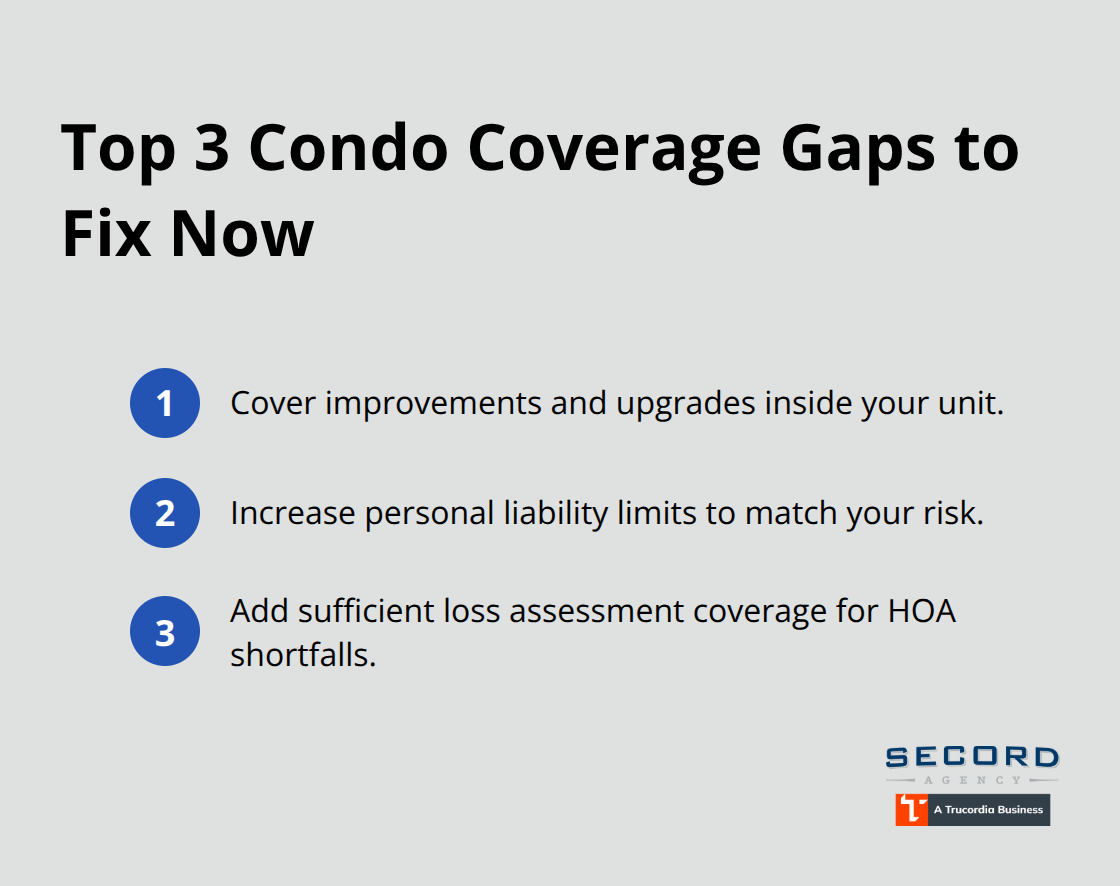
Most condo owners discover coverage gaps only after a loss occurs, and by then it’s too late. The master policy protects the building structure, but it explicitly excludes anything you’ve added or modified inside your unit, leaving you personally liable for repairs that can easily cost tens of thousands of dollars. If you’ve upgraded your kitchen cabinets, installed hardwood flooring, added custom closet systems, or replaced the bathroom vanity with a higher-end model, the master policy won’t touch those improvements. Your HO-6 policy must cover these upgrades, but only if you specifically add an endorsement for building property protection or ensure your dwelling coverage limit reflects the actual cash value of your unit with those improvements included. Many owners skip this step and later face a devastating gap when fire or water damage destroys their renovated space.
The cost difference is minimal-adding improvement coverage to your HO-6 typically costs $15 to $40 per year-but the protection is essential. An owner who spent $30,000 upgrading their unit without proper coverage will absorb that entire loss themselves. This gap affects far more owners than most realize, especially in Seattle and Bellevue where unit renovations are common.
Personal Liability Beyond Master Policy Limits
The association’s general liability covers common-area incidents like someone slipping in the lobby, but it doesn’t protect you if a guest is injured inside your unit due to a hazard you created or failed to maintain. Your HO-6 liability coverage provides this protection, but the standard limit of $100,000 to $300,000 may be inadequate for serious injuries. A 2022 average premises-liability settlement in Washington ran around $68,000, meaning a single incident could exhaust your standard liability limit and leave you personally responsible for the remainder.
We at Secord Agency – A Trucordia Business recommend condo owners carry at least $300,000 in personal liability on their HO-6, and those with pools, trampolines, or frequent guests should consider $500,000 or higher. Umbrella or excess liability coverage costs far less than most owners expect-around $100 to $150 per year for $1 million in additional protection-and it covers gaps that your HO-6 doesn’t.
Loss Assessment Coverage
The third and most overlooked gap is loss assessment coverage, which protects you when the association’s master policy limit is exhausted or a loss falls outside coverage and the board charges unit owners a special assessment to cover the shortfall. Without this coverage, a major loss could trigger an assessment that costs you $5,000, $10,000, or more depending on your unit’s percentage ownership.
Loss assessment coverage on your HO-6 typically costs $50 to $100 annually and reimburses these special assessments up to your coverage limit, usually $1,000 to $5,000, but you can request higher limits for additional premium. Water damage alone accounts for 53% of Washington condo claims, and deductibles on master policies can reach $25,000. This coverage is not optional-it’s a financial necessity that protects you from decisions made by your HOA board.
Final Thoughts
Request your association’s master policy declaration and current insurance summary from your HOA president or property manager to confirm which format your building uses-Bare Walls-In, Single Entity, or All-Inclusive. Verify the master policy’s dwelling limit meets the 80% replacement cost requirement and note the deductible amount, as this directly affects your out-of-pocket costs after a loss. Check what the policy lists as covered common elements versus what falls to unit owners so you understand your actual exposure.
Compare your current HO-6 coverage against the gaps we’ve outlined in this Washington condo insurance guidance. Confirm your dwelling limit reflects the actual cash value of your unit with improvements included, add building property protection if needed, and verify your personal liability reaches at least $300,000 (consider $500,000 or higher if you host frequent guests). Ensure loss assessment coverage sits at $1,000 to $5,000 minimum and review whether additional living expense coverage fits your financial situation.
We at Secord Agency – A Trucordia Business shop multiple carriers to deliver tailored condo coverage paired with competitive rates and local, advocate-led service. Contact us for a personalized policy review that identifies your specific gaps and protects your investment across all three coverage layers.