
Insurance carrier comparison WA: Choosing The Right Partner For Your Coverage
Finding the right insurance carrier in Washington requires more than just picking the cheapest option. An insurance carrier comparison in WA reveals significant differences in coverage quality, financial stability, and customer support that directly impact your protection.
At Secord Agency – A Trucordia Business, we help clients navigate these choices by breaking down what actually matters when comparing carriers. This guide walks you through the essential factors that separate a good insurance partner from one that leaves you underprotected.
What Coverage Do You Actually Need in Washington?
Assess Your Actual Protection Needs
Insurance carrier comparison in Washington starts with understanding exactly what protection you need before you compare a single quote. Many Washington residents purchase coverage based on assumptions rather than actual circumstances. This creates two problems: you either overpay for coverage you don’t use, or you discover gaps when you need the protection most.
The Washington Office of the Insurance Commissioner publishes resources that break down standard homeowners coverage, which typically includes dwelling, other structures, personal property, loss of use, personal liability, and guest medical payments. For auto insurance, Washington requires minimum liability coverage, but your personal injury protection needs, collision coverage decisions, and whether you carry passengers regularly shape what you actually purchase.
Your coverage requirements differ significantly based on whether you own or rent, whether you have dependents, what vehicles you drive, and whether you operate a business. A renter in a Seattle apartment needs fundamentally different protection than a homeowner in Spokane with a mortgage and multiple vehicles. List what you own that needs protection, what liabilities you face, and what financial losses would actually harm you.
Account for Washington’s Unique Risk Factors
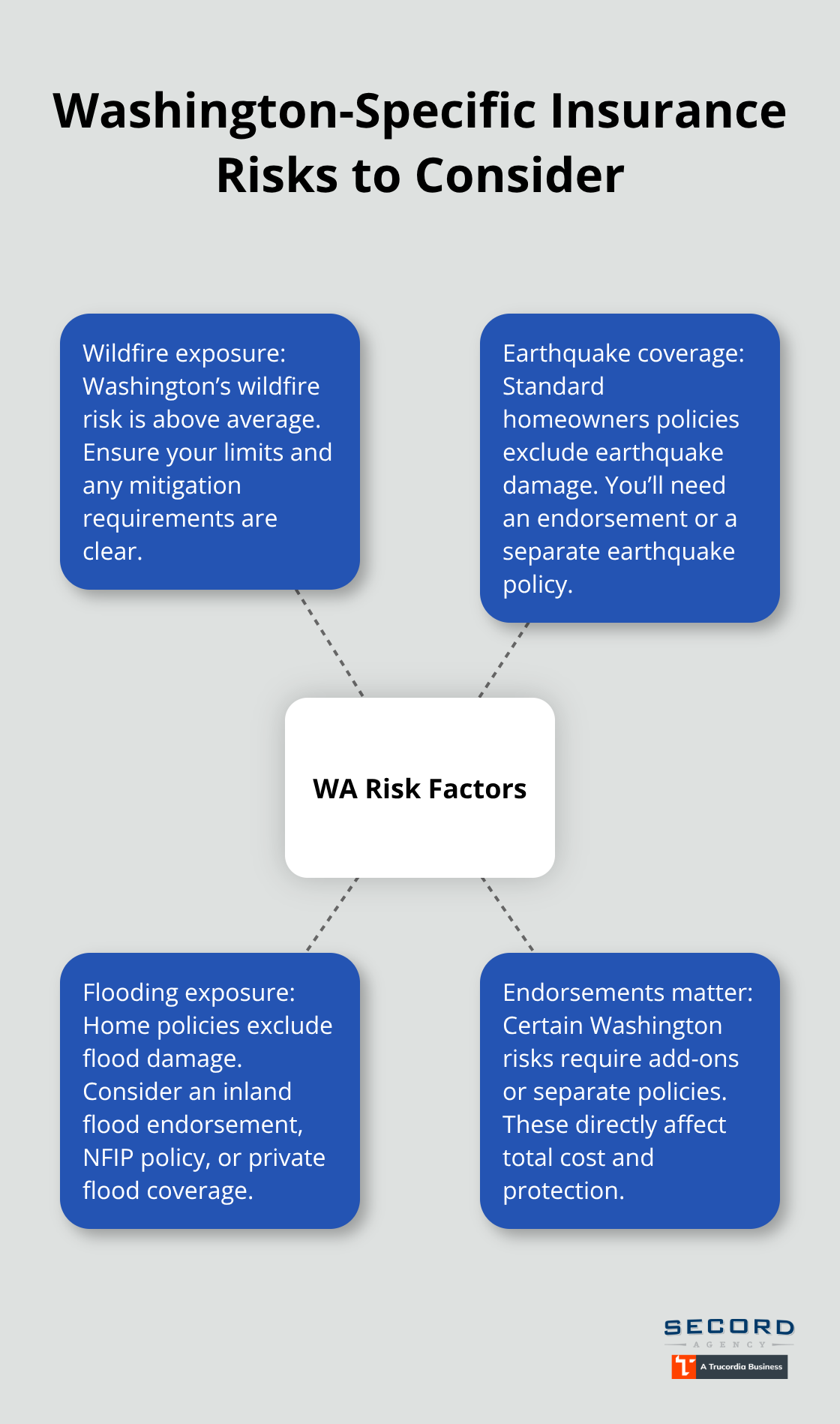
Washington’s specific risks demand coverage most other states don’t require. Wildfire risk in Washington is above average, and standard homeowners policies exclude earthquake and flood damage entirely. For homeowners, flood coverage requires either an inland flood endorsement or a separate policy through the National Flood Insurance Program or private carriers. Earthquake coverage also requires an endorsement or separate policy. These aren’t optional considerations in Washington-they’re practical necessities that affect your total cost and protection.
The Washington Health Benefit Exchange lists qualified health plans from carriers like Premera, Regence BlueShield, and Kaiser, but your health coverage needs depend on your employment status, family size, and anticipated medical usage. Your specific situation in Washington determines which risks matter most to your household or business.
Balance Your Budget Against Deductible Tolerance
Your budget and deductible preferences work together with these risk factors. A higher deductible lowers your monthly premium but increases what you pay when you file a claim. For homeowners with a $600,000 dwelling in Washington, PEMCO charges around $1,550 annually, while State Farm costs approximately $2,348 for the same coverage. These price differences reflect not just rates but also what each carrier includes and excludes.
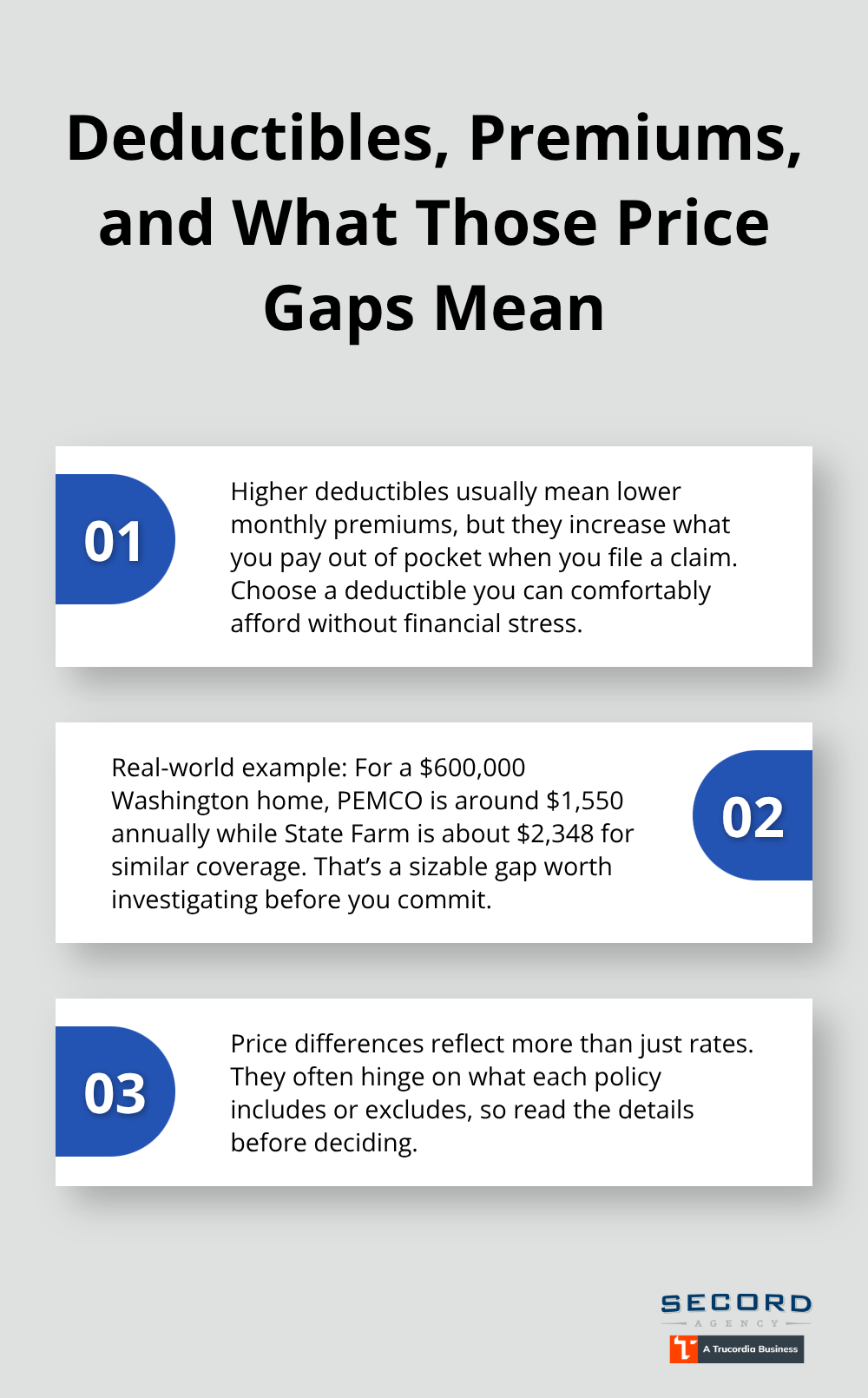
Determine your actual deductible tolerance before comparing carriers. If you can comfortably cover a $2,500 deductible without financial stress, you’ll save significantly compared to someone who needs a $500 deductible. The Washington Office of the Insurance Commissioner provides tools to verify carrier licensing and access complaint histories, which helps you understand what you’re actually paying for across different providers.
With your coverage needs, risk factors, and budget clearly defined, you’re ready to evaluate which carriers actually deliver the protection and service Washington residents require.
Which Washington Carriers Actually Deliver What You Need
Washington’s insurance market splits into three distinct groups, and each serves different priorities. National carriers like State Farm, Allstate, and Progressive operate across all fifty states with standardized processes and broad product lines. Regional carriers like PEMCO focus specifically on Washington and Oregon, building local expertise into their underwriting and pricing. Specialty carriers fill gaps that mainstream insurers won’t touch, from high-risk drivers to unique business exposures. Understanding which group matches your situation prevents wasting time on carriers that won’t serve you well.
Regional Carriers: Local Expertise and Pricing Advantages
PEMCO stands out as Washington’s dominant regional player, particularly for homeowners insurance. The company charges around $1,550 annually for a $600,000 dwelling according to U.S. News Best Homeowners Insurance in Washington, undercutting State Farm at $2,348 and Allstate at $2,012 for identical coverage. PEMCO’s customer-owned mutual structure means profits return to policyholders rather than external shareholders, a distinction that drives their pricing advantage in the Pacific Northwest. However, PEMCO’s regional focus creates a real drawback: the carrier operates only in Washington and Oregon, so relocation outside these states ends your policy. Additionally, some long-term customers report that PEMCO cancels policies after a single incident, which contradicts the mutual company narrative some use to justify their choice.
For auto insurance in Washington, PEMCO remains competitive but faces stronger regional competition from carriers like Safeco. WA drivers consistently cite Safeco for balanced pricing and customer service, though some report rate increases that prompted them to shop competing quotes. USAA serves military-connected individuals with strong rates and a notable Wildfire Response Program that monitors nearby fire activity to accelerate firefighter response, but eligibility restrictions limit its utility to military families only.
National Carriers: Aggressive Competition and Flexibility
National carriers operate differently in Washington than regional players. Progressive frequently appears in rate shopping discussions as a savings option when drivers switch from higher-cost carriers, meaning the company competes aggressively on price for specific risk profiles rather than dominating across all customer types. Travelers can deliver substantial savings relative to established carriers like Safeco, with brokers reporting annual differences exceeding $100 on identical coverage, making comparison shopping genuinely valuable rather than theoretical.
Allstate offers private flood insurance through Beyond Floods and NFIP options, addressing a critical Washington gap, though the carrier carries more NAIC complaints than competitors, signaling customer service challenges. The Washington Office of the Insurance Commissioner publishes annual Market Information Reports with Top 40 and Top 10 carrier lists by line of business, enabling direct side-by-side financial comparisons of which carriers actually dominate homeowners, auto, health, and other coverage areas in Washington. This data reveals which carriers hold real market share in your specific coverage type rather than relying on national reputation.
Specialty Carriers and Health Insurance Options
Specialty carriers like Metromile address pay-as-you-drive needs but warrant caution: drivers report rate increases after initially lower pricing, suggesting the model attracts customers with artificially low introductory rates before adjusting upward. For health insurance, the Washington Health Benefit Exchange lists qualified plans from Premera, Regence BlueShield, Kaiser, Molina, and others, but each carrier offers different deductibles, out-of-pocket maximums, and network restrictions that directly affect your actual costs versus advertised rates. Comparing these plans requires examining specific numbers rather than carrier names, since a plan from one carrier at one metal level often costs significantly more than a competitor’s offering for the same coverage level.
The Rate Shopping Reality
Shopping every two years, as WA drivers consistently report doing, remains the only reliable way to capture rate reductions and avoid the premium creep that affects all carriers over time. Your carrier choice matters far less than your commitment to periodic rate comparisons. Once you understand which carriers operate in your market and what financial stability they maintain, the next step involves requesting actual quotes and analyzing what each carrier truly offers for your specific situation.
Getting Actual Numbers Before You Decide
Request Quotes from Multiple Carriers
Requesting quotes from multiple carriers reveals the real price differences that generic rate tables miss. A WA driver with a 2024 Nissan Altima SR AWD reported paying just over $200 monthly for auto insurance while financing the vehicle, but that single data point tells you nothing about what you’ll pay for your specific vehicle, driving history, and coverage selections. The only way to know your actual cost is to request quotes from at least three to five carriers operating in Washington.
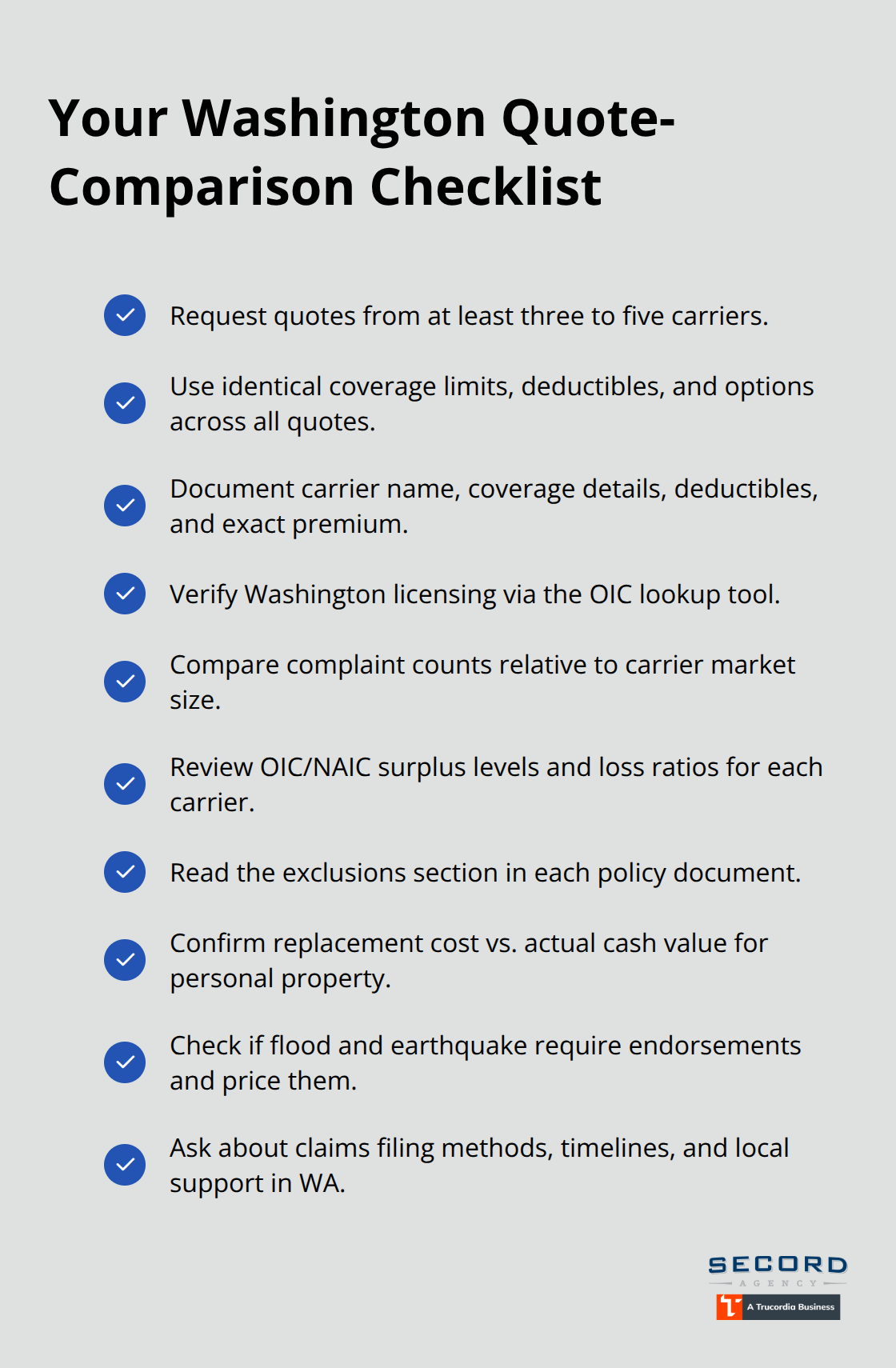
When you request quotes, provide identical coverage levels across all carriers-same deductibles, same liability limits, same optional coverages. Changing even one element between quotes invalidates the comparison. Many carriers offer online quote tools that take fifteen to twenty minutes, though some require phone calls for accurate pricing on older vehicles or complex situations. Document each quote with the carrier name, coverage details, deductible amounts, and the exact premium.
Verify Financial Stability and Complaint History
A quote fifty dollars cheaper monthly means six hundred dollars annually, but that savings disappears instantly if the carrier denies your claim or takes three months to process it. The Washington Office of the Insurance Commissioner provides an Agent and Company Lookup Tool to verify that any carrier you’re considering holds a current license in Washington. More importantly, use the OIC’s complaint lookup to compare how many complaints each carrier receives relative to their market size. A carrier with two hundred complaints might be fine if they insure two million Washington residents, but the same number signals serious problems for a regional player with fifty thousand customers.
The OIC publishes annual Market Information Reports listing the top carriers by line of business with financial statement data sourced from the National Association of Insurance Commissioners. These reports show which carriers actually dominate homeowners, auto, health, or other coverage in Washington rather than relying on national reputation. Review Appendix B’s financial data to compare surplus levels and loss ratios between carriers you’re considering. A carrier with declining surplus or rising loss ratios may cut rates aggressively now but could raise them sharply later to recover.
Examine Policy Language and Coverage Details
Financial stability and complaint history matter, but policy language determines whether you’re actually covered when you file a claim. Request the actual policy documents from your top two or three carriers, not just marketing summaries. Read the exclusions section carefully-this is where carriers list what they won’t pay for. For homeowners, confirm that your policy specifies replacement cost coverage for personal property rather than actual cash value, which depreciates items and leaves you undercompensated. Check whether flood and earthquake coverage require separate endorsements and what the additional cost is.
For auto insurance, verify what your collision and comprehensive coverage actually covers, what deductibles apply to each coverage type, and whether you have uninsured motorist protection if another driver hits you without insurance.
Evaluate Claims Processing and Local Support
Call the claims number and ask how you report a claim, what documentation they require, and what the average processing time is. Some carriers offer online claims filing and next-day decisions; others require phone calls and paperwork. Ask about their claims adjustment process-do they use their own adjusters or hire third parties? Do they have local offices in Washington or route everything through call centers? A qualified local insurance agent can help guide you through this evaluation, ensuring you recover from loss smoothly, which matters far more than saving thirty dollars monthly on your premium.
Final Thoughts
Insurance carrier comparison in WA requires periodic attention rather than a single decision you make and forget. Your life changes, your risk profile shifts, and carrier pricing adjusts annually, which means what worked three years ago may cost significantly more today while competitors offer better rates for your current situation. Schedule a policy review every two years to capture savings that accumulate to hundreds of dollars annually.
The comparison framework throughout this guide prevents both overpaying for unnecessary coverage and discovering gaps when you need protection most. Assess what coverage you genuinely need, account for Washington’s specific risks like wildfire and flood exposure, balance your budget against deductible tolerance, and verify that any carrier you choose maintains financial stability and reasonable complaint histories. The Washington Office of the Insurance Commissioner’s resources remain available throughout your policy term to verify carrier licensing, file complaints if service fails, and access educational materials about coverage changes or new risks.
We at Secord Agency – A Trucordia Business help Washington residents and businesses navigate this entire process by shopping multiple carriers to find coverage that matches your actual needs at competitive rates. Whether you need auto, home, condo, renters, specialty vehicles, earthquake or flood protection, or comprehensive business coverage, our local team in Seattle’s Wallingford neighborhood delivers personalized advice paired with fast claims support. Contact us at secordagency.com to start your insurance carrier comparison with an advocate who understands Washington’s specific insurance landscape.