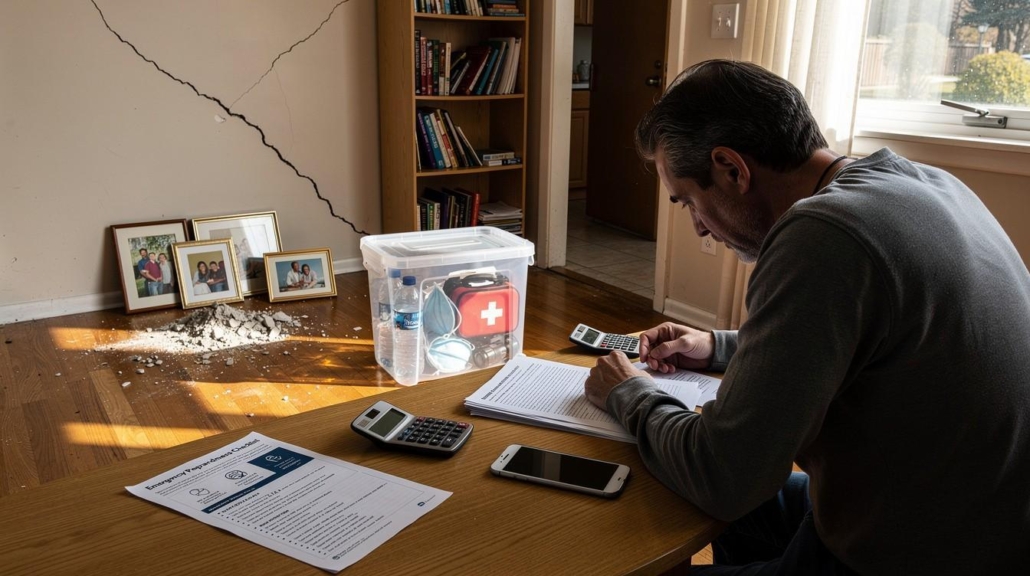
Washington Earthquake Coverage Homeowners: Guard Your Family Home
Washington earthquake coverage for homeowners isn’t optional-it’s a financial necessity. Standard homeowners insurance policies exclude earthquake damage, leaving your home and possessions vulnerable when the ground shakes.
At Secord Agency – A Trucordia Business, we help Washington homeowners understand what protection actually covers and how to build a policy that matches your home’s real risk. This guide walks you through everything you need to know.
Understanding Washington’s Earthquake Risk
Seismic Activity Patterns in Washington State
Washington sits on one of the most seismically active regions in North America. The Washington Geological Survey records over 1,000 earthquakes annually across the state. About a dozen of these shake hard enough for people to feel them. This isn’t theoretical risk-it’s happening right now.
The state faces three major earthquake scenarios that threaten homes and families. First, deep intraslab earthquakes like the Nisqually quake of February 28, 2001 near Olympia struck at magnitude 6.8 and caused between $500 million to $4 billion in damage. The Washington Geological Survey considers another deep intraslab event highly likely within the next 50 years.
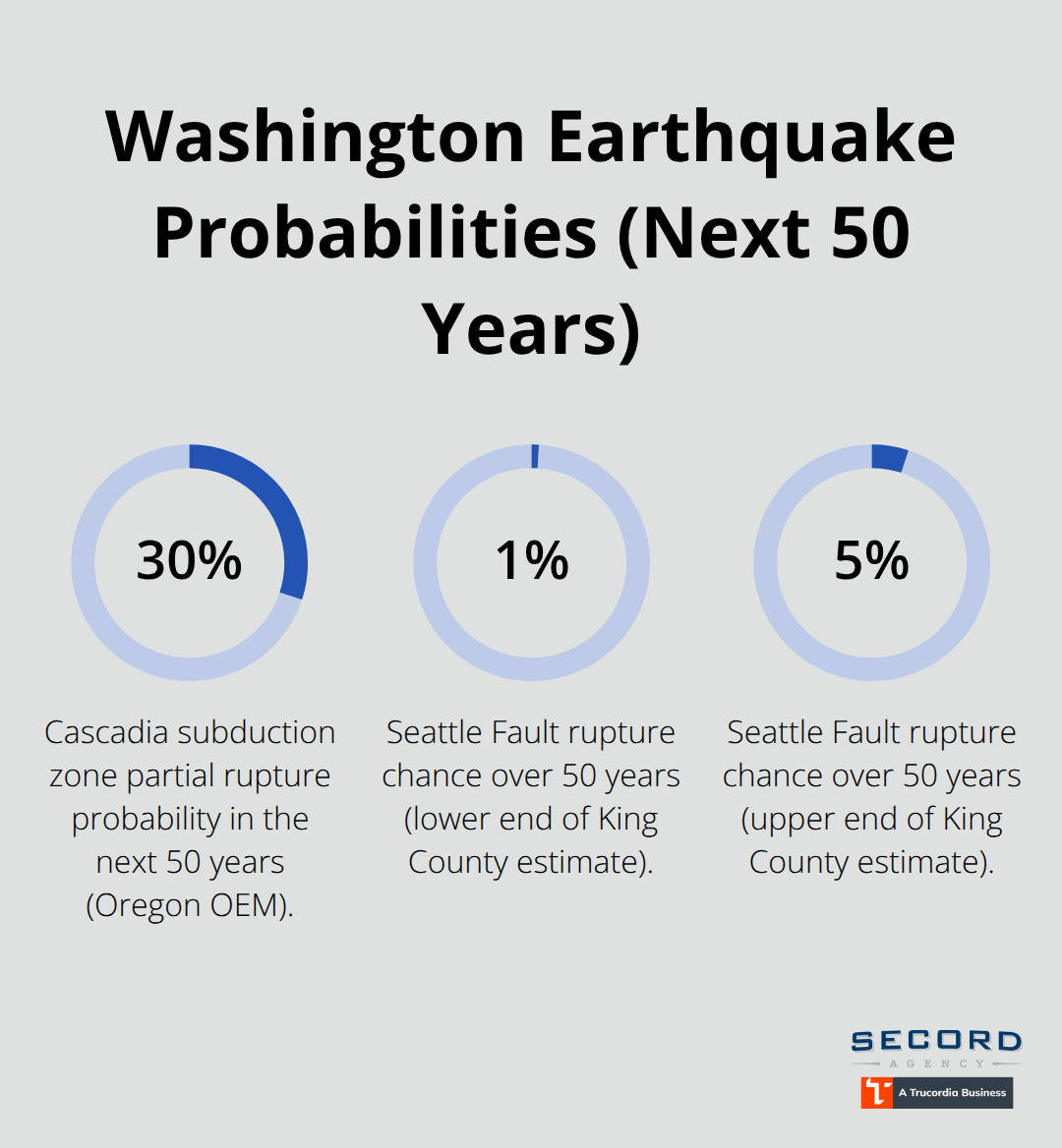
Second, the Cascadia subduction zone-the largest active fault in Washington-could produce a partial rupture around magnitude 8.0, with roughly a 30% probability in the next 50 years according to the Oregon Office of Emergency Management. Third, the Seattle Fault poses a smaller but still serious threat, with King County estimating a 1% to 5% chance of rupture in 50 years, potentially reaching magnitude 8.0.
How Location and Home Construction Affect Your Risk
Your home’s exposure depends heavily on where you live in Washington. Areas with softer soils face amplified shaking and liquefaction risk, particularly in the Seattle-Tacoma basins. Older homes built before 1980 are significantly more vulnerable to collapse. Unreinforced masonry buildings and mid-rise structures on soft ground face the highest danger. This means location and home construction matter when calculating your actual risk-not every Washington home faces identical threat levels.
Why Standard Insurance Leaves You Exposed
Standard homeowners insurance explicitly excludes earthquake damage, which shocks most people who file claims after seismic events. Your policy covers fire, theft, and weather-related destruction, but not ground movement. This gap exists because earthquake risk concentrates geographically and strikes unpredictably, making it impossible for insurers to price standard policies fairly.
You need separate earthquake coverage, either as a standalone policy or an endorsement added to your existing homeowners insurance. Many Washington homeowners skip this protection, assuming federal or state assistance will cover rebuilding costs. Federal assistance after major earthquakes is limited and often falls short of actual damage. This means you either carry earthquake insurance or you absorb potentially hundreds of thousands of dollars in losses yourself.
Understanding what earthquake coverage actually includes-and what it doesn’t-helps you make informed decisions about protecting your home and family.
What Earthquake Coverage Actually Protects
Structural Damage Coverage Forms Your Foundation
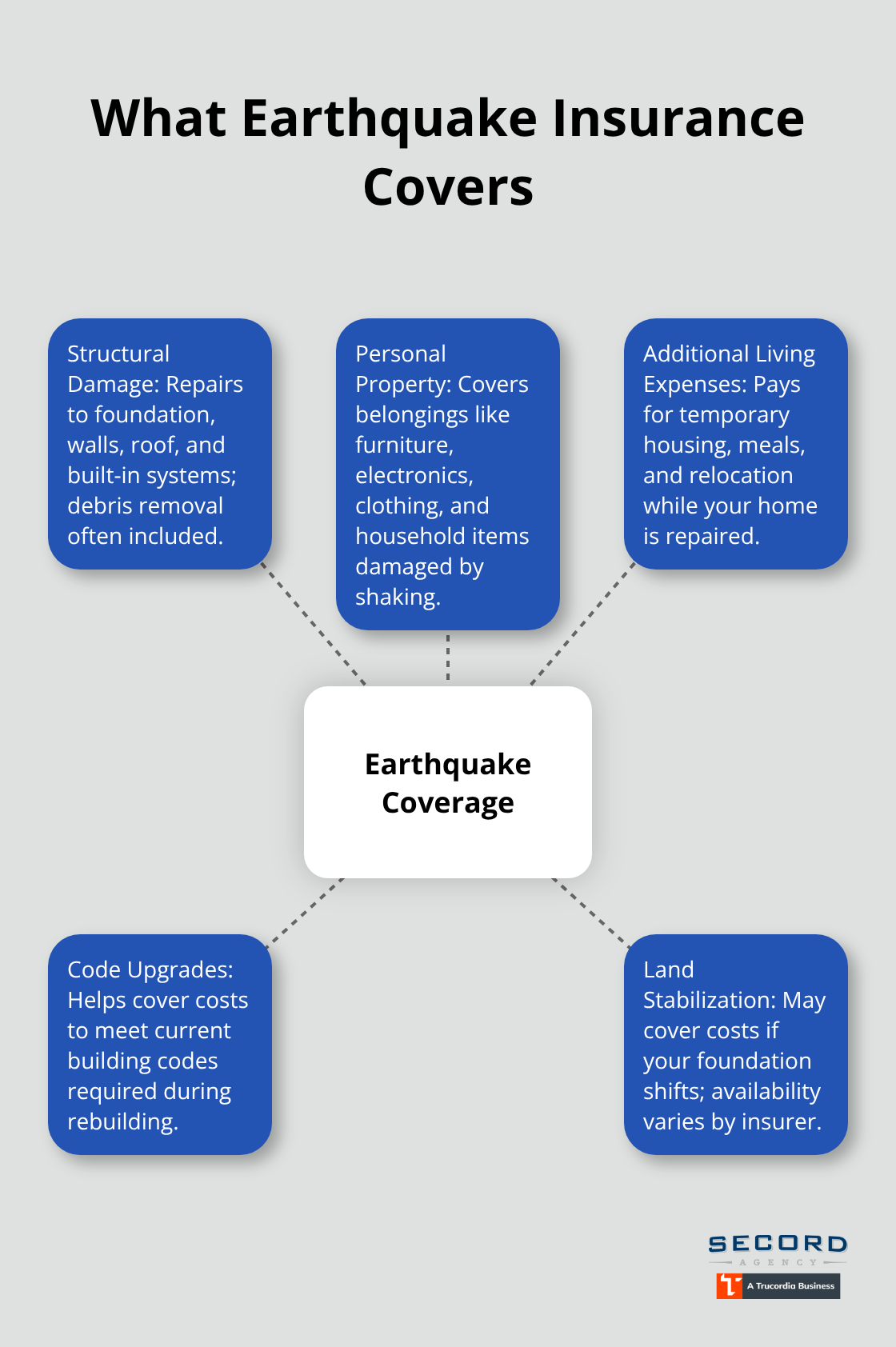
Earthquake insurance covers three major categories of loss that standard homeowners policies explicitly exclude. Structural repairs form the foundation of most policies, covering damage to your home’s foundation, walls, roof, and permanent fixtures like built-in cabinets or plumbing systems. If an earthquake cracks your foundation or collapses interior walls, your earthquake policy pays for repairs after you meet your deductible. The deductible typically ranges from 10% to 25% of your policy limit, meaning on a $500,000 home insured at $500,000, you could face a $50,000 to $125,000 out-of-pocket cost before coverage kicks in.
Understanding your deductible percentage matters far more than focusing on the premium alone.
Debris removal also falls under structural coverage, which becomes critical after serious quakes when clearing rubble can cost tens of thousands of dollars. This protection prevents you from absorbing massive cleanup expenses on top of repair bills.
Personal Property Protection Covers Your Belongings
Personal property protection covers your belongings inside the home-furniture, electronics, clothing, and household items. This protection extends to items damaged by earthquake shaking and structural collapse. If your television crashes during a quake or your kitchen cabinets collapse onto dishes and appliances, earthquake coverage reimburses replacement costs. This protection applies broadly to household contents, giving you financial recovery when possessions are destroyed.
Renters can obtain earthquake coverage too, protecting their belongings without needing landlord involvement. Landlords’ policies typically do not cover tenants’ possessions, leaving renters completely exposed unless they purchase separate earthquake protection.
Additional Living Expenses Keep You Stable During Repairs
Additional living expenses cover temporary housing, meals, and other costs if your home becomes uninhabitable during repairs. This coverage pays for hotel stays, restaurant meals, and relocation expenses while your home is being repaired. For Washington homeowners facing weeks or months of repairs after a major earthquake, this protection prevents you from draining savings on emergency housing.
Some policies also cover code upgrade costs when rebuilding requires meeting current building codes, and land stabilization if your foundation shifts. These add-ons vary by insurer, so comparing policies reveals which carriers offer the protection you actually need.
Understanding Costs and Coverage Limits
The typical annual cost in the Pacific Northwest runs about $3 to $15 per $1,000 of coverage, varying by ZIP code, home age, size, and construction materials. This affordability makes earthquake insurance accessible for most Washington homeowners, yet many skip it to save money on premiums. Calculating realistic coverage limits based on actual replacement costs matters more than underinsuring to reduce your annual bill. When you underinsure, a major earthquake leaves you with significant out-of-pocket losses even after your policy pays its share.
Many insurers require a property inspection before coverage to verify bolts, bracing, and securing water heaters. This inspection protects both you and the insurer by identifying vulnerabilities that affect your home’s resilience. Comparing quotes from multiple carriers helps you find the right balance between premium cost and adequate protection. With coverage limits and deductibles locked in, you’re ready to assess which policy actually fits your home’s vulnerability and your financial situation.
How to Choose the Right Earthquake Policy
Assess Your Home’s Actual Vulnerability
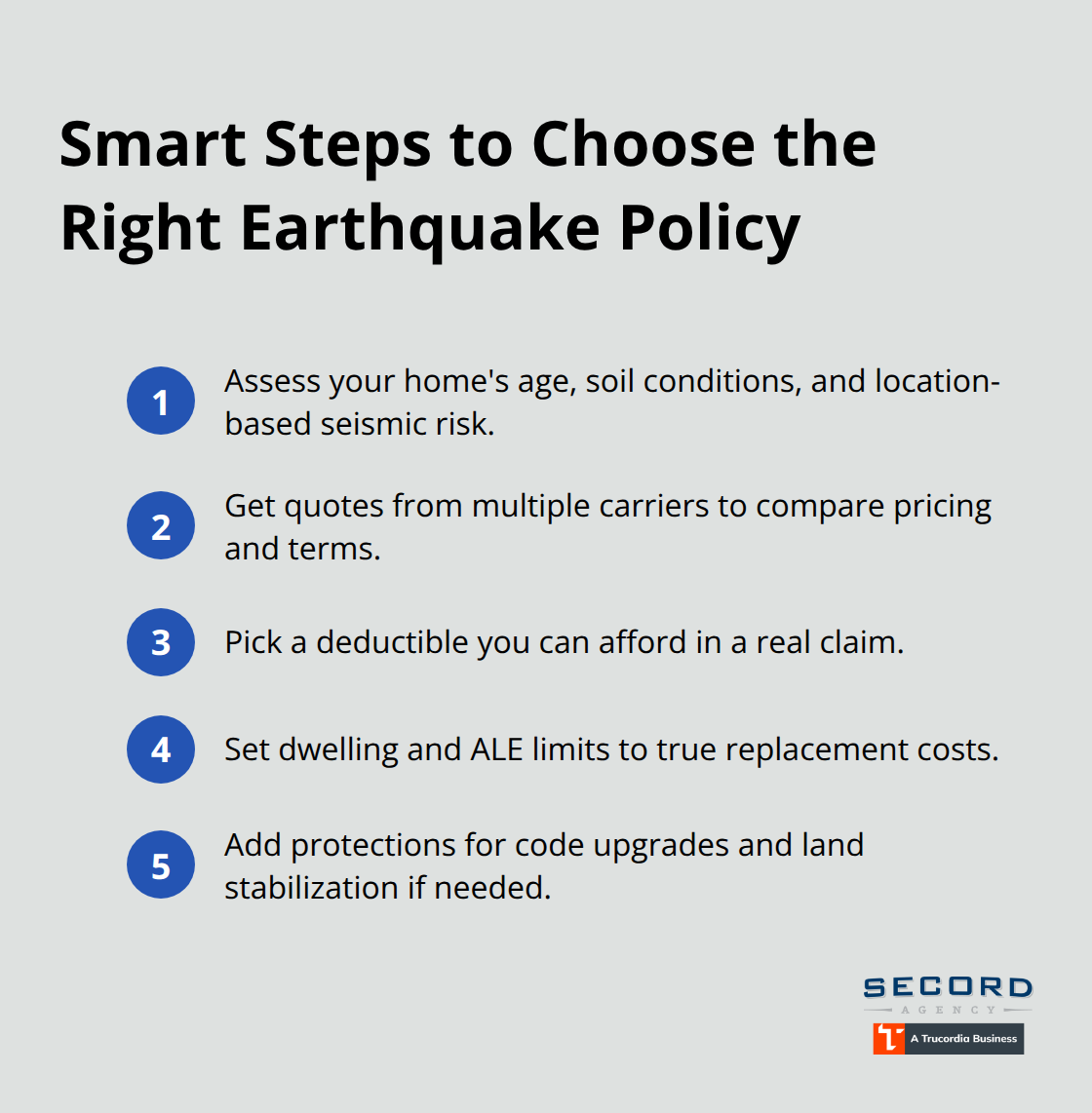
Start with your home’s earthquake vulnerability rather than assuming all Washington properties face identical risk. Homes built before 1980 lack modern seismic bracing and foundation anchoring, making them significantly more vulnerable. If your house sits in the Seattle-Tacoma basins or other areas with softer soils, liquefaction and amplified shaking become real concerns that justify higher coverage limits. A newer home on stable ground in a low-risk zone warrants different protection levels. Most insurers require property inspections to verify bolts, bracing, and water heater strapping before coverage approval. This inspection provides concrete data about your home’s actual resilience. Ask the inspector specifically about vulnerabilities that affect your deductible decision.
Compare Rates Across Multiple Carriers
Your ZIP code matters enormously because earthquake coverage in the Pacific Northwest typically ranges from $3 to $15 per $1,000 of coverage annually, with rates varying significantly by location, home age, size, and construction materials. A home in downtown Seattle costs substantially more to insure than an identical house 20 miles away. Request quotes from multiple carriers to see how dramatically rates swing based on these factors. Don’t fixate on the lowest premium alone; that policy might carry a 25 percent deductible that leaves you paying $125,000 out of pocket on a $500,000 home before coverage kicks in.
Choose Your Deductible Strategically
Deductible percentage matters far more than annual cost because it determines your actual financial exposure during a claim. A 10 percent deductible costs more annually but protects you better when damage strikes. Calculate what you could realistically pay out of pocket without devastating your finances, then work backward to find the deductible that matches your situation. This approach prevents you from facing catastrophic losses when earthquakes damage your home.
Set Coverage Limits Based on Replacement Cost
Coverage limits should reflect your home’s actual replacement cost, not its market value-these numbers diverge significantly. Many homeowners underinsure to save money on premiums, then face massive out-of-pocket losses when earthquakes damage their homes. A professional replacement cost estimate beats guessing. Additional living expenses coverage deserves serious consideration because after a major earthquake, temporary housing costs escalate quickly while your home undergoes weeks or months of repairs.
Address Coverage Gaps and Special Protections
Some policies cover code upgrade expenses when rebuilding requires meeting current building codes, which can add substantial costs if your older home needs seismic retrofitting during repairs. Ask carriers specifically whether they cover land stabilization if your foundation shifts, as this protection varies widely between policies. Discuss riders or separate coverage with insurers to address gaps-particularly for flood or landslide damage, which standard earthquake policies often exclude.
Final Thoughts
Washington earthquake coverage for homeowners protects your investment when standard policies leave you exposed. Over 1,000 earthquakes strike Washington annually, and the 2001 Nisqually quake caused $500 million to $4 billion in damage-damage your homeowners policy won’t cover. Without earthquake insurance, a major seismic event forces you to pay $50,000 to $125,000 out of pocket just to meet your deductible before repairs start.
Three decisions determine whether your home stays protected. Assess your home’s actual vulnerability based on its age, location, and soil conditions rather than assuming generic risk applies everywhere in Washington. Compare quotes across multiple carriers because rates swing dramatically by ZIP code, ranging from $3 to $15 per $1,000 of coverage annually. Choose your deductible percentage strategically by calculating what you could realistically afford to pay without financial devastation.
We at Secord Agency – A Trucordia Business help Washington homeowners find tailored earthquake protection at competitive rates by shopping multiple carriers. Our local team provides personalized advice and ongoing policy reviews to keep your coverage aligned with your home’s real risk. Contact us today to secure the earthquake protection your family home actually needs.