Personal Umbrella Policy WA: Elevate Your Protection
Your homeowners and auto insurance policies have limits. When a lawsuit exceeds those limits, your personal assets face real risk.
A personal umbrella policy in WA fills those gaps with additional liability coverage, typically starting at $1 million. We at Secord Agency – A Trucordia Business help Washington residents understand exactly how much protection they actually need based on their situation.
What a Personal Umbrella Policy Actually Covers
A personal umbrella policy stacks additional liability coverage on top of your existing homeowners and auto insurance. When someone sues you for injuries or property damage and the claim exceeds what your standard policies will pay, your umbrella activates to cover the gap. In Washington, these policies typically start at $1 million in coverage and can extend to $5 million or higher, depending on your assets and risk exposure. The cost is remarkably low-roughly $383 per year for $1 million in coverage through most carriers, making it one of the cheapest forms of protection you can buy relative to what it shields.
Why Standard Policies Leave You Exposed
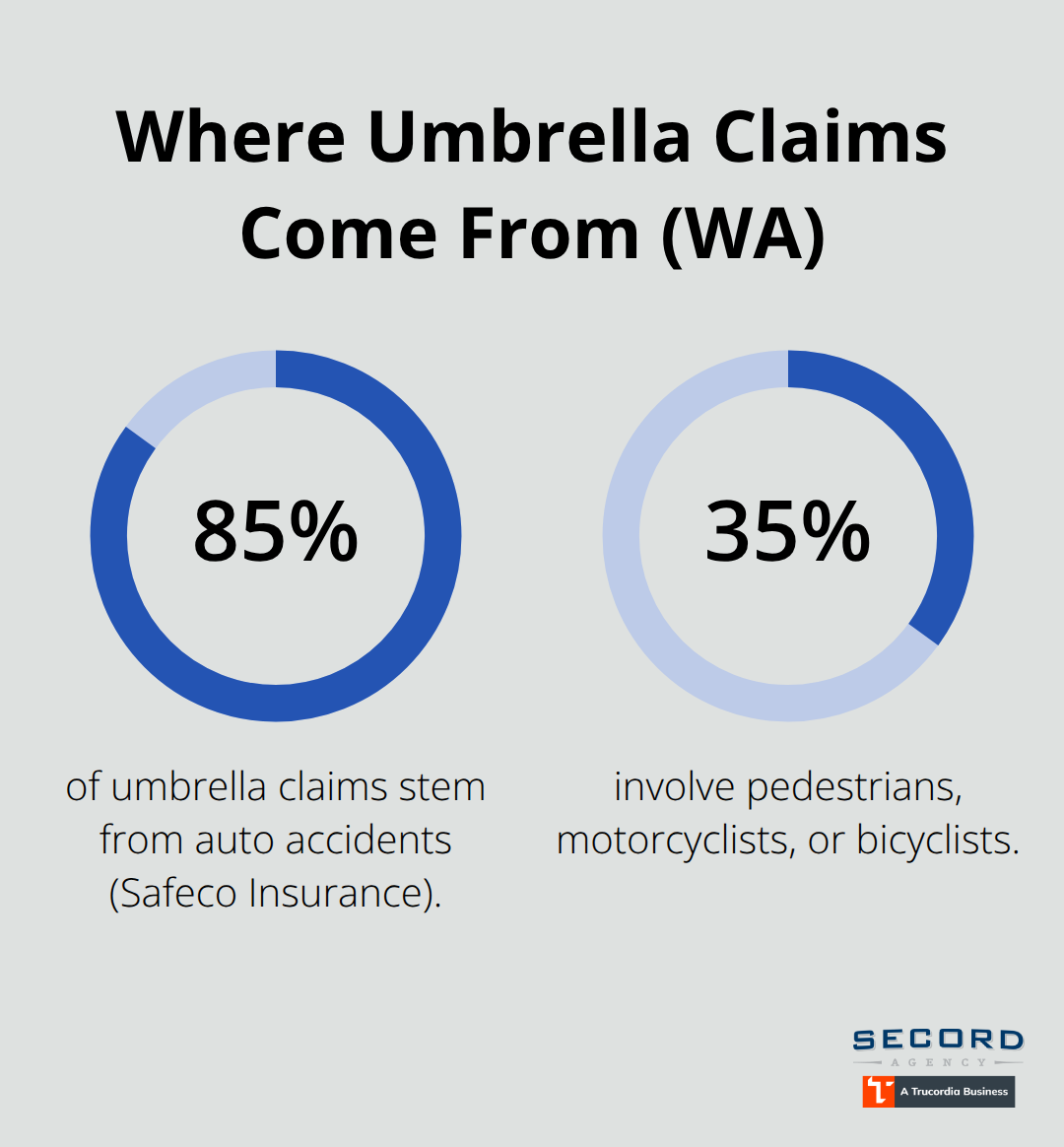
Most Washington homeowners carry auto liability limits of $250,000 per person and $500,000 per accident, paired with homeowners liability of around $300,000. A single serious accident involving a pedestrian or motorcyclist can generate medical bills, lost wages, and pain-and-suffering judgments that far exceed these limits. Real Washington verdicts from recent years illustrate the risk: a 2023 wrongful death case resulted in a $3.7 million judgment, a 2022 pedestrian injury case reached $1.85 million, and a 2021 birth injury case hit $6 million. Data from Safeco Insurance shows that roughly 85% of umbrella claims stem from auto accidents, with about 35% involving pedestrians, motorcyclists, or bicyclists. Without umbrella coverage, you personally pay anything above your policy limits-which means your savings, future earnings, and assets become targets in a judgment.
What Your Umbrella Actually Protects
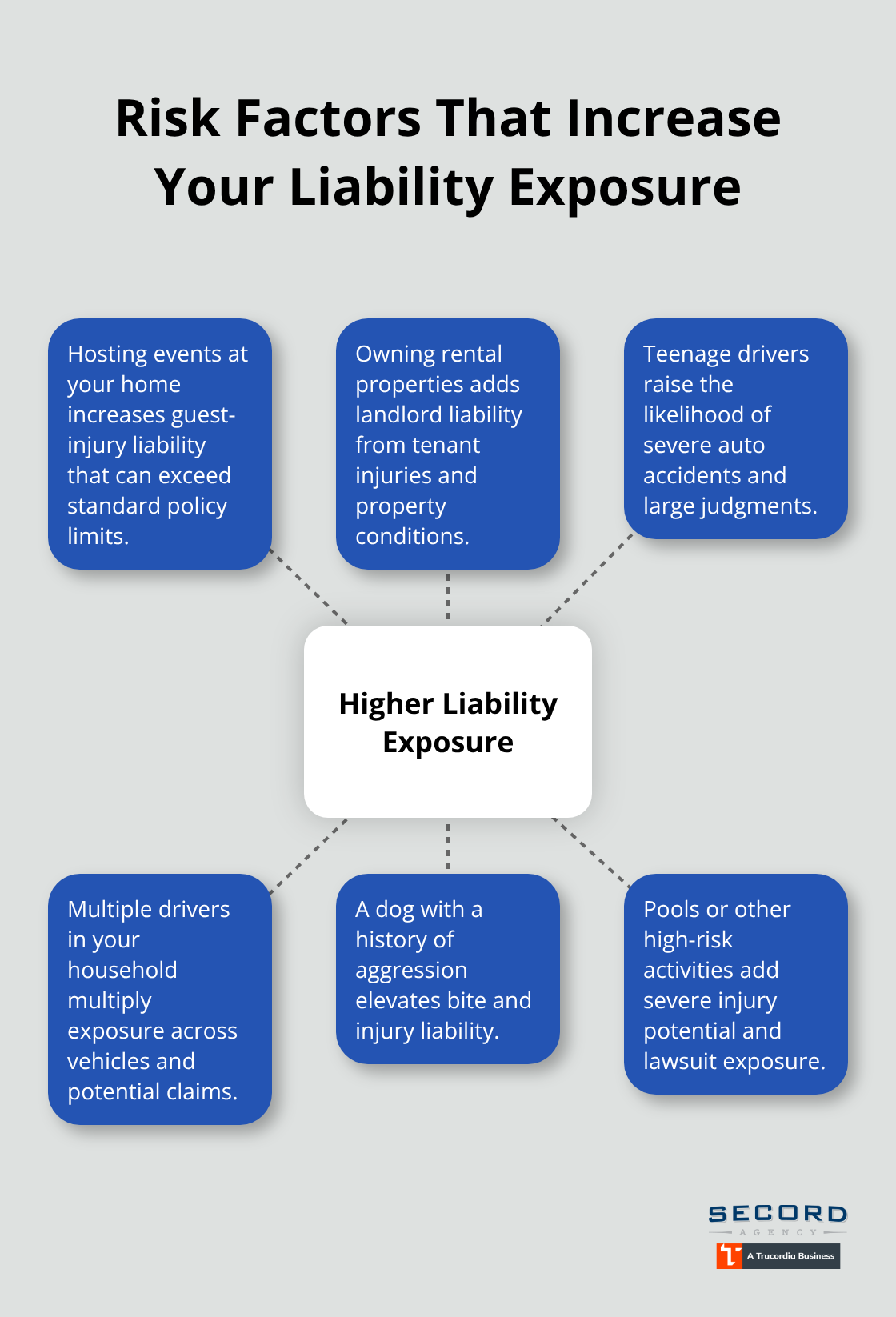
Umbrella coverage extends to injuries you cause, property damage you cause, defamation claims, false imprisonment, and legal defense costs. If you host events at your home, own rental property, or have teenage drivers, your exposure climbs significantly. The umbrella covers these situations across the United States and internationally, so protection travels with you. It also covers incidents your base policies might exclude or only partially cover. However, it does not cover damage to your own property, intentional acts, or business liabilities-those require separate business insurance.
Assessing Your Real Risk Exposure
Your net worth determines how much umbrella coverage you actually need. For residents with net worth above $500,000, the annual premium is so small compared to what you stand to lose that skipping umbrella coverage becomes financially reckless. Consider your lifestyle and assets: do you own rental properties, host frequent gatherings, or have multiple teenage drivers? Each factor increases your liability exposure and strengthens the case for adequate umbrella limits. An independent agent can review your specific situation and recommend coverage that aligns with your assets and risk profile.
Taking the Next Step
Understanding your current policy limits is the first move toward better protection. Pull your homeowners and auto declarations pages to confirm your existing liability limits, then calculate your total net worth (including your home, vehicles, savings, and investments). This information helps you determine whether a $1 million umbrella, $2 million, or higher limit makes sense for your circumstances. Once you know what you’re working with, you can explore quotes from multiple carriers to find competitive rates and coverage that fits your needs.
Coverage Gaps Your Homeowners and Auto Policies Leave Behind
What Your Standard Limits Actually Cover
Your homeowners policy likely caps liability at $300,000, and your auto policy probably maxes out around $250,000 per person and $500,000 per accident. These numbers sound substantial until you face a real claim. A pedestrian struck by your vehicle who requires years of medical care, lost wages, and pain-and-suffering compensation can easily generate a $1 million judgment. Washington verdicts prove this regularly: specific cases like a 2022 pedestrian injury judgment of $1.85 million demonstrate how quickly liability exposure exceeds standard policy limits.
Where Your Coverage Stops
Your homeowners and auto policies stop paying once they hit their limits, and anything above that comes straight from your personal assets. Safeco Insurance data shows that roughly 85% of umbrella claims stem from auto accidents, with about 35% involving pedestrians, motorcyclists, or bicyclists-the exact scenarios that generate the largest judgments. A single serious accident involving vulnerable road users can wipe out your standard coverage in minutes.
Hidden Exclusions in Your Current Policies
Standard policies contain gaps that most people never notice until they need coverage. Your homeowners policy excludes certain liability exposures like rental property you own, and your auto policy won’t cover defamation claims or false imprisonment allegations. Legal defense costs compound the problem: your insurer pays attorneys and court expenses until your policy limit exhausts, then stops. A $750,000 claim might consume $200,000 in legal fees before paying a single dollar toward damages, leaving your base coverage depleted faster than you’d expect.
Exposures That Amplify Your Risk
If you host events at your home, own rental properties, or have teenage drivers, your actual exposure climbs significantly beyond what your standard policies address. Each of these situations creates liability scenarios that standard homeowners and auto coverage either excludes or only partially covers. The gap between what you think you’re protected for and what you actually are protected for grows wider with every additional risk factor you carry.
An independent agent can pull your current declarations and show you exactly where your coverage ends and your personal liability begins-a conversation that typically costs nothing and often reveals exposures you didn’t know existed. Understanding these gaps sets the stage for determining how much umbrella protection actually makes sense for your specific situation.
How Much Umbrella Coverage Do You Actually Need
Calculate Coverage Based on Your Net Worth
Start with your net worth, not your gut feeling. Your total assets-home value, vehicles, savings, investments, retirement accounts-determine your real exposure in a lawsuit. If your net worth sits between $500,000 and $1 million, a $1 million umbrella provides solid protection; for net worth above $2 million, most financial advisors recommend moving to $3 million to shield future earnings that could face garnishment. The math is straightforward: a $1 million umbrella costs roughly $150 to $300 per year in Washington, while upgrading to $2 million adds only modest additional cost. That annual investment protects vastly more wealth than it costs.
Washington Medical Malpractice Annual Report data showed average settlements around $3.6 million, illustrating why underestimating your coverage needs creates genuine financial danger. A single serious judgment can exceed your standard policy limits within hours.
Account for Your Lifestyle and Exposures
Your lifestyle multiplies this calculation. Teenage drivers in your household, rental properties you own, frequent home gatherings, or even a dog with a history of aggression all elevate your liability exposure beyond what standard policies address. A single incident involving a guest injured at your home or a tenant suing over a property condition can produce claims that dwarf your homeowners liability limit.
Data from Safeco Insurance confirms that roughly 85% of umbrella claims stem from auto accidents, with about 35% involving pedestrians, motorcyclists, or bicyclists-the exact scenarios producing six and seven-figure judgments. If you host events, own rental units, or have multiple drivers under your roof, your exposure justifies moving from $1 million to $2 million in coverage.
Work with an Independent Agent to Align Your Coverage
An independent agent transforms this from abstract math into actionable strategy. Pull your homeowners and auto declarations pages to confirm your current liability limits, then list your specific exposures: rental properties, events you host, teenage drivers, pools, or high-risk activities. An independent agent can review these factors against your net worth and recommend coverage that actually fits your situation rather than a generic one-size-fits-all limit.
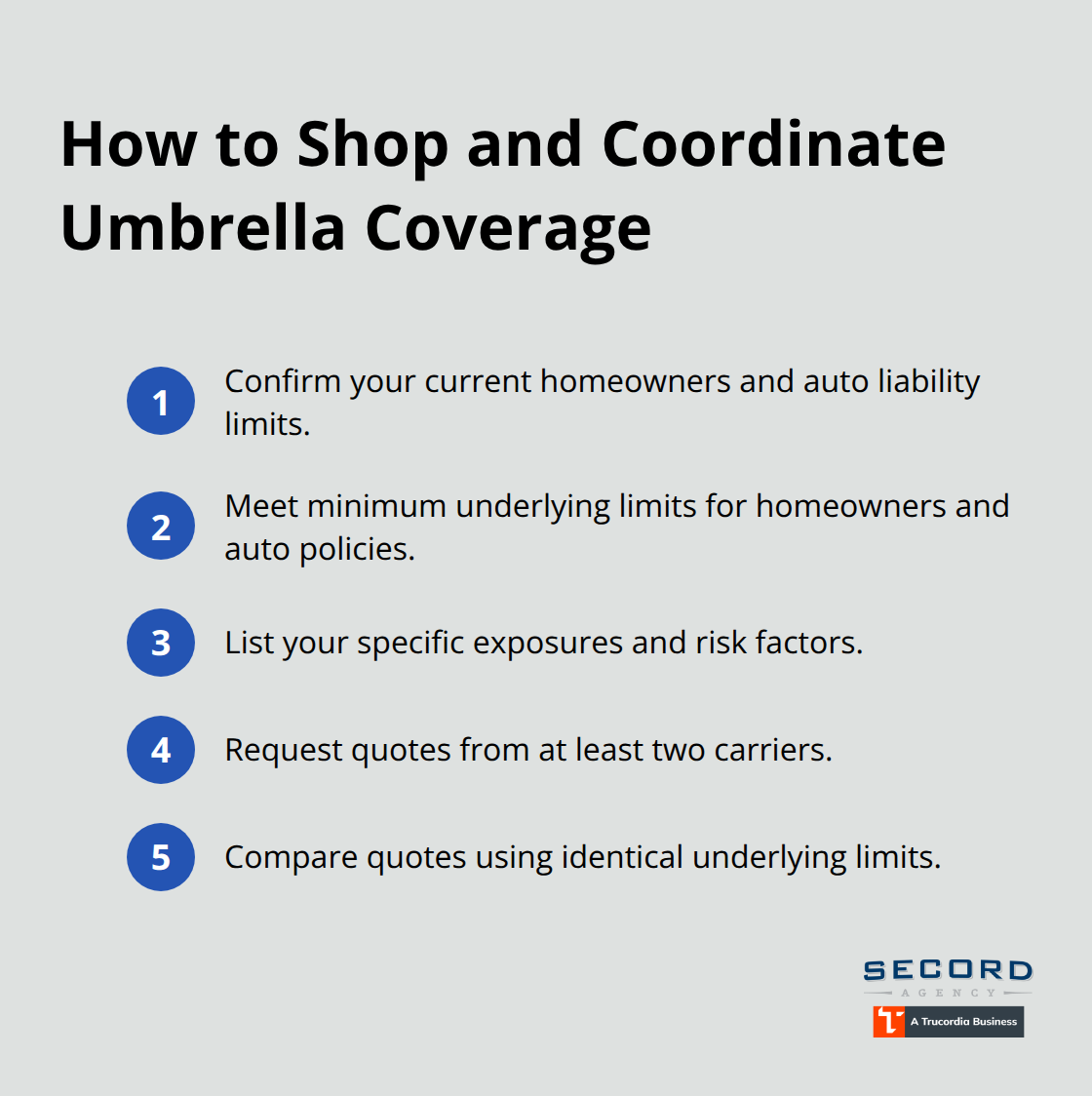
Most Washington insurers require minimum underlying limits of about $300,000 on homeowners liability and $250,000 per person for auto bodily injury before they issue umbrella coverage. Misaligned limits create coverage gaps that defeat the purpose of having umbrella protection at all.
Compare Quotes from Multiple Carriers
Request quotes from at least two carriers using the same underlying limits so you can compare apples to apples. Most quotes take minutes to gather and cost nothing, yet the difference between adequate and inadequate coverage could mean the difference between protecting your financial future and losing it to a single judgment. An independent agency can shop multiple carriers on your behalf, saving you time while identifying competitive rates and proper coordination between your umbrella and underlying policies.
Final Thoughts
A personal umbrella policy in WA provides the financial protection that standard homeowners and auto insurance simply cannot deliver. Washington residents face real liability exposure from everyday situations-a pedestrian struck by your vehicle, a guest injured at your home, or a tenant suing over property conditions. The verdicts prove it: $3.7 million for wrongful death, $1.85 million for pedestrian injury, $6 million for birth injury.
The math makes umbrella coverage impossible to ignore. A $1 million policy costs roughly $383 per year in Washington-less than $1 per day for protection that shields hundreds of thousands of dollars in assets. Upgrading to $2 million adds only about $75 annually, while your standard policies max out far below the judgments courts regularly award.
Start by pulling your homeowners and auto declarations pages right now and write down your current liability limits. Calculate your net worth including your home, vehicles, savings, and investments, then identify your specific exposures like rental properties, teenage drivers, or frequent events at your home. Contact Secord Agency to shop quotes from multiple carriers and receive a personalized coverage assessment that costs nothing.