
Renters condo coverage WA: Is Your Policy Ready for The Next Move?
Most renters and condo owners in Washington think their coverage is solid until they file a claim. That’s when gaps appear-and they’re expensive.
At Secord Agency – A Trucordia Business, we’ve seen policies that look complete on paper but leave owners vulnerable. This guide walks you through what renters condo coverage WA actually includes, what it misses, and how to fix it before you need it.
What’s Actually Covered When You Rent or Own a Condo in Washington
How Renters Insurance and Condo Policies Differ
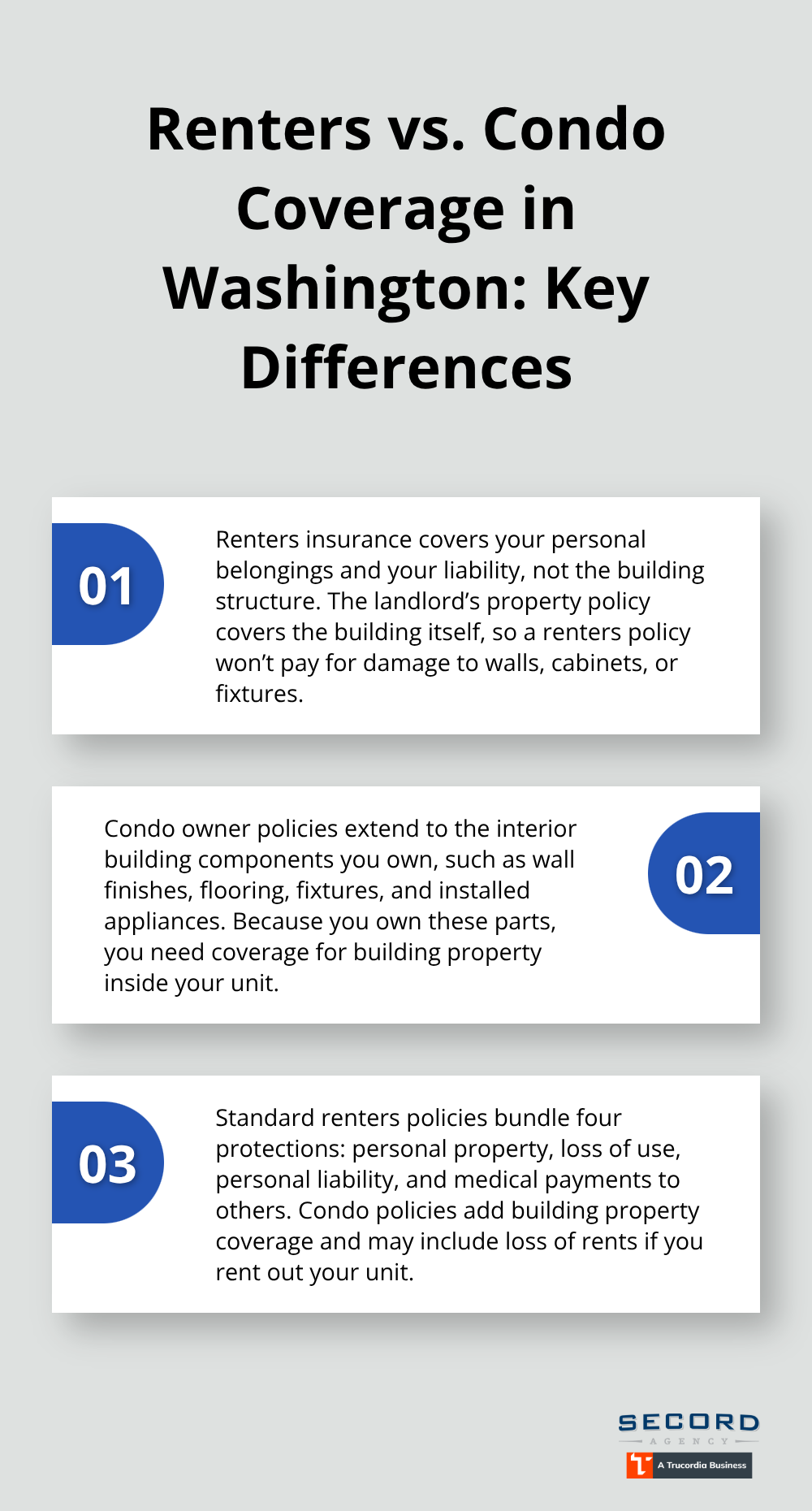
Renters insurance and condo owner policies protect fundamentally different things, and Washington renters often confuse them. Renters insurance covers your personal belongings and your liability if someone gets hurt in your rental unit. It does not cover the building structure-that’s the landlord’s responsibility through their property policy. A condo owner policy works differently because you own the interior of your unit, so your policy covers the building components you’re responsible for: wall finishes, floor coverings, fixtures, and appliances you’ve installed. According to the Washington State Office of Insurance Commissioner, standard renters policies typically include four major coverages: personal property (your belongings), loss of use (temporary housing costs if you can’t stay there), personal liability (protection if you injure someone or damage their property), and medical payments to others (covering injuries to guests in your home). Condo owner policies add building property coverage for the structure itself, plus loss of rents coverage if you rent out your unit and it becomes uninhabitable. The distinction matters because a renters policy won’t reimburse you for damage to the unit’s walls or cabinets, while a condo policy won’t cover a tenant’s personal belongings-that’s why tenants need their own renters insurance.
Personal Property Coverage: What You Actually Get Back
Personal property coverage forms the foundation of renters policies, but it has strict limits that catch many owners off guard. Standard coverage pays actual cash value, meaning your five-year-old television is worth far less than you paid for it, not replacement cost. High-value items like engagement rings, cameras, or collectibles typically hit coverage caps-often $2,500 or less for jewelry alone. To protect these items, the Washington State Office of Insurance Commissioner recommends adding a scheduled personal property endorsement, which insures specific items at their replacement value without depreciation. This approach costs more upfront but prevents heartbreak when you file a claim.
Liability Coverage and Water Damage Exclusions
Liability coverage protects you when someone is injured at your place or you accidentally damage their property; standard coverage runs around $100,000, though many renters underestimate how quickly medical bills and legal fees can exceed that. Water damage from sudden incidents like burst pipes is covered, but flood damage and earthquake damage are excluded from standard policies. In Washington, where seismic risk is real, earthquake coverage is available as an add-on but requires a separate premium and typically includes a higher deductible. Moving to a newer building with enhanced security features can actually lower your premium because theft risk decreases, so your address and building type directly affect what you pay. These gaps in coverage-especially water and earthquake protection-become critical when you’re preparing to move or reassess your current protection level.
What Renters and Condo Owners Actually Leave Unprotected
Water Damage and Flood Coverage Gaps
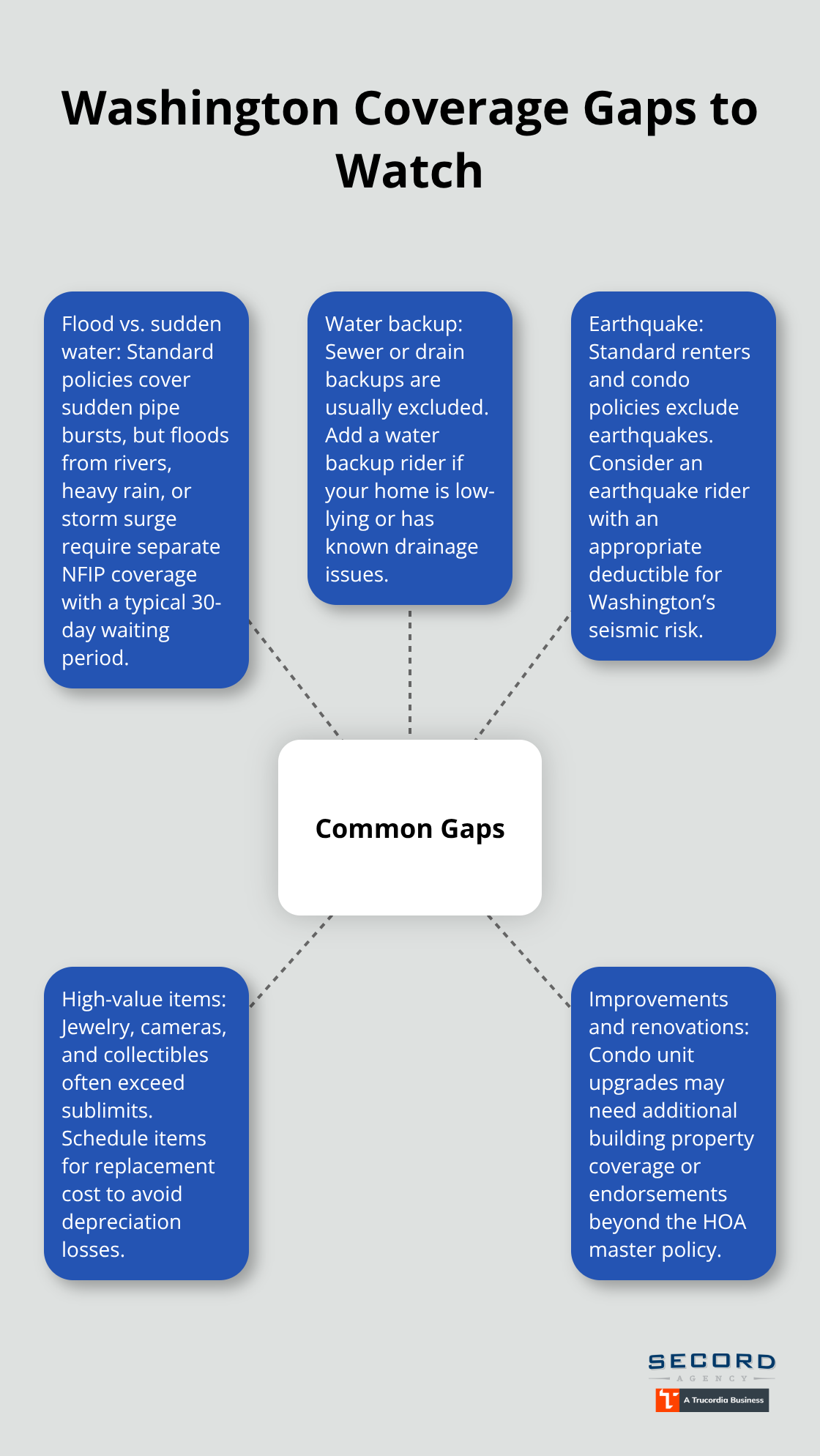
Water and earthquake damage represent the biggest blind spots in Washington renters and condo policies, and most owners don’t realize these gaps exist until water seeps into their apartment or the ground shakes. Standard renters policies cover sudden water damage from burst pipes or appliance failures, but they explicitly exclude flood damage, which the National Flood Insurance Program defines as water overflowing from natural sources like rivers, heavy rain, or storm surge. If you live in a flood zone or near a creek, you need separate flood coverage through NFIP, though expect a 30-day waiting period before it becomes effective-waiting until after you’ve signed a lease is too late. The Washington State Office of Insurance Commissioner notes that water backup from sewer or drain failures also falls outside standard coverage, so you may need to add water backup coverage as a rider if your rental sits in a low-lying area or has experienced drainage issues.
Earthquake Risk in Washington
Earthquake coverage is similarly absent from standard policies, yet Washington’s Cascade Subduction Zone poses genuine seismic risk. According to the Washington State Office of Insurance Commissioner, earthquakes and volcanic explosions are typically excluded, but you can add earthquake coverage as a rider for an additional premium and a higher deductible. Condo owners in particular should verify whether their HOA master policy covers earthquake damage to the building structure, because if it doesn’t, you’re responsible for repairs to shared areas. Progressive reports that for 2025, Washington renters policies average about $15.06 per month, but adding earthquake coverage typically increases that by 15 to 25 percent depending on your location and deductible choice.
High-Value Items and Depreciation Problems
High-value items create a second major gap because standard personal property coverage pays actual cash value, which means depreciation eats the payout. Your jewelry, cameras, collectibles, and electronics all hit per-item limits that usually max out around $2,500 for jewelry alone, far below what you actually own. The Washington State Office of Insurance Commissioner recommends using a scheduled personal property endorsement to list and insure specific items at their replacement cost without depreciation. This approach requires an appraisal or receipt for each item, which sounds tedious but prevents sticker shock when you file a claim and discover your engagement ring is worth $8,000 but your policy covers only $2,500. Liberty Mutual offers blanket jewelry coverage that protects high-value pieces without requiring individual appraisals, a practical option if you own multiple valuable items.
Coverage for Built-In Improvements and Renovations
Condo owners should also confirm whether built-in improvements, renovated kitchens, or custom finishes are covered under their building property coverage or whether they need additional riders. When you move, reassess your belongings and update coverage limits because your new apartment may have different security features, theft risk, or exposure to water damage that changes what you need to protect. These gaps in coverage-especially water, earthquake, and high-value item protection-become critical when you’re preparing to move or reassess your current protection level, which is why comparing your current policy against your actual belongings and local risks matters before you sign a new lease.
How to Fix Coverage Gaps Before Moving
Catalog Your Actual Belongings, Not Your Assumptions
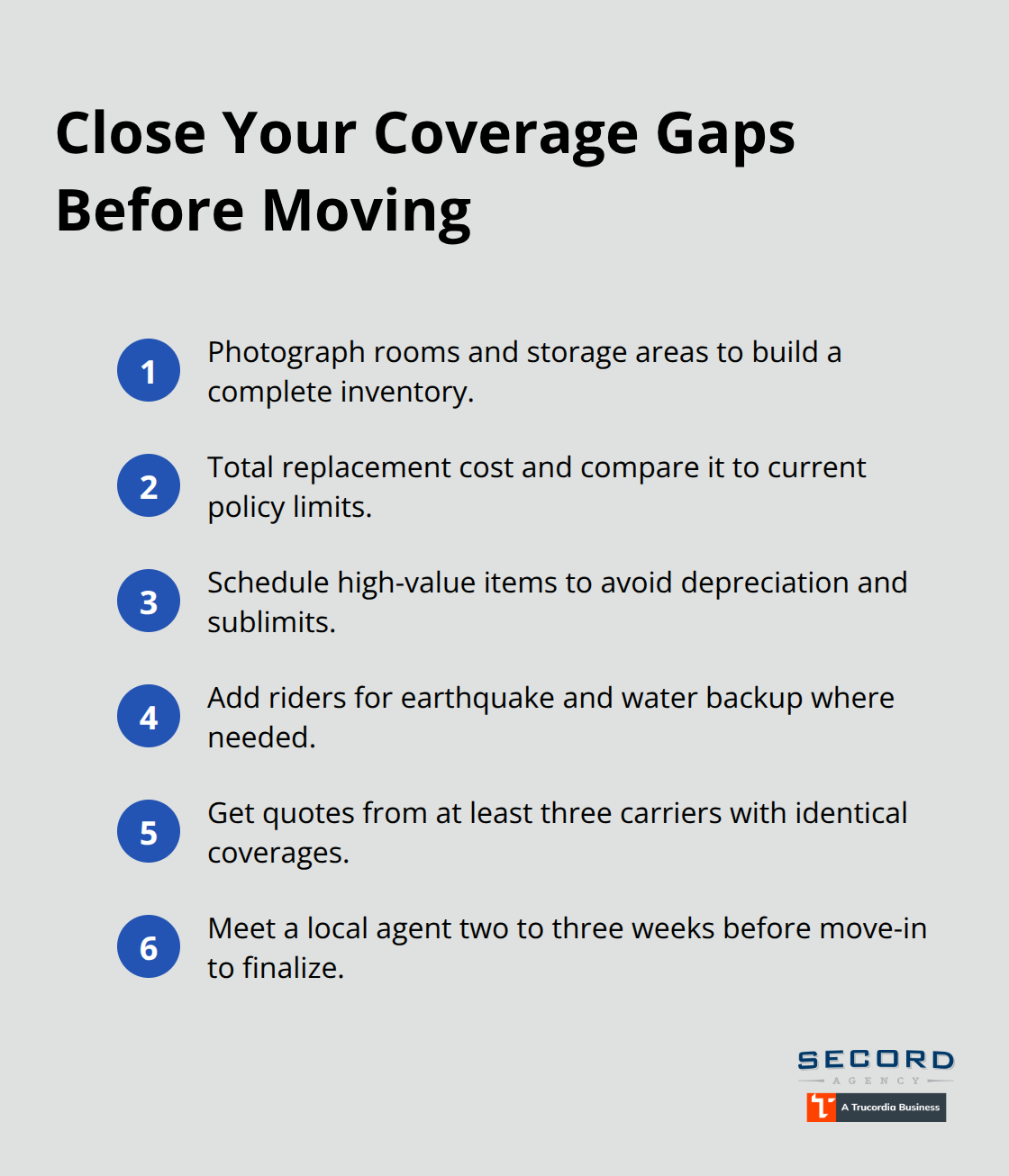
Start with what you actually own, not what you think you own. Most renters and condo owners in Washington vastly underestimate their personal property value until they sit down and catalog everything. Pull out your phone and photograph each room, including closets, drawers, and storage areas. Open cabinets and take video walkthroughs so you capture appliances, electronics, furniture, and clothing.
Use this inventory to total your belongings-most people discover they own $18,000 to $25,000 worth of stuff, well above the $15,000 baseline many assume covers them. Once you have real numbers, compare your current policy limits against actual replacement cost. If your policy caps personal property at $20,000 but your inventory shows $24,000, you’re underinsured and will absorb the difference in a claim.
Protect High-Value Items with Scheduled Endorsements
Scheduled personal property endorsements become essential when you own valuable items. List your highest-value items separately-engagement rings, cameras, collectibles, electronics-and insure them at replacement cost rather than actual cash value. An appraisal costs $100 to $300 per item but prevents thousands in depreciation losses when you file a claim.
Liberty Mutual offers blanket jewelry coverage that protects high-value pieces without requiring individual appraisals, a practical option if you own multiple valuable items. This approach eliminates the per-item limits (typically $2,500 for jewelry) that standard policies impose and ensures you recover full value in a loss.
Compare Quotes Across Multiple Carriers
Get quotes from at least three different carriers before renewing or moving to a new address. Progressive, Liberty Mutual, and State Farm each price risk differently based on location, building security, and claims history. A newer apartment with gated access and alarm systems may cost 10 to 15 percent less than an older building in the same neighborhood because theft risk drops.
Request quotes that include earthquake coverage and water backup coverage as riders so you see the true cost of closing gaps. Don’t just compare monthly premiums-compare what’s actually covered at each price point. One carrier’s $12 monthly policy might exclude water damage while another’s $15 policy includes it.
Work with a Local Agent Before Your Move
When you find a policy that matches your actual needs, contact a local independent agent who can review your inventory, confirm coverage limits, and adjust endorsements before you move. Local agents in Washington understand regional risks like seismic activity and can recommend earthquake coverage deductibles that make sense for your situation, something online quotes often gloss over.
Secord Agency, a Trucordia business based in Seattle’s Wallingford neighborhood, shops multiple carriers to deliver tailored coverage and pairs competitive rates with fast, local service. Set this review for two to three weeks before your move-in date so coverage activates on day one without gaps.
Final Thoughts
Coverage gaps cost money when you file a claim, and most renters and condo owners in Washington discover these gaps too late. You now understand that renters condo coverage WA requires more than a basic policy-it demands an honest inventory of what you own, a realistic assessment of local risks like earthquakes and floods, and protection for high-value items that standard limits won’t cover. The difference between adequate coverage and underinsurance often comes down to decisions you make before moving, not after a loss occurs.
Start this week by photographing your belongings and totaling the replacement cost, then pull your current policy to compare what you actually own against what’s covered. If you find gaps-and most renters and condo owners do-add scheduled endorsements for high-value items and riders for earthquake or water backup coverage. Get quotes from multiple carriers so you see how location, building security, and coverage choices affect your premium, since a newer apartment with gated access might cost 10 percent less than an older building.
The final step most people skip is working with a local agent who understands Washington’s specific risks and can review your coverage before your move-in date. We at Secord Agency – A Trucordia Business shop multiple carriers to deliver tailored coverage that matches your actual needs, not a one-size-fits-all template. Contact us two to three weeks before you move so your protection activates on day one without gaps.