Low Premium Auto WA: Getting More Coverage for Less
Auto insurance in Washington doesn’t have to drain your budget. Finding low premium auto WA coverage that actually protects you is possible when you know where to look and what to ask for.
We at Secord Agency – A Trucordia Business help drivers cut costs without sacrificing protection. This guide shows you exactly how.
Finding the Right Coverage at the Right Price
Shopping for auto insurance quotes across multiple carriers isn’t optional if you want low premiums in Washington-it’s the foundation of smart insurance buying. According to the National Association of Insurance Commissioners, drivers who compare just three quotes save an average of $470 annually compared to those who accept their first offer. Most insurers take 5-10 minutes per quote online, so spending 30 minutes comparing three to five carriers directly impacts your wallet. Progressive, State Farm, GEICO, and Allstate dominate Washington’s market, but regional carriers and smaller players often undercut them for specific driver profiles. A 35-year-old with a clean driving record might find the best rate at one carrier, while a 25-year-old with one accident finds better pricing elsewhere. Don’t assume your current insurer remains competitive-rate changes happen annually, and loyalty rarely rewards you with the lowest premium.
Bundling delivers bigger savings than individual discounts
Bundling auto insurance with home or renters coverage can save you 10% to 25%, which matters more than chasing individual discounts because bundling changes your base rate, not just applies a percentage reduction. A driver paying $1,200 annually for auto insurance might drop to $900-1,020 with bundling, while individual discounts like safe driver or paperless billing usually save $50-150 combined. Review your home and renters policies when comparing auto quotes-if your homeowners insurance isn’t competitive, switching everything to one carrier for bundling might still cost less overall than keeping separate policies.
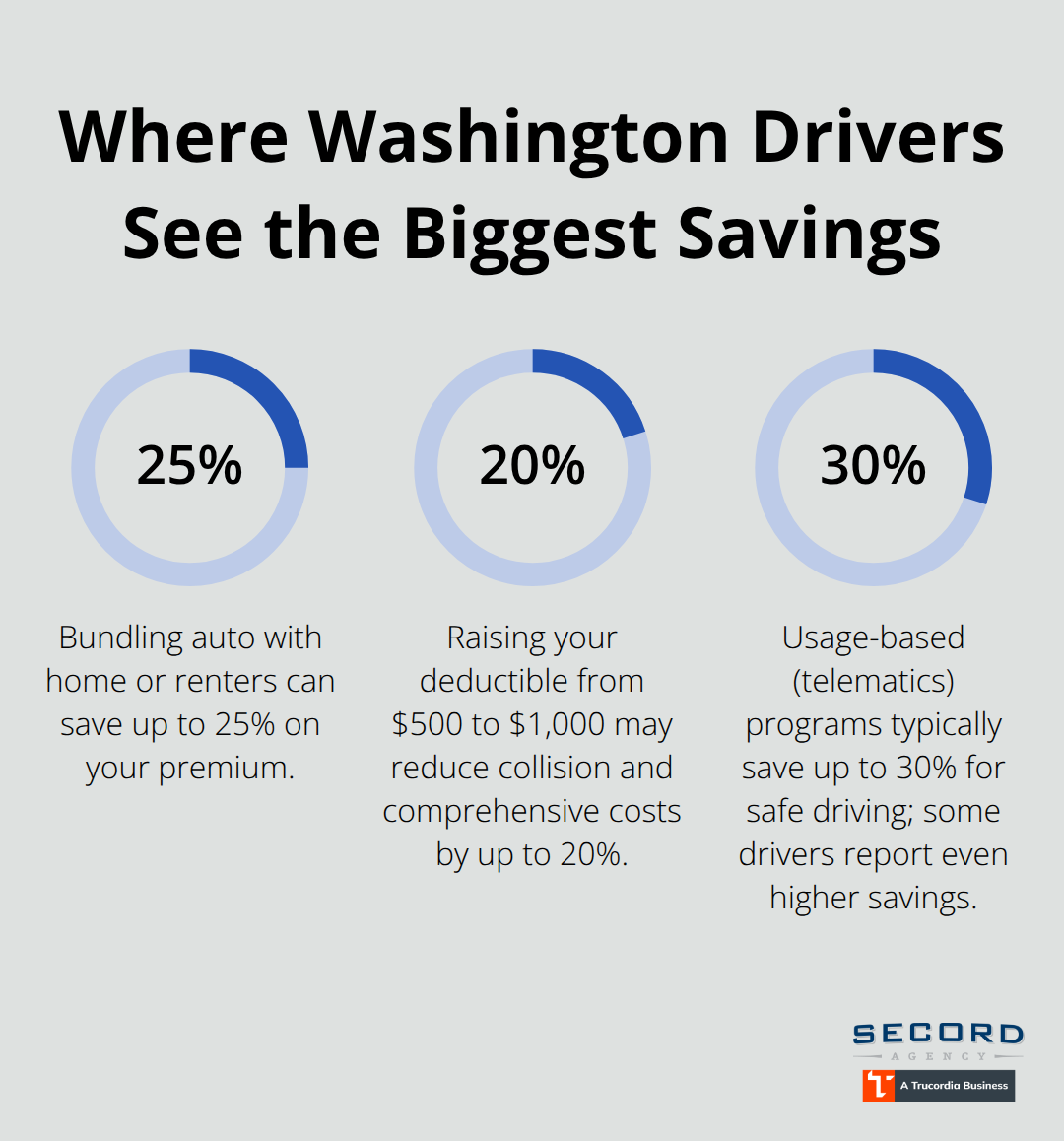
An independent agent can evaluate whether bundling makes financial sense or if splitting policies to different carriers actually delivers better rates.
Coverage limits require annual attention
Washington state mandates minimum liability coverage of 25/50/25, meaning $25,000 bodily injury per person, $50,000 per accident, and $25,000 property damage. These minimums are dangerously low-a single serious injury claim easily exceeds $25,000, and you’d be personally liable for the difference. Most financial advisors recommend 100/300/100 coverage as a baseline, which typically costs only $100-150 more annually than state minimums. If you own significant assets, jumping to 250/500/250 or adding an umbrella policy protects you far better than accepting bare-minimum coverage to save $50 per year. Review your limits every two years, especially after major life changes like home purchases or income increases, because your coverage needs shift over time.
What happens when you skip the review process
Drivers who ignore policy reviews often miss rate drops or fail to adjust coverage after life changes. A policy that made sense five years ago might leave you overinsured in some areas and underinsured in others. Rate shopping every 1-2 years typically uncovers $200-400 in annual savings that most drivers never claim. Your next step involves identifying which specific discounts apply to your situation and understanding how your driving habits affect your premium.
Cut Your Premium Without Cutting Coverage
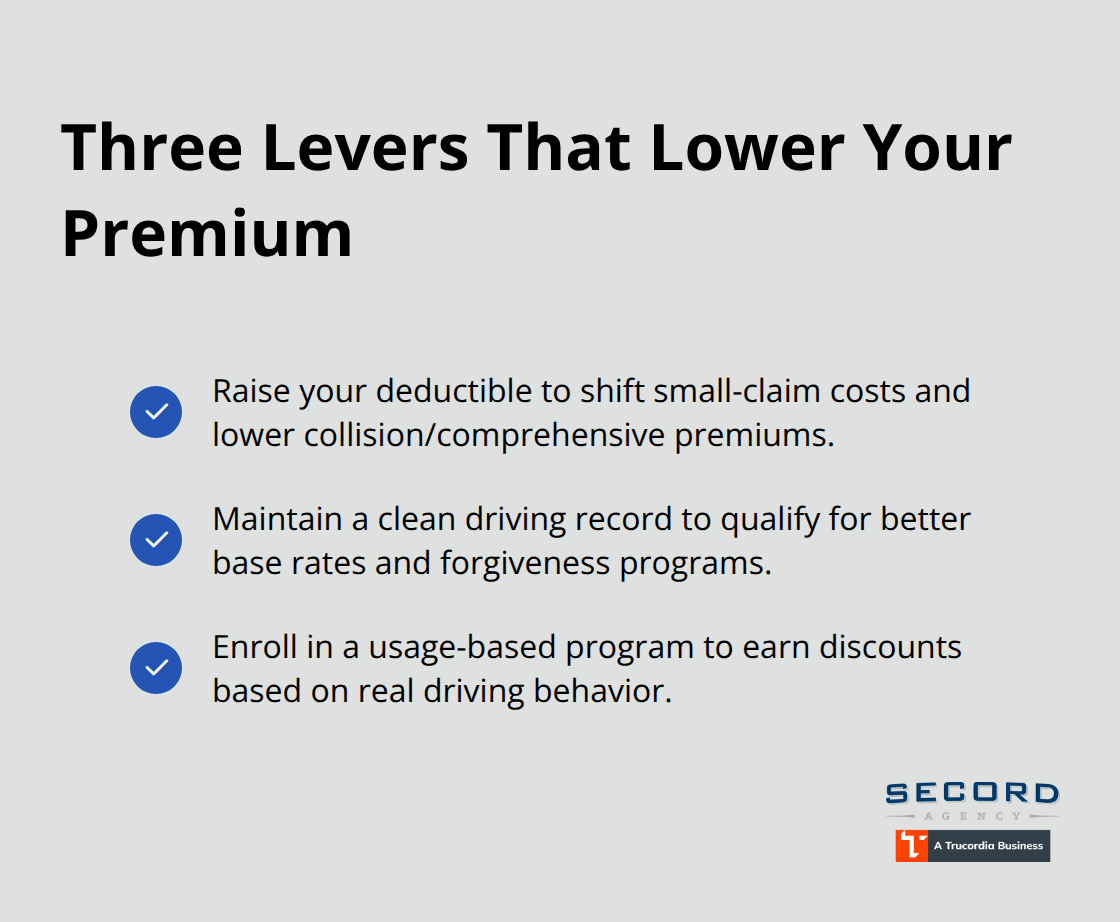
Reducing your auto insurance cost requires strategy, not just shopping around. Three levers directly lower what you pay: raising your deductible, maintaining a clean driving record, and adopting usage-based insurance programs that track your actual driving behavior. Each works differently, and understanding which combination fits your situation determines whether you save $200 or $800 annually.
Your deductible is your biggest cost control lever
Increasing your deductible from $500 to $1,000 may reduce your collision and comprehensive premiums by 10 to 20 percent. A driver paying $1,200 annually might drop to $900–1,020 simply by accepting a higher deductible. You tell your insurer you’ll absorb smaller repair costs yourself, shifting risk away from them. The critical question isn’t whether you can afford the higher deductible in theory-it’s whether you actually have $1,000 in savings set aside if you need to file a claim. If you don’t have that cushion, jumping to a $1,000 deductible creates financial stress when you need it least. A practical middle ground for many Washington drivers involves setting your deductible at what you could comfortably pay from your emergency fund without triggering debt. Track your actual savings before committing to this strategy.
Clean driving records deliver concrete rate reductions
Insurance companies reward drivers without accidents or violations with measurable premium cuts. A single at-fault accident typically raises your rate 20% to 40% for three to five years, while a speeding ticket costs 5% to 15% depending on the violation severity. This means a driver with a clean record for five years holds genuine negotiating power-many carriers offer accident forgiveness programs or loyalty discounts specifically for these drivers. If you received a violation years ago, ask your insurer about defensive driving courses, which can remove points from your record in Washington and qualify you for additional discounts. Some carriers like GEICO and State Farm specifically advertise accident forgiveness, but regional carriers sometimes offer better rates to clean drivers than these national names. Compare quotes specifically highlighting your clean record, because not all carriers weight this factor equally.
Usage-based programs reward actual driving patterns
Telematics programs like Allstate’s Drivewise, Progressive’s Snapshot, and State Farm’s Drive Safe & Save install apps or devices that monitor your speed, braking, time of day you drive, and total miles. Drivers who participate typically save 10% to 30% on premiums, with some policyholders reporting savings exceeding 40% after demonstrating safe habits. Your premium adjusts based on actual behavior, not demographic assumptions. A night-shift worker driving safely at 2 a.m. pays less than the insurance model predicted, while someone commuting during rush hour with aggressive braking pays more. The catch involves privacy-your location and driving habits are tracked and stored, which concerns some drivers. If you drive predictable routes, maintain steady speeds, and avoid hard braking, these programs typically deliver savings within the first three months.
Combining strategies amplifies your savings
Stacking these three approaches (higher deductible, clean record, usage-based enrollment) often produces results that exceed what any single tactic delivers. A driver who raises their deductible to $1,000, maintains a clean record, and enrolls in a telematics program might save $600–800 annually instead of $200–300 from one strategy alone. The order matters-start with what you control immediately (your deductible and driving habits), then layer in programs that reward your behavior. An independent agent can help you model different combinations to see which saves the most for your specific situation and risk tolerance. Your next step involves identifying which mistakes commonly sabotage these savings strategies and how to avoid them.
What Mistakes Are Costing You Money on Auto Insurance
Most drivers accidentally overpay for auto insurance by making three preventable errors that compound over time. Understanding these mistakes and correcting them saves hundreds annually and protects your financial security.
Underinsuring leaves you exposed to catastrophic loss
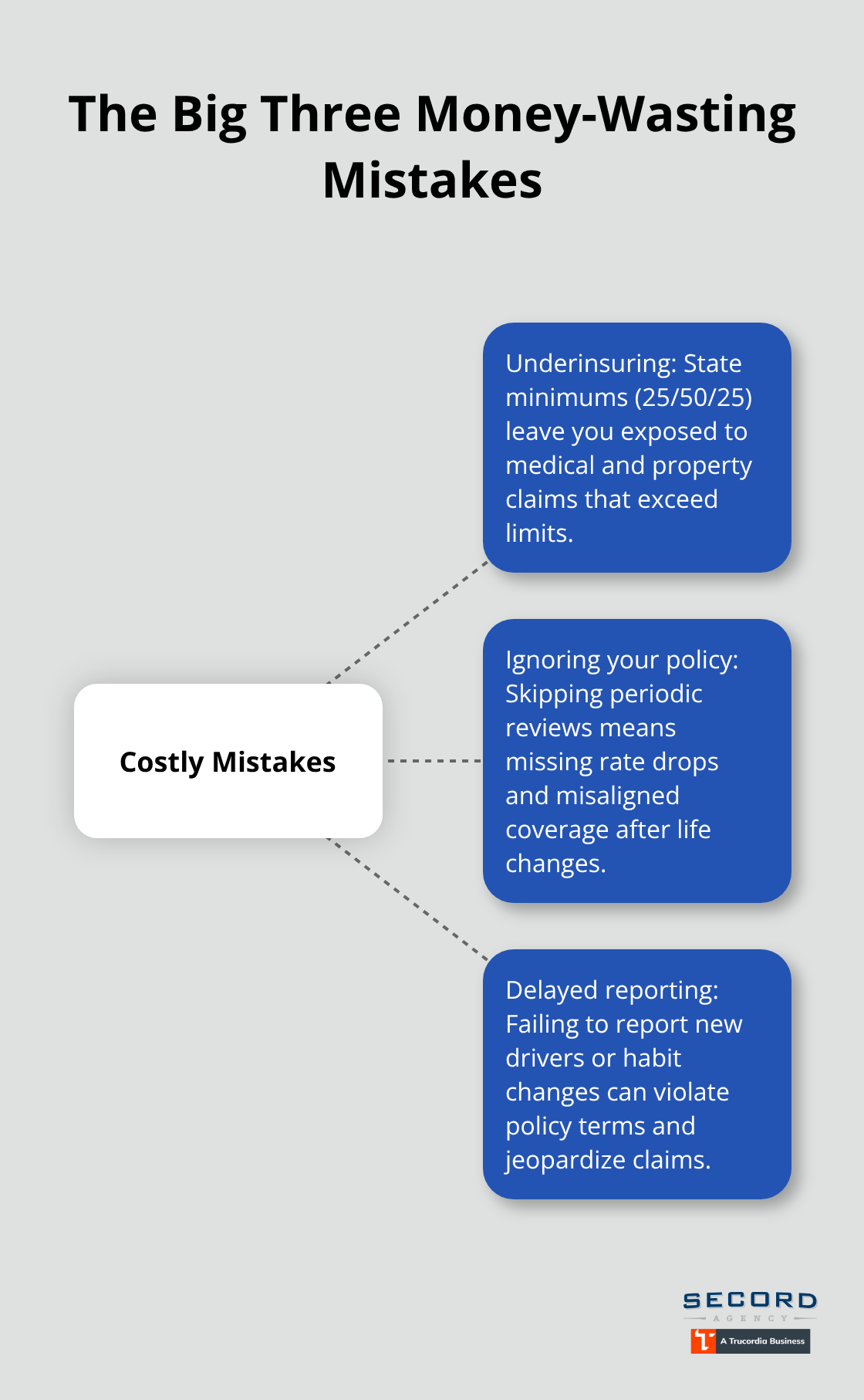
The first mistake involves carrying coverage limits that don’t match your actual financial exposure. Washington state minimums create a false sense of security-a serious accident with multiple injuries or significant property damage easily generates claims exceeding $50,000, leaving you personally liable for anything above your limit. According to the Insurance Information Institute, the average liability claim in Washington exceeds $15,000, yet drivers choosing minimum coverage assume they’re protected.
If you own a home, have savings, or earn a solid income, state minimums are financial recklessness disguised as budget-consciousness. A $100–150 annual difference between minimum coverage and higher protection becomes meaningless when a single accident wipes out your home equity. One serious accident can eliminate years of savings and trigger wage garnishment for years afterward. The real cost isn’t the premium difference-it’s the catastrophic risk you’re accepting.
Ignoring your policy costs you money every year
The second mistake involves letting your policy sit unchanged for years without reviewing coverage or shopping rates. Most Washington drivers review their auto insurance zero times annually, missing rate drops or failing to adjust coverage after marriage, home purchase, job relocation, or vehicle changes. Your commute distance directly impacts your premium-a driver who switches from downtown Seattle to remote work saves substantially, yet never mentions this to their insurer.
Insurance companies won’t reduce your premium without your input. You must actively shop and communicate changes to capture available savings. A practical approach involves scheduling a policy review every 18 months with your agent and comparing quotes from at least three carriers annually to catch rate increases before they stick around for years.
Delayed reporting of life changes violates your policy
The third mistake involves failing to report changes in driving habits or household composition. Adding a teenage driver to your policy increases rates significantly according to the National Association of Insurance Commissioners, but some families delay reporting this change hoping to avoid the increase. That delay violates your policy terms and can result in claim denial if an accident occurs.
Similarly, changes in employment, relocation, or vehicle modifications affect your coverage needs and rates. Report any driving habit changes within 30 days to maintain policy compliance and avoid coverage gaps. Insurance companies conduct periodic reviews, but they reward proactive communication with better rates and appropriate protection levels.
Final Thoughts
Low premium auto WA coverage becomes achievable when you combine rate shopping, strategic deductible increases, and behavioral rewards into a coordinated plan. The three cost-cutting approaches outlined above-comparing multiple carriers, raising your deductible, and enrolling in usage-based programs-work best together rather than in isolation. A driver implementing all three typically saves $600–800 annually while maintaining stronger protection than state minimums provide.
Equally important is avoiding the three mistakes that sabotage these savings: underinsuring your vehicle, ignoring annual policy reviews, and delaying reporting of life changes. These errors compound over years, costing you thousands in unnecessary premiums or leaving you exposed to catastrophic financial loss. Active management beats passive acceptance of whatever rate your current insurer quotes.
An independent agent shops multiple carriers simultaneously, identifies which discounts apply to your specific situation, and reviews your coverage annually without requiring you to manage the process alone. We at Secord Agency – A Trucordia Business handle this work for drivers across Washington, pairing competitive rates with personalized advice that adjusts as your life changes. Visit Secord Agency to connect with our team in Seattle’s Wallingford neighborhood and get a personalized quote that reflects your driving profile and protection needs.