Commercial auto insurance WA: Fleet And Vehicle Coverage That Scales
Running a fleet in Washington means navigating specific insurance requirements that protect your business and comply with state law. Commercial auto insurance in WA isn’t one-size-fits-all, especially as your operation grows.
At Secord Agency – A Trucordia Business, we help fleet owners find coverage that matches their actual needs and scales with their business. This guide walks you through what you need to know.
What Washington Actually Requires for Your Fleet
Washington state mandates commercial auto insurance for every business-owned vehicle, with no exceptions based on fleet size or industry. The minimum liability limits are $25,000 per person and $50,000 per accident for bodily injury, plus $10,000 for property damage according to RCW 46.29.450. However, these minimums are dangerously low for any serious operation. About 21% of Washington drivers lack insurance, making uninsured motorist coverage critical-match your uninsured/underinsured motorist limits to your liability limits rather than accepting state minimums. If your vehicles have USDOT numbers or operate under heavier commercial purposes, federal requirements kick in immediately. The Federal Motor Carrier Safety Administration requires minimum liability of $750,000 for nonhazardous cargo and $5,000,000 for hazardous cargo. Fines for operating without proper coverage reach $250, but the real cost is exposure: one claim against insufficient limits can bankrupt a small operation. Washington is a pure comparative negligence state, meaning injured parties can recover damages even when partially at fault, which elevates your risk substantially.
Core Coverages That Actually Matter
A basic commercial auto policy includes liability, collision, comprehensive, uninsured/underinsured motorist, and medical payments coverage. Liability covers damage you cause to others-this is your primary financial shield and typically represents 50 to 65% of your total premium. Collision pays to repair or replace your vehicles after an accident regardless of fault. Comprehensive handles theft, vandalism, fire, and weather damage, which matters in Washington given increasing rainfall and wildfire smoke affecting physical-damage rates. Medical payments coverage limits around $5,000 to $10,000 per person help cover employee medical expenses after a crash. Optional endorsements deserve serious attention: hired and non-owned auto coverage protects when employees use personal vehicles for work, cargo coverage is mandatory if freight brokers require minimum $100,000 in protection, and downtime/rental reimbursement keeps operations moving during repairs. Loading and unloading coverage protects goods during transport-critical if your fleet carries equipment or materials.
The Commercial Versus Personal Policy Gap
Your personal auto policy explicitly excludes business use. Insurers can deny coverage entirely if a claim involves work-related activity, and this exclusion applies to liability, collision, comprehensive, medical payments, and uninsured motorist protection simultaneously. Some policies exclude the entire contract, not just individual coverages. If you operate without proper commercial coverage and file a claim, you face outright denial and potential uninsured status. Washington law since July 1, 2016 prevents insurers from denying otherwise covered claims solely because commercial transportation use would normally be excluded, but this protection applies only to transportation network companies under specific regulations-not traditional fleet operations. The distinction matters: commercial policies are underwritten for business risk, priced accordingly, and include business-specific endorsements. Personal policies are priced for occasional commuting and entertainment use. Dual-use scenarios require explicit endorsements negotiated with your carrier. If your fleet includes vehicles operated by multiple drivers or used for deliveries, loading, or client transport, commercial coverage is non-negotiable.
What Happens When You Scale
As your fleet grows, your coverage needs shift dramatically. A two-vehicle operation faces different underwriting scrutiny than a ten-vehicle fleet, and insurers adjust liability limits and coverage options based on fleet type and usage patterns. Larger fleets benefit from underwriting leverage and more predictable loss histories, which helps lower per-unit costs. When you add vehicles, you must update your policy schedule with accurate VINs and usage classifications-errors here create coverage gaps that claims adjusters exploit. Federal requirements also escalate: if you cross into FMCSA territory, you’ll need certificates of insurance (Form E or MCS-90) filed with regulators. The regulatory framework includes UTC requirements starting at $300,000 and scaling up to $1.5 million for 16+ passenger buses. Each vehicle addition should trigger a review of your deductibles, sub-limits on cargo coverage, and territorial restrictions (some policies exclude Mexico or remote Canadian provinces unless endorsed). This is where working with an independent agent who understands growth becomes essential-they help you avoid over-insuring smaller fleets or under-insuring larger ones.
Your next step involves understanding how to actually reduce what you pay while maintaining protection. Driver safety programs, telematics technology, and strategic deductible choices can lower premiums significantly without cutting coverage.
How to Cut Fleet Premiums Without Sacrificing Protection
Telematics and Driver Monitoring Deliver Real Savings
Reducing what you pay for fleet insurance starts with understanding what actually moves the needle on your premiums. Telematics systems deliver the fastest savings-fleets using real-time driver monitoring see premium reductions of up to 15 percent. A seafood distributor in Washington with 14 refrigerated units cut loss frequency by 60 percent after adopting advanced driver assistance systems and telematics coaching, which resulted in a 12 percent renewal rate reduction and $18,400 in annual savings. That’s not theoretical; that’s what happens when you measure driver behavior and act on it.
Safety Programs and Maintenance Lower Your Costs
Formal driver training programs, comprehensive safety manuals, and rigorous preventive maintenance logs move underwriter calculations significantly. Many carriers credit dash cameras up to 10 percent if you retain footage for 90 days, which costs almost nothing compared to the savings. Raising your deductible from $500 to $2,500 typically cuts physical damage premiums by 15 to 25 percent-a Spokane Valley construction firm saved over $22,000 annually by raising deductibles and bundling fleet, inland marine, and general liability coverage together. Setting annual mileage caps, maintaining thorough driver vetting with motor vehicle records pulled quarterly, and participating in group or captive insurance programs also lower costs.
Shopping Quotes and Reviewing Coverage Annually
The mistake most fleet owners make is accepting whatever quote they receive first. You need at least three competitive quotes annually, and you should review your broker quarterly to ensure you’re not overpaying for coverage you’ve outgrown or missing endorsements that could cost you later. An independent agent who shops multiple carriers can identify gaps and opportunities that captive agents miss.
Claims Management Impacts Your Renewal Rates
The claims process itself impacts your long-term premiums more than most owners realize. Report incidents within 24 hours, have drivers complete accident forms immediately, and collect statements and photos at the scene-your carrier’s adjuster typically responds within 48 hours, and simple damage claims close in about 12 days. Subrogation (recovering costs from at-fault third parties) reduces your loss history, which insurers review heavily at renewal. An accident review committee that meets quarterly to analyze claims patterns helps you identify whether specific drivers, routes, or vehicle types are driving losses.
Strategic Risk Management Compounds Your Advantages
If you operate in Washington and cross into FMCSA territory with heavier vehicles, you’re already dealing with higher liability minimums and stricter underwriting. In those cases, every loss prevention dollar you invest compounds through lower renewal rates. When you bundle multiple coverage lines with one carrier, document safety initiatives with data, and demonstrate that you’re serious about loss prevention, underwriters reward you with better pricing. That’s how fleets move from paying the highest rates in their category to securing competitive advantages over competitors who treat insurance as an afterthought. The next step involves understanding how your fleet structure and vehicle types affect what you actually pay and how to adjust your policies as you add vehicles to your operation.
How Your Fleet Structure Changes What You Pay
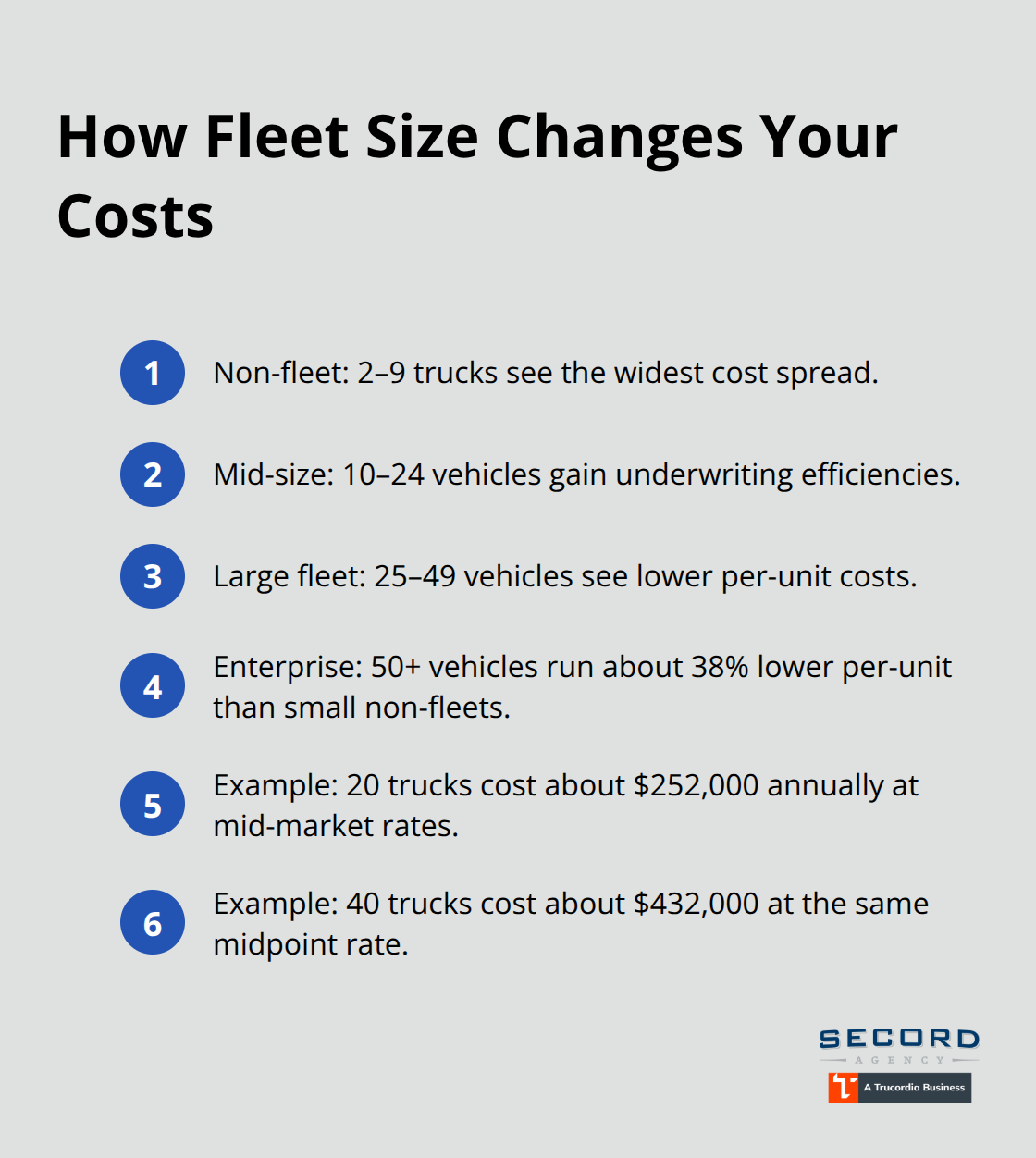
Adding vehicles to your operation forces immediate decisions about policy structure, and those decisions ripple through your renewal rates for years. When you move from a two-vehicle operation to ten vehicles, your insurer reclassifies your account from non-fleet to mid-size status, which triggers different underwriting scrutiny and different pricing models. A non-fleet operator with 2 to 9 trucks faces the widest cost spread depending on driver tenure, cargo type, and claims history, while a mid-size fleet with 10 to 24 vehicles benefits from underwriting efficiencies. At 25 to 49 vehicles, you enter large-fleet territory where per-unit costs drop further, and at 50 or more vehicles you reach enterprise status where per-unit costs run roughly 38 percent lower than small non-fleet operators at the low end. This scaling advantage means a 20-truck mid-size fleet at mid-market rates costs approximately $252,000 annually, while a 40-truck fleet at the same midpoint rate costs about $432,000, so the cost-per-unit advantage compounds as you grow.
Update Your Vehicle Schedule Accurately
The critical error fleet owners make is failing to update their vehicle schedules with accurate VINs and usage classifications each time they add a truck or van. Errors in your schedule create coverage gaps that adjusters exploit during claims, and misclassified vehicles can result in coverage denial or premium recalculation at renewal. When you add vehicles, schedule an immediate review with your agent to verify every vehicle is correctly listed, confirm your deductibles still match your financial capacity, and check whether cargo sub-limits or territorial restrictions need adjustment for your expanded operation.
Account for Different Vehicle Types and Risk Levels
Managing different vehicle types across your fleet requires separate attention because liability exposure varies dramatically between a light-duty cargo van and a refrigerated semi-truck. Your liability insurance must account for the highest-risk vehicle in your fleet because one major claim can exhaust your limits regardless of which vehicle caused the accident. A wine tour operator in Washington faced UTC liability requirements of $5 million while managing passenger transport exposure, which is fundamentally different from a construction contractor hauling equipment. If your fleet mixes delivery vans with service trucks that visit job sites, your underwriter needs to know the specific activities at each location because a service truck at a residential property carries different risk than the same truck at a commercial site.
Match Load Types to Appropriate Coverage
Load types matter equally: refrigerated cargo, hazardous materials, or high-value equipment each require different endorsements and sub-limits. Your carrier must understand what your vehicles actually transport and where they operate, because these factors determine whether your coverage protects you or leaves you exposed. A fleet that hauls temperature-controlled goods faces different physical-damage risks than one that transports construction materials, and your policy should reflect those differences through specific endorsements and adequate sub-limits.
Work with an Agent Who Understands Your Operation
When you work with an independent agent who understands your specific operation, they help you avoid the trap of over-insuring smaller fleets with enterprise-level coverage or under-insuring larger operations with inadequate limits. An independent agent shops multiple carriers to match your fleet structure to appropriate coverage rather than forcing you into standardized packages that miss your actual exposures. As your fleet grows and vehicle types diversify, quarterly reviews of your policy become non-negotiable because what protected a three-vehicle operation may leave a fifteen-vehicle fleet dangerously exposed.
Final Thoughts
Commercial auto insurance in Washington requires more than checking a box and hoping for the best. Your fleet’s protection depends on understanding state minimums, recognizing that those minimums leave you dangerously exposed, and building coverage that actually matches your operation as it grows. Telematics systems cut premiums by up to 15 percent, formal safety programs move underwriter calculations significantly, and strategic deductible choices save thousands annually without cutting protection.
Local expertise matters because Washington’s insurance landscape is specific. You operate in a pure comparative negligence state where injured parties recover damages even when partially at fault, you deal with 21 percent of drivers lacking insurance (making uninsured motorist coverage critical), and you navigate FMCSA requirements if you cross into heavier commercial territory. An independent agent who understands these dynamics helps you avoid over-insuring smaller fleets or under-insuring larger ones while shopping multiple carriers to match your fleet structure to appropriate coverage.
Your next step is scheduling a conversation with an agent who understands growth. Secord Agency-A Trucordia Business shops multiple carriers to deliver tailored commercial auto insurance in WA that scales with your operation, pairs competitive rates with fast local service, and provides ongoing policy reviews to catch gaps before claims expose them.