
Washington Auto Insurance Rates: How They Are Calculated in Your State
Washington auto insurance rates vary significantly based on how insurers calculate premiums in your state. Understanding these factors helps you identify where you can save money on coverage.
At Secord Agency – A Trucordia Business, we break down the rate calculation process and show you practical steps to lower your costs.
How Washington Regulates Insurance Rates
Washington’s insurance commissioner reviews and either approves or denies auto insurance rates before carriers can charge customers. This regulatory process differs sharply from states with looser oversight, which means Washington insurers cannot simply raise rates without justification. The state requires insurers to file detailed rate applications that show their actuarial data, loss projections, and underwriting guidelines. If rates appear excessive or unjustified, the commissioner can reject them outright. This protection exists because Washington treats insurance as a regulated utility rather than an uncontrolled market. The downside is that approval timelines can stretch several months, sometimes delaying rate changes that insurers need to implement. As of October 2026, Washington’s regulatory stance remains one of the strictest in the nation, which generally keeps premiums more stable than in states with minimal oversight.
What Drives Rate Differences Across Carriers
Different insurers file different rates because they use different loss data and underwriting criteria. One carrier might weight your driving record heavily while another focuses on vehicle type and location. This variation means two identical drivers can receive vastly different quotes from competing insurers, which is why shopping multiple carriers matters in Washington. Carriers also adjust rates based on their own claims experience in specific zip codes. An insurer that paid out more claims in Seattle’s Fremont neighborhood might charge higher rates there than a competitor with better experience.
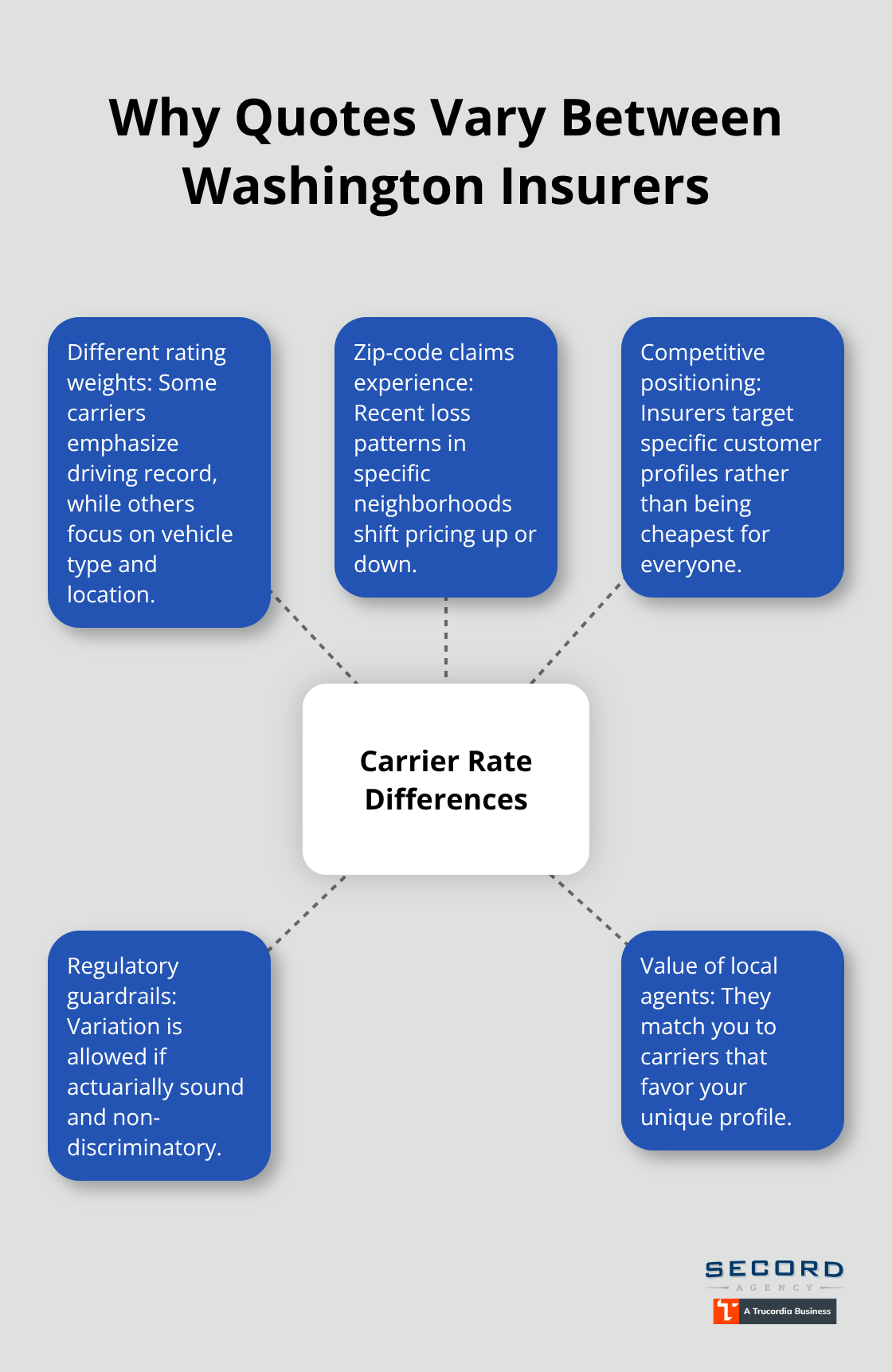
The state’s regulatory framework doesn’t prevent this kind of rate variation-it only prevents rates from being discriminatory or actuarially unsound. This reality makes local agents invaluable because they understand which carriers price competitively for your specific profile rather than just offering the lowest advertised rate.
How Washington Compares to Other States
Washington’s average auto insurance rates sit below the national median, primarily because the state’s regulatory environment keeps insurers honest about pricing. States with minimal rate regulation often see premiums climb faster and with less predictability. Washington drivers typically pay less than drivers in neighboring Oregon or Idaho, though rates still vary dramatically within the state itself. Urban areas like Seattle command higher premiums than rural counties, reflecting genuine differences in accident frequency and repair costs. The competitive pressure from multiple carriers operating in Washington also suppresses rates compared to states where fewer insurers dominate the market. This competitive landscape rewards drivers who actually compare quotes instead of accepting their current insurer’s renewal rate.
Why Local Knowledge Matters for Your Rates
Insurers operating in Washington don’t all price the same risk the same way. A carrier with strong claims experience in Spokane might offer better rates there than a competitor focused on coastal markets. Local agents understand these nuances and can match you with carriers that price favorably for your specific situation (zip code, vehicle, driving history, and coverage needs). Shopping quotes on your own often misses these carrier-specific advantages because you won’t know which insurers weight your profile most favorably. An agent who works with multiple carriers can identify which ones offer the best value for your circumstances rather than just the lowest headline rate. This knowledge advantage becomes especially valuable when you need to file a claim or adjust your coverage, since agents advocate on your behalf with insurers who understand your local market.
What Reduces Your Premium Most in Washington
Driving Record and Claims History Shape Your Rates
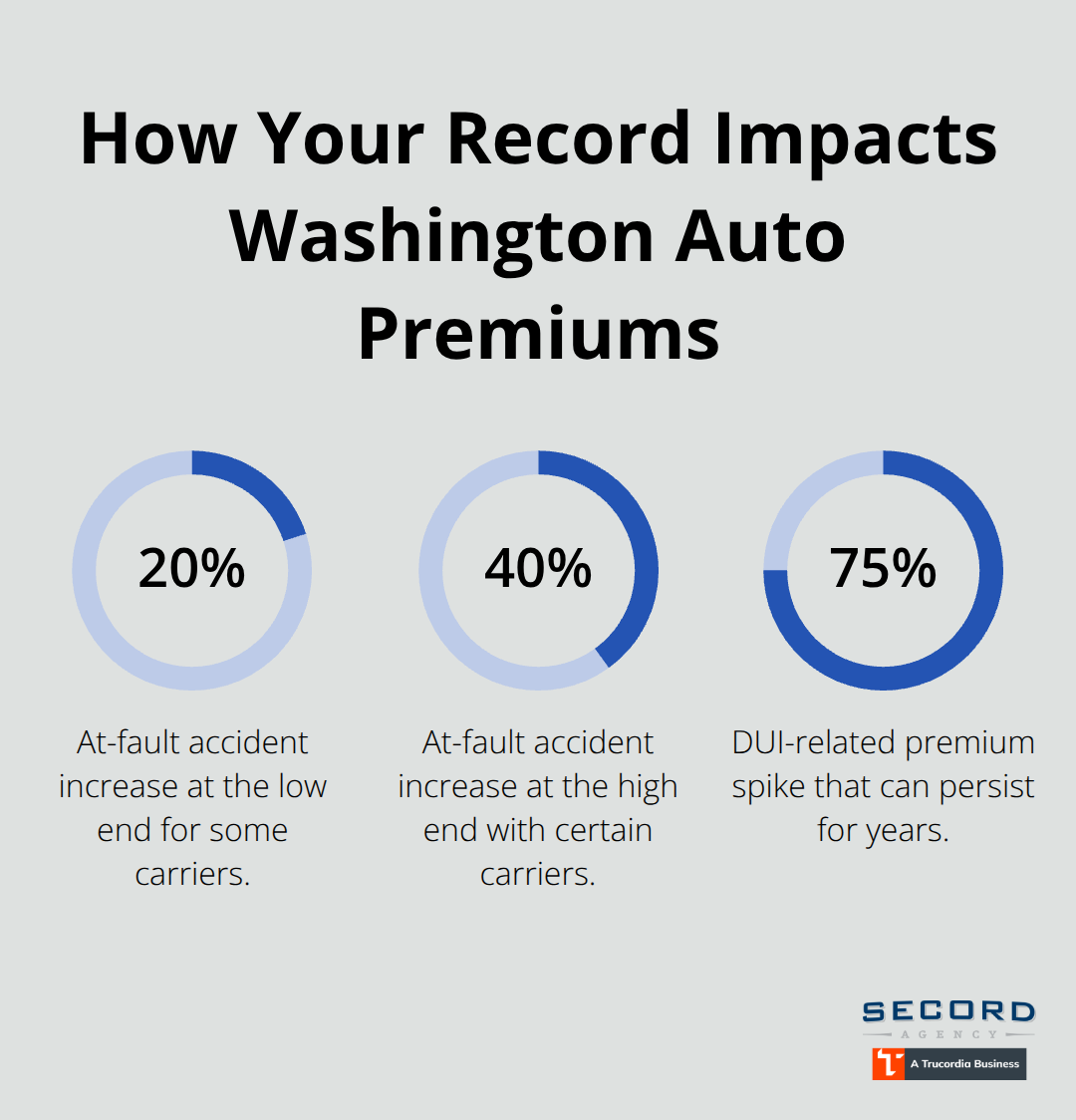
Your driving record carries the heaviest weight in Washington rate calculations, and insurers scrutinize it more carefully than almost any other factor. A single at-fault accident raises your premium by 20 to 40 percent depending on the carrier, while a DUI conviction spikes rates by 75 percent or more for years afterward. Clean records unlock the best pricing across all carriers, which means avoiding even minor violations pays off substantially over time.
Claims history matters equally-filing two or more claims within three years signals to insurers that you represent elevated risk, and they price accordingly. Insurers typically look back five to seven years at your driving record and claims history, so an old accident eventually ages out of consideration. Your past driving behavior directly determines your current options and costs, which is why maintaining a clean record produces far better rate outcomes than any other strategy available.
Vehicle Type and Safety Features Impact Your Costs
Vehicle choice dramatically influences what you pay because repair costs and accident frequency vary wildly by model. Newer vehicles with advanced safety features like automatic emergency braking and lane-keeping assist qualify for substantial discounts (sometimes 10 to 15 percent) because insurers recognize these systems reduce claim frequency. Conversely, high-performance vehicles and luxury models carry premiums 30 to 50 percent higher than comparable sedans due to expensive parts and repair labor.
Safety ratings matter more than most drivers realize. A vehicle with a five-star crash test rating from the National Highway Traffic Safety Administration typically qualifies for better rates than a three-star model, even if both are the same age. Insurers reward structural integrity and occupant protection because these features reduce injury claims and medical costs.
Location and Mileage Determine Your Risk Profile
Your zip code and annual mileage create the final pricing layer: Seattle drivers pay roughly 40 to 60 percent more than rural Washington residents because urban accident rates are genuinely higher (this reflects actuarial reality, not discrimination). Commuters driving 25,000 miles annually pay more than those driving 7,500 miles yearly since exposure to risk increases with miles on the road.
Urban congestion, higher traffic density, and more frequent interactions with other vehicles all contribute to elevated premiums in cities. Rural areas experience fewer accidents per capita, which translates directly into lower insurance costs. If you work from home or drive infrequently, you should report accurate mileage to your insurer because overestimating your annual miles costs you money unnecessarily.
Deductibles Offer Direct Control Over Your Premium
Raising your deductible from $500 to $1,000 typically reduces your premium by 15 to 25 percent, making this the most direct way to control costs once your driving record and vehicle are fixed. This strategy works because you absorb more of the risk yourself, which reduces the insurer’s exposure and lowers their pricing accordingly.
The key is matching your deductible to your actual financial capacity. If you lack emergency savings to cover a $1,000 deductible, a lower deductible protects you from financial hardship when accidents happen. Conversely, if you maintain a solid emergency fund, a higher deductible saves you hundreds annually on premiums. This calculation shifts based on your personal circumstances, which is why one-size-fits-all recommendations fail. Shopping multiple quotes with different deductible levels reveals exactly how much you save at each tier, allowing you to make an informed choice rather than accepting default settings that carriers suggest.
Understanding these rate drivers positions you to make strategic decisions about coverage and risk management. The next section explores how to actively shop for competitive quotes and identify which carriers price most favorably for your specific profile.
How to Secure Lower Rates in Washington
Compare Quotes Across Multiple Carriers
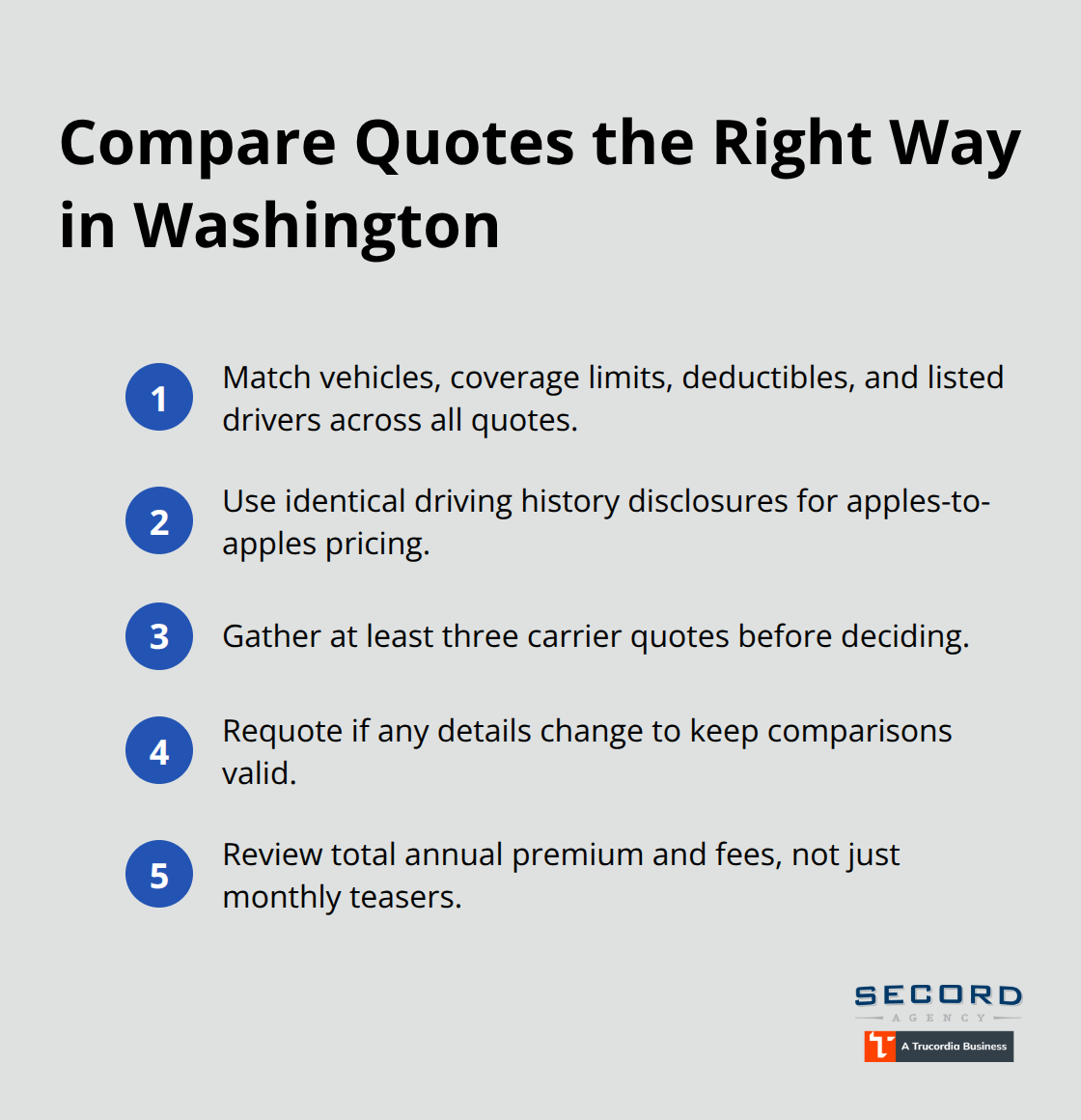
Shopping multiple carriers isn’t optional if you want competitive pricing in Washington-it’s the only reliable way to find your actual best rate. Insurers price risk differently based on their own claims data and underwriting algorithms, which means the cheapest quote for your neighbor might cost 30 percent more than the best option for you. When you request quotes, provide identical information across all carriers: same vehicle details, coverage limits, deductibles, and driving history. This consistency reveals genuine rate differences rather than variations caused by inconsistent data entry.
Most drivers accept their current insurer’s renewal rate without shopping, which costs them hundreds annually because carriers routinely raise rates on existing customers while offering lower rates to new policyholders. Comparison shopping can help you find better rates on premiums. Collect at least three quotes from different carriers before making any decision, since the spread between the highest and lowest quote often exceeds $1,000 per year for identical coverage.
Bundle Policies Strategically
Bundling your auto and home policies with a single insurer typically reduces your overall costs by 10 to 25 percent because carriers offer substantial multi-policy discounts to retain customers across multiple lines. However, bundling only makes financial sense if the bundled rate beats your best standalone quotes for each policy. Some drivers pay more total premium when bundling than when splitting policies between two carriers, which defeats the purpose entirely.
Before bundling, obtain separate quotes for auto and home from competing carriers, then compare the bundled total against keeping policies split. Your driving record directly influences what bundling savings you qualify for-clean records unlock the deepest discounts while violations limit your options. Raising your deductible simultaneously with bundling amplifies savings since the combination effect exceeds what either strategy produces alone. A driver moving from a $500 deductible to $1,000 while bundling home and auto policies can reduce total annual costs by $800 to $1,500 depending on their specific risk profile and carrier.
Final Thoughts
Washington auto insurance rates reflect multiple interconnected factors: your driving record, vehicle type, location, and coverage choices. The state’s regulatory framework holds insurers accountable, but it doesn’t eliminate the need for active shopping on your part. Rates vary significantly across carriers because each insurer weights risk differently based on their own claims experience and underwriting philosophy, which creates genuine savings opportunities for drivers willing to compare quotes.
Gather quotes from at least three different carriers using identical information for each request, then test different deductible levels to see how much you save by accepting higher out-of-pocket costs. Verify that your reported annual mileage matches your actual driving patterns, since overestimating costs you money unnecessarily. Evaluate whether bundling your auto and home policies actually reduces your total premium compared to keeping them separate (this calculation varies by carrier and your specific risk profile).
Local agents matter because they understand carrier-specific pricing patterns in your area and match you with insurers that price favorably for your exact situation. Contact Secord Agency – A Trucordia Business to compare your current rates against what competitive carriers actually offer, and our Seattle-based team will handle everything from auto and home policies to specialty vehicles and comprehensive business coverage.