Auto Insurance Roadside Assistance Seattle: Quick Help When You Need It
Your car breaks down on I-5 during rush hour. Your battery dies in a parking lot. You’re locked out with no spare key nearby. These situations happen to Seattle drivers constantly, and that’s where auto insurance roadside assistance becomes invaluable.
At Secord Agency – A Trucordia Business, we know that roadside emergencies don’t follow a schedule. The right coverage can mean the difference between a minor inconvenience and a costly, stressful situation.
What Roadside Assistance Actually Covers
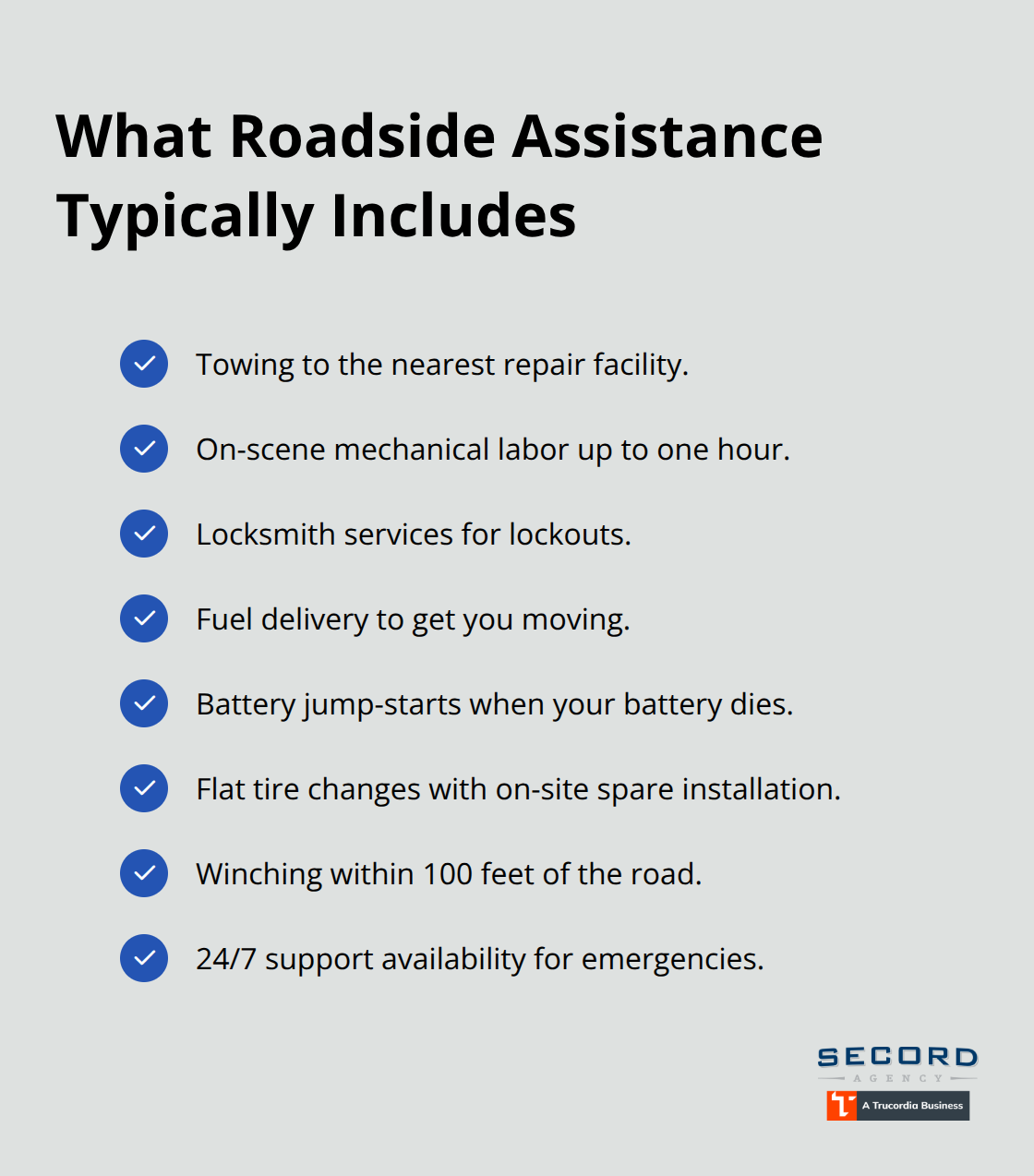
Roadside assistance is not a luxury add-on-it’s practical protection that covers specific breakdowns most drivers will face. State Farm handles roughly 24,400 insurance claims daily, and a significant portion involve roadside emergencies. The coverage typically includes towing to the nearest repair facility, on-scene mechanical labor up to one hour, locksmith services, fuel delivery, battery jump-starts, and flat tire changes. Progressive covers winching services to pull vehicles stuck in mud, snow, water, or sand within 100 feet of a road. AAA Washington members across the Seattle area receive 24/7 support that includes lockouts, fuel delivery, and flat tire service with on-site spare installation.
The distinction between roadside assistance and basic auto insurance matters because collision and comprehensive coverage address damage to your vehicle, while roadside assistance addresses the immediate problem of getting your car moving again or to a repair shop safely.
Why Seattle’s Weather and Roads Create Specific Risks
Seattle’s climate and geography create roadside emergencies that drivers in other regions rarely face. Rain and flooding cause battery failures and electrical issues during winter months. The region’s steep hills and winding roads increase the likelihood of vehicles getting stuck or needing winching assistance. Traffic congestion on I-5 and I-90 means breakdowns happen in high-stress environments where quick response times matter significantly. Progressive’s on-scene labor coverage of up to one hour addresses minor fixes that get you back on the road without a tow, which proves especially valuable during Seattle’s rush hour gridlock. AAA’s towing service reaches the nearest repair facility, eliminating the choice between expensive out-of-pocket towing or sitting stranded.
What Happens When You Skip This Coverage
A single towing incident in the Seattle area costs $150 to $300 without coverage, depending on distance and time of day. Locksmith services for vehicle lockouts run $100 to $200 for labor alone. Battery replacement averages $100 to $200. Fuel delivery charges without coverage can reach $50 to $75.
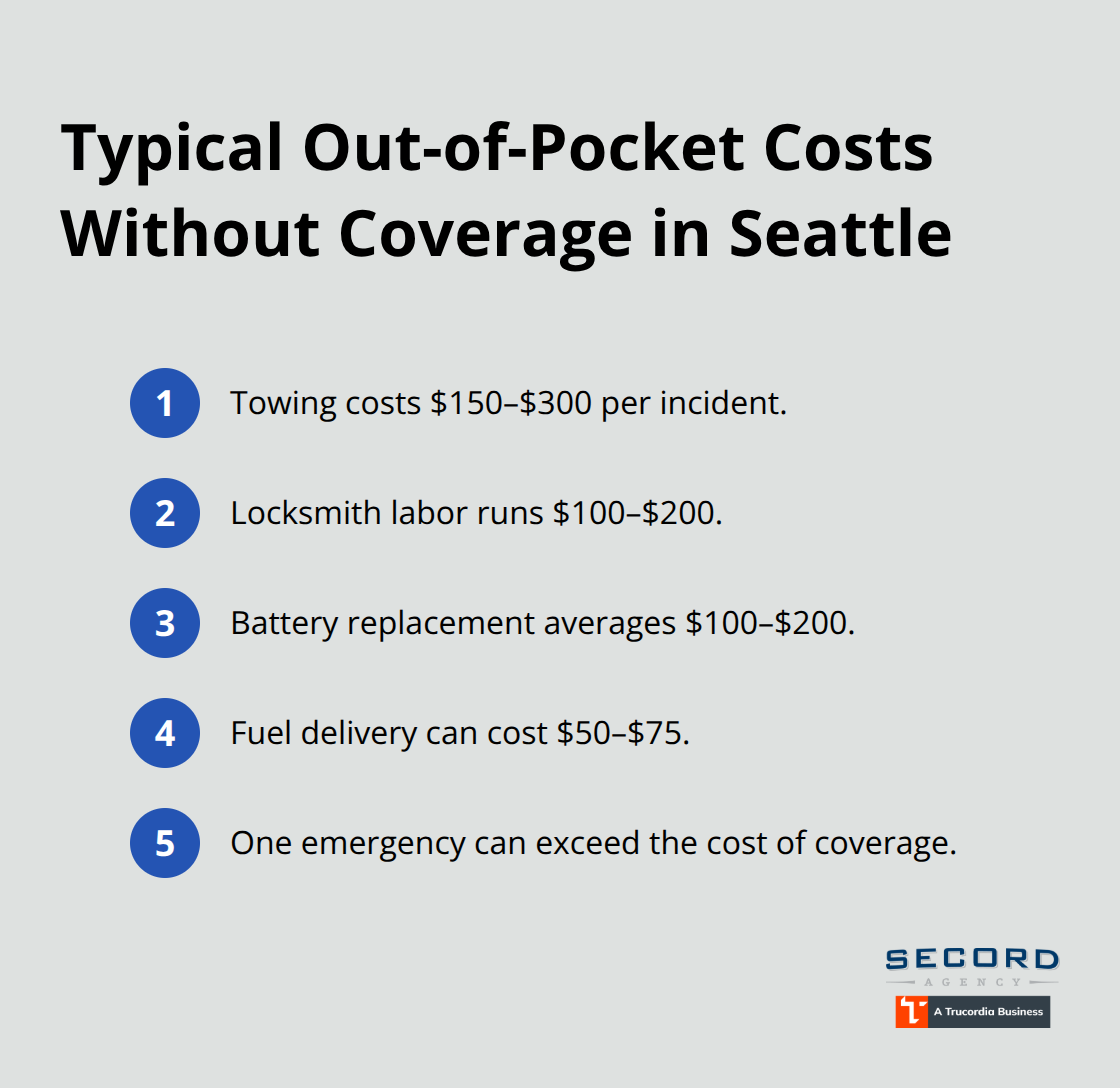
These individual costs pale compared to being stranded on I-5 at midnight or missing work because your car won’t start. State Farm’s roadside coverage adds to existing auto policies at a cost determined by your specific situation, making it affordable relative to a single emergency call.
How Coverage Limits Affect Your Protection
Different insurance carriers structure their roadside benefits differently, and understanding these limits protects you from unexpected costs. Some policies limit towing to a 15-mile radius, meaning you pay extra mileage if the nearest repair shop sits farther away. On-scene labor caps at one hour with most carriers, so complex repairs require a tow rather than roadside fixes. Trip interruption coverage (where available) covers breakdown-related lodging, food, and transportation costs up to $500 total if your breakdown occurs more than 100 miles from home. These variations mean two drivers with similar policies may face different out-of-pocket expenses during the same type of emergency.
Getting the Right Coverage for Seattle Conditions
Your roadside assistance needs depend on how often you drive outside the city and what vehicles you own. Drivers who commute long distances on I-5 or I-90 benefit from higher towing limits and trip interruption coverage. Urban drivers who rarely leave Seattle may prioritize quick response times and on-scene service over extended towing distances. Progressive, State Farm, and AAA all serve Seattle drivers, each with different service networks and coverage options. The next step involves comparing what each carrier offers and matching their benefits to your actual driving patterns and risk tolerance.
What Services Actually Show Up When You Call for Help
Towing: Distance Limits That Affect Your Wallet
Seattle drivers face a stark reality when their car breaks down: the quality of roadside assistance varies dramatically between carriers, and knowing exactly what arrives matters more than knowing what’s theoretically covered. Towing services form the backbone of roadside assistance, but the details determine whether you pay extra out of pocket or walk away covered. Progressive tows your vehicle within a 15-mile radius to the nearest repair facility at no cost, though distances beyond that 15-mile radius require you to cover additional mileage charges. State Farm arranges towing to the nearest repair facility with emergency road service available 24/7/365, and their network of over 19,000 auto insurance agents nationwide means Seattle drivers have local support when filing claims. AAA Washington members receive towing to repair shops within their service area, eliminating the guesswork about where your car goes.
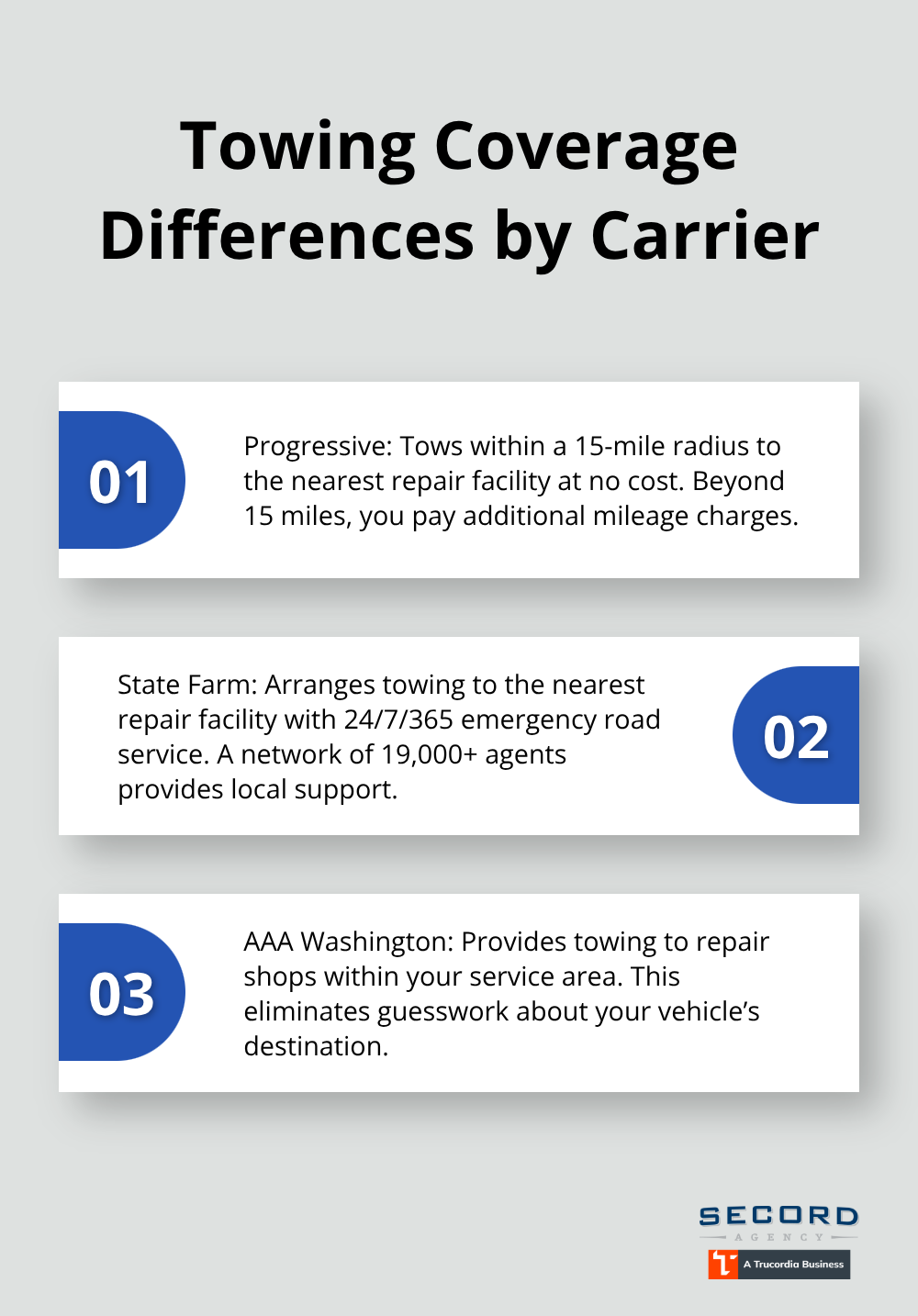
The practical advantage here is straightforward: a breakdown on I-5 near the SeaTac airport triggers different towing distances than a breakdown near Snoqualmie Pass, and carriers structure their radius differently. If you regularly drive mountain passes for weekend trips, the 15-mile limit becomes a financial liability rather than protection.
Locksmith Services and Fuel Delivery: The Services You’ll Actually Use
Locksmith services and fuel delivery represent the immediate assistance most Seattle drivers actually need. Progressive covers locksmith labor up to one hour when your keys are locked inside or lost, though you pay for replacement key costs separately (typically $150 to $300 depending on your vehicle’s locking system complexity). Fuel delivery arrives at no service charge with Progressive, and you only pay for the fuel itself, avoiding the $50 to $75 markup that independent roadside services charge. Battery jump-starts happen on-scene with no charge, getting you back on the road within minutes rather than waiting for a tow truck. State Farm covers battery testing, jump-starts, and often battery replacement if needed. AAA Washington provides battery service including testing and jump-starts as standard member benefits.
Response Times Matter in Seattle’s Weather
The real advantage emerges when you consider frequency: State Farm handles 26K+ claims daily across all types, and roadside assistance represents a meaningful portion of those calls. For Seattle drivers, response times matter because winter weather frequently causes battery failures and lockouts simultaneously, and waiting three hours for help during a rainstorm creates genuine hardship. Coverage that sounds identical on paper delivers different real-world outcomes based on response times and service network density. Your choice of carrier directly affects how quickly help arrives when you need it most (especially during Seattle’s rainy season when electrical failures spike). The next chapter examines how to evaluate coverage limits and service radius to match your actual driving patterns and risk tolerance.
Matching Coverage to Your Actual Driving Patterns
Assess Your Real Driving Habits First
Choosing roadside assistance coverage requires honest assessment of your driving patterns rather than selecting the most comprehensive option available. Seattle drivers who commute locally within the city limits face different risks than those regularly driving to Portland, Bend, or mountain passes, and overpaying for unnecessary coverage wastes money while underpaying for your real needs creates financial exposure. Start by tracking how often you drive beyond 15 miles from home and which routes you take most frequently.
Distance-Based Coverage Limits Create Real Costs
Drivers who rarely leave Seattle’s urban core can prioritize quick response times and on-scene service over extended towing distances, since the nearest repair shop typically sits within that 15-mile radius. Conversely, drivers who regularly tackle I-5 south toward Tacoma or head east toward the Cascades should reject the standard 15-mile towing limit offered by Progressive and instead seek carriers offering unlimited towing distance or higher radius coverage. State Farm’s approach of towing to the nearest repair facility without distance-based charges proves superior for long-distance commuters, eliminating the scenario where you pay extra mileage because the nearest qualified shop sits 20 or 25 miles away.
Trip Interruption Coverage Protects Long-Distance Travelers
Trip interruption coverage covers up to $500 of covered breakdown costs like alternative transportation, hotel, and food when breakdowns occur far from home. If you take annual road trips or drive frequently to the Oregon coast or mountain destinations, this coverage prevents a single breakdown from triggering expenses that exceed the cost of the coverage itself.
Compare Costs Across Multiple Carriers
The practical reality of roadside assistance costs forces a choice between low-cost policies that cover minimal services and comprehensive policies that address nearly every scenario. AAA Washington membership costs roughly $65 to $150 annually depending on tier level, providing roadside assistance plus additional benefits like travel services and approved repair shop discounts. Adding roadside coverage to an existing State Farm auto policy depends on your specific circumstances and location, requiring conversation with a local agent rather than online quoting. Progressive offers roadside coverage as an add-on with transparent pricing visible during the quote process.
Find the Right Coverage Match for Your Situation
For Seattle drivers, the decision hinges on whether you want service from a single integrated carrier or prefer shopping multiple options through an independent agent. An independent insurance agency can shop multiple carriers for you, comparing which combination of coverage limits, response times, and out-of-pocket costs actually protects your specific driving situation rather than selling you generic roadside packages. The goal involves matching your real-world driving patterns to coverage that prevents financial surprises when emergencies occur, not selecting the cheapest option available or the most expensive coverage that sits unused.
Final Thoughts
Roadside assistance transforms how Seattle drivers handle emergencies, shifting the burden from your wallet to your insurance carrier. The coverage protects you against towing costs that reach $150 to $300, locksmith services running $100 to $200, and fuel delivery charges up to $75. More importantly, it eliminates the stress of being stranded on I-5 during rush hour or stuck in winter weather without immediate help.
Your next step involves matching coverage to your actual driving patterns rather than selecting generic packages. Seattle drivers who commute locally benefit from quick response times and on-scene service, while those regularly traveling mountain passes need higher towing limits or trip interruption coverage. State Farm’s 24/7 roadside network, Progressive’s 15-mile towing radius, and AAA Washington’s comprehensive member benefits each serve different driver profiles.
We at Secord Agency – A Trucordia Business shop multiple carriers to find auto insurance roadside assistance in Seattle that matches your specific driving situation and budget. Our team handles the comparison work, securing competitive rates while ensuring you understand exactly what arrives when you call for help. Contact us to review your current coverage or explore roadside assistance options that protect your actual driving patterns across Washington.