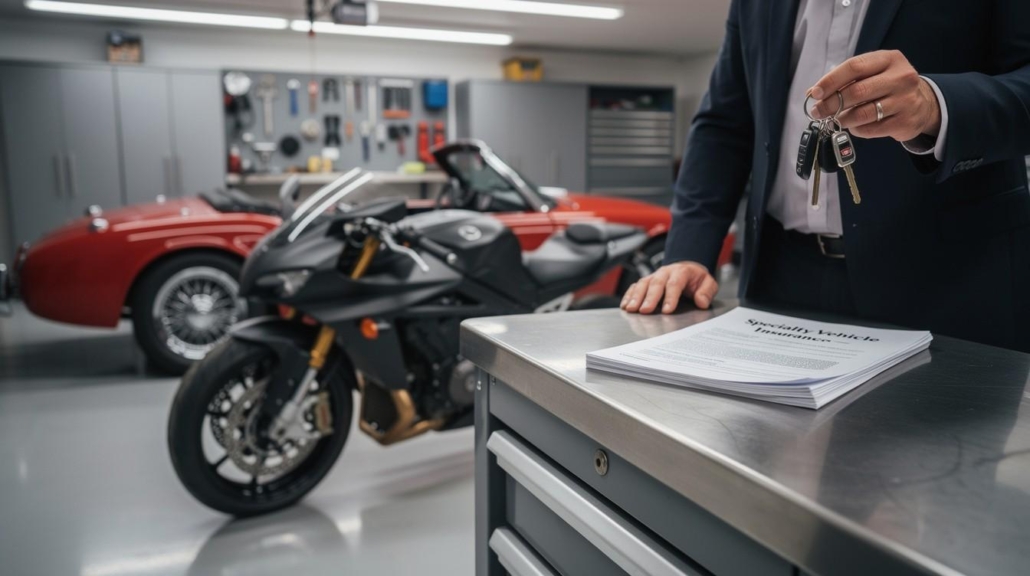
Specialty vehicle insurance WA: Coverage for High-Value Rides
Your specialty vehicle deserves protection that standard policies simply don’t provide. Whether you own a high-performance sports car, a meticulously restored classic, or a custom-built machine, standard auto insurance leaves significant gaps in coverage.
At Secord Agency – A Trucordia Business, we understand that specialty vehicle insurance in WA requires a different approach. This guide walks you through the coverage options designed specifically for high-value rides and how to protect your investment properly.
What Qualifies as a Specialty Vehicle in Washington
Understanding Specialty Vehicle Classification
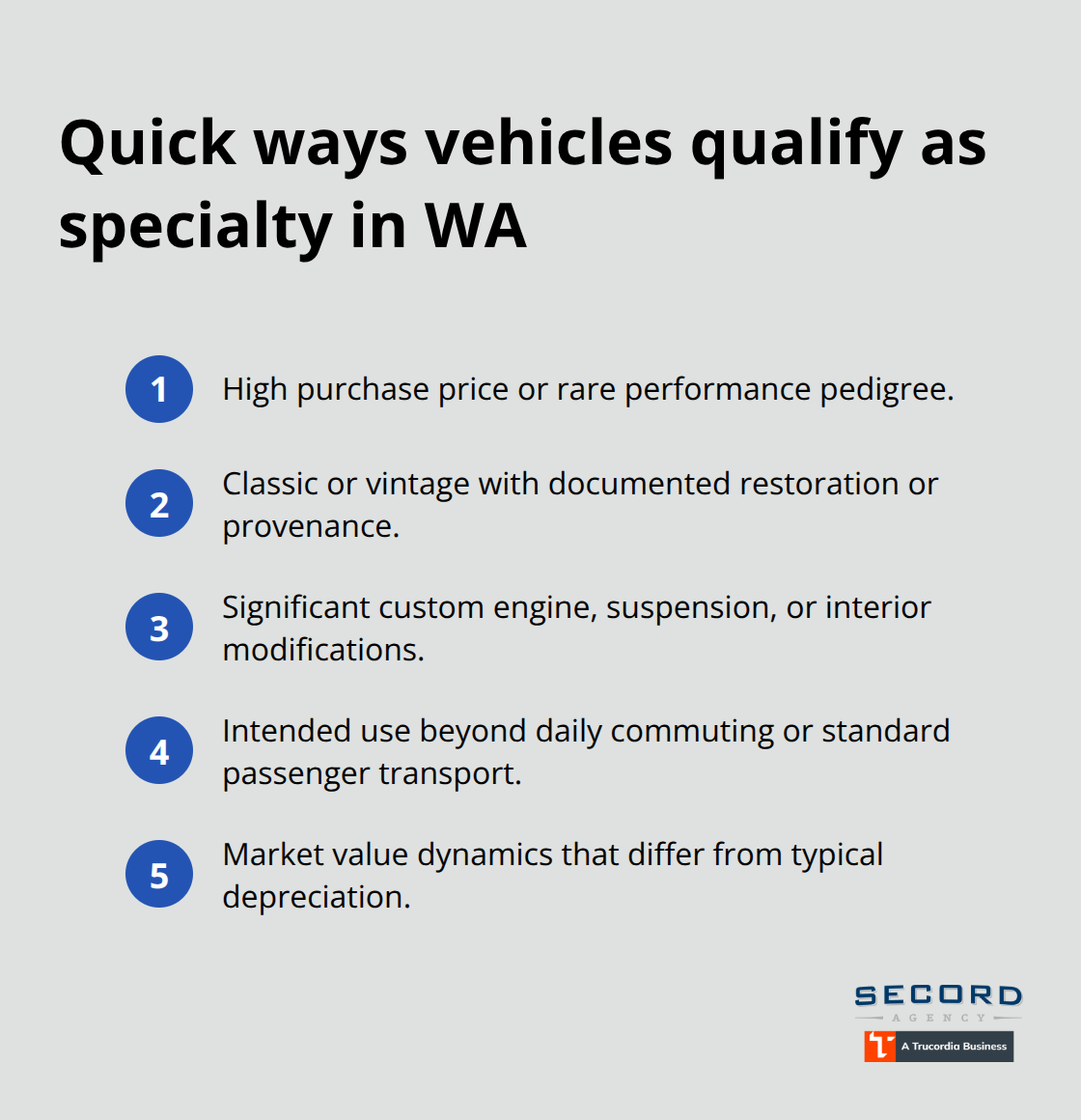
High-performance sports cars, classic automobiles, and custom-built machines fall into specialty vehicle territory, but the distinction matters more than you might think. Insurance companies classify specialty vehicles differently than standard passenger cars, and Washington state doesn’t have a single legal definition. Instead, insurers determine specialty status based on factors like purchase price, year of manufacture, modification level, and intended use. A 2023 Porsche 911 qualifies immediately. A 1967 Chevrolet Corvette with documented restoration work qualifies. A street-legal hot rod with a custom engine and suspension qualifies. What separates these from ordinary vehicles is that standard policies treat them as standard vehicles-and that creates real problems.
High-Performance and Sports Cars
High-performance and sports cars typically cost between $60,000 and $500,000 or more, and repair costs reflect that price tag. A single replacement part for a rare performance vehicle can run $10,000 to $50,000. Standard insurance policies cap payouts at actual cash value, which undervalues these machines significantly. A 2024 Ferrari worth $300,000 might receive a valuation of $180,000 under actual cash value calculations, leaving a $120,000 gap if totaled.
Classic and Vintage Automobiles
Classic and vintage automobiles present different challenges. A 1961 Jaguar E-Type might be worth $150,000 to $300,000 depending on condition and provenance, but standard appraisals miss the nuances that drive real market value. These vehicles appreciate over time, yet standard policies fail to account for that appreciation.
Custom-Built and Modified Vehicles
Custom-built and modified vehicles create the most complexity because standard policies often exclude coverage for modifications entirely. A truck with a $40,000 custom suspension system, $25,000 in engine modifications, and $15,000 in interior work has $80,000 in additions that standard policies won’t cover if damaged. This gap between what you’ve invested and what standard coverage protects explains why specialty vehicle owners need different protection strategies.
Understanding whether your vehicle qualifies for specialty coverage sets the foundation for proper protection. The next section reveals why standard auto insurance fails to meet the needs of high-value rides and what coverage gaps actually exist.
Why Standard Auto Insurance Fails Specialty Vehicles
Standard auto insurance policies operate on actual cash value, which means insurers calculate your vehicle’s worth by subtracting depreciation from its original purchase price. This approach works fine for a 2019 Honda Civic worth $18,000, but it destroys owners of specialty vehicles. A 2024 Ferrari F8 Tributo worth $280,000 might receive an actual cash value assessment of $165,000 after depreciation calculations, leaving a $115,000 gap if the vehicle is totaled. High-performance vehicles like Lamborghinis, McLarens, and Porsches lose value differently than standard cars, yet standard policies ignore these market realities.
Repair costs amplify this problem significantly. Replacing a transmission in a 2023 Porsche 911 Turbo runs $15,000 to $25,000, while a standard sedan transmission costs $3,000 to $8,000. A custom paint job on a luxury sports car costs $8,000 to $15,000 compared to $1,500 to $3,000 on ordinary vehicles.
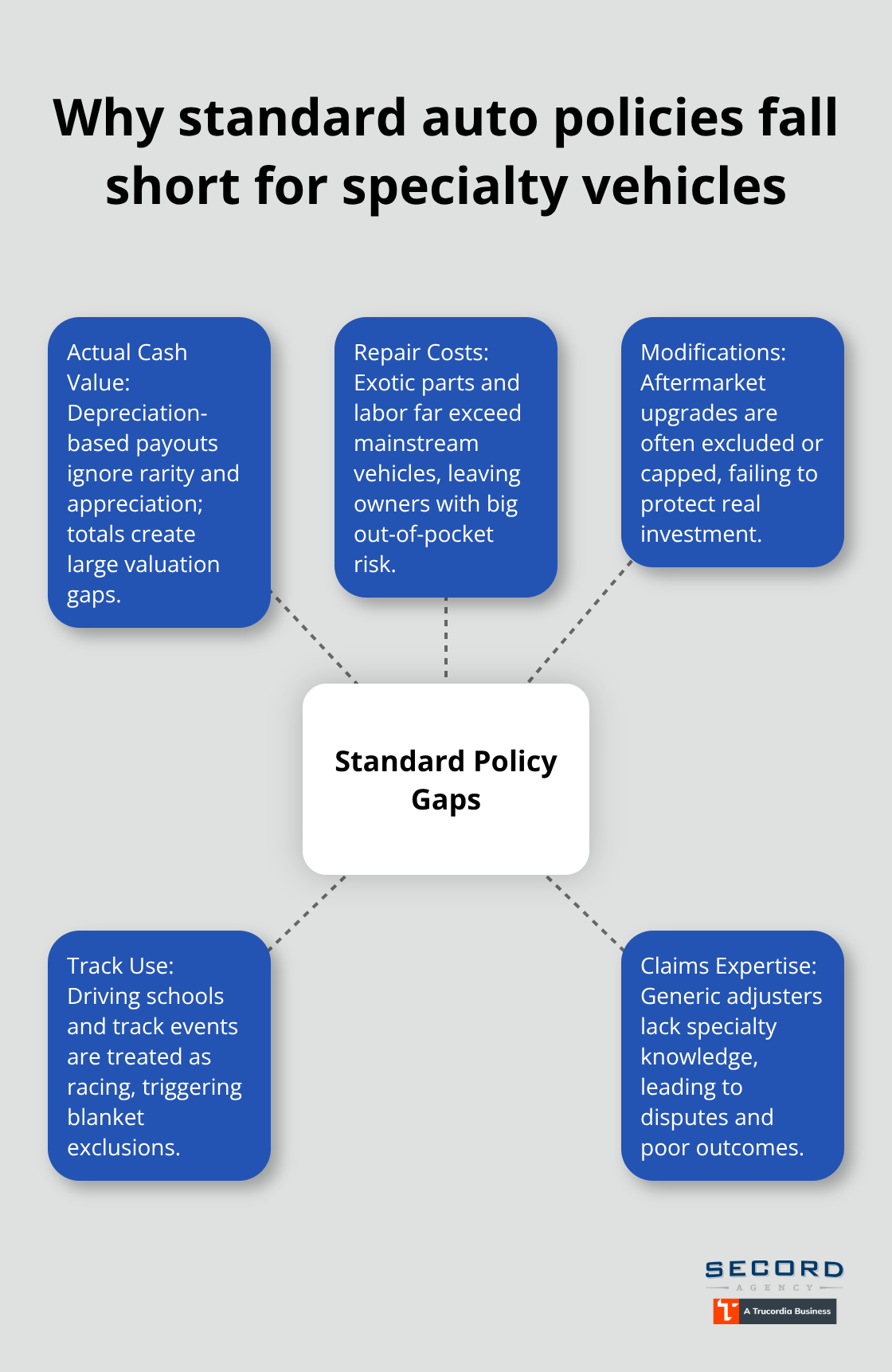
Standard policies cap payouts based on actual cash value rather than repair costs, forcing owners to absorb massive out-of-pocket expenses when damage occurs.
The Actual Cash Value Trap
Actual cash value policies create a documented problem for specialty vehicle owners across Washington and nationwide. When insurers total a high-value vehicle, they hire independent adjusters who apply generic depreciation formulas that don’t account for market conditions, rarity, or condition premiums. A 1965 Ford Mustang fastback in museum-quality condition might be valued at $85,000 in the collector car market, but an actual cash value assessment could return $35,000 to $45,000.
Agreed value policies solve this problem by allowing owners and insurers to establish a vehicle’s worth upfront, eliminating valuation disputes entirely. Specialty vehicle carriers understand that a pristine 1961 Jaguar E-Type isn’t worth the same as a standard 1961 sedan, and they structure policies accordingly. Standard carriers simply won’t engage in these conversations because specialty vehicles fall outside their underwriting models.
Coverage Gaps for Modifications
Custom modifications create another critical gap in standard coverage. A truck owner who invests $35,000 in a lifted suspension, custom interior, and upgraded engine components discovers that standard policies won’t cover these additions beyond the original vehicle value. If that truck sustains damage, the owner recovers the base vehicle value only, losing the entire modification investment.
The problem intensifies when owners add high-end components to performance vehicles. A sports car with $50,000 in engine modifications, $20,000 in suspension work, and $15,000 in custom interior upgrades has $85,000 in additions that standard policies exclude entirely. This gap between what you’ve invested and what standard coverage protects explains why specialty vehicle owners need different protection strategies.
Track Use and Racing Exclusions
Track use and racing activities receive outright exclusions from standard policies. If your specialty vehicle sustains damage during track events, autocross competitions, or high-performance driving school sessions, standard insurance denies the entire claim. Owners who participate in organized track days or racing events need explicit coverage endorsements that standard policies simply don’t offer.
This exclusion affects more owners than you might expect. Over 150,000 drivers participate in organized track events annually across North America. Standard carriers treat any track activity as racing, regardless of whether you’re competing or simply attending a driving school. Specialty vehicle carriers, however, understand the difference and offer coverage options that standard insurers won’t consider.
These gaps in standard coverage make specialty vehicle protection a fundamentally different conversation. The next section explores the coverage options that actually address these problems and protect your investment properly.
Coverage Options for Specialty Vehicles in Washington
Agreed Value Coverage Protects Your True Investment
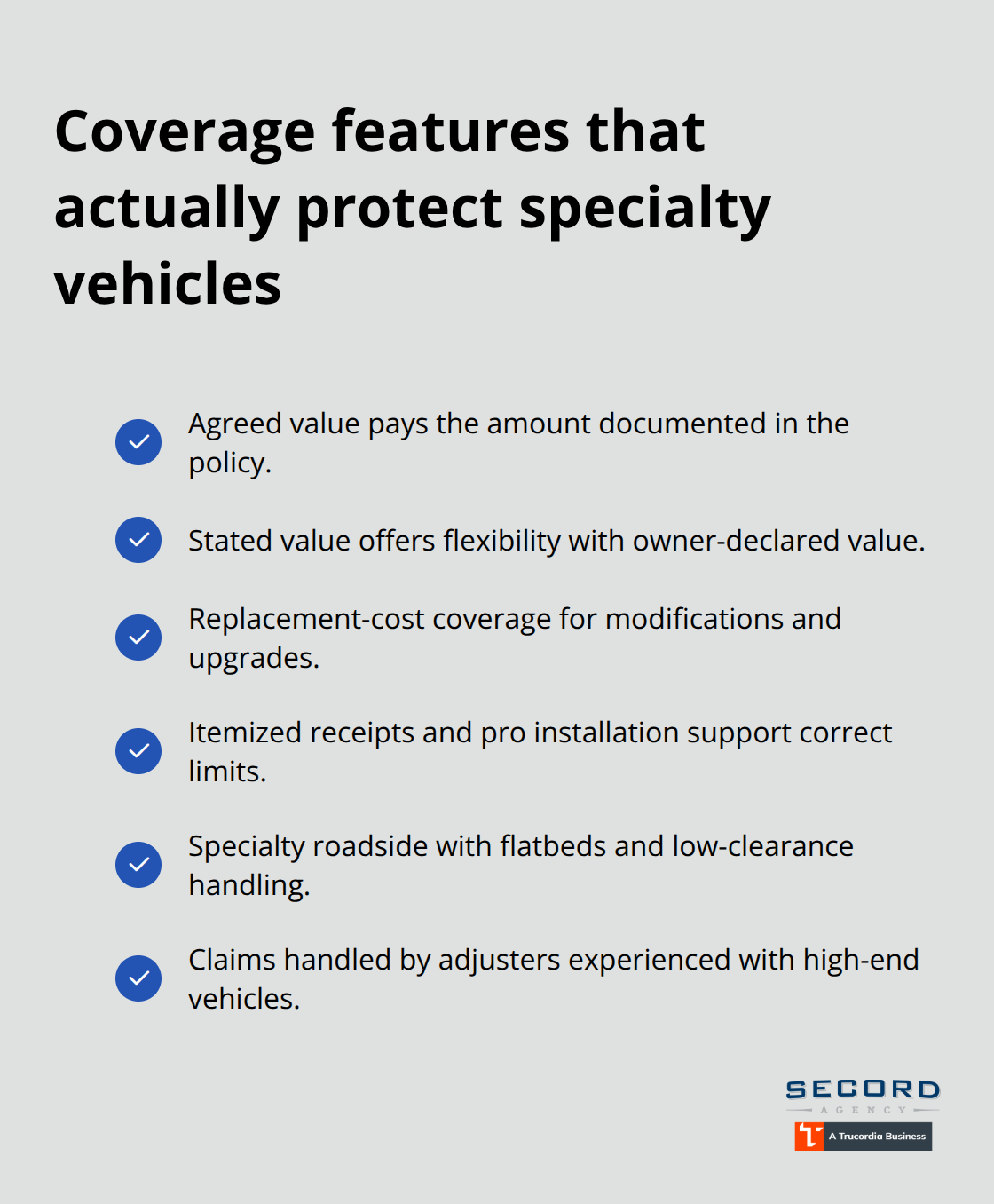
Agreed value coverage fundamentally changes how specialty vehicle insurance works in Washington. Instead of letting an insurer apply depreciation formulas after damage occurs, you and your insurance carrier establish your vehicle’s value upfront through a professional appraisal. This eliminates valuation disputes entirely. A 1963 Corvette Stingray receives that exact amount documented in your policy, so if it’s totaled, you receive the agreed-upon value rather than fighting an adjuster over its worth. Stated value policies offer a similar but slightly different approach: you declare your vehicle’s value, and the carrier accepts that declaration without requiring an appraisal upfront. This works well for owners who’ve recently had professional appraisals completed or who maintain detailed documentation of their vehicle’s condition and market comparables. Both approaches protect you far better than standard actual cash value policies that undervalue specialty vehicles systematically.
Modification Coverage at Replacement Cost
Modifications and customizations demand explicit coverage endorsements that standard policies won’t provide under any circumstances. A truck owner with significant investment in custom fabrication needs coverage that specifically includes those modifications at their actual replacement cost, not at some depreciated amount. Specialty carriers calculate modification coverage by reviewing itemized receipts, professional installation documentation, and current market prices for similar components.
Each modification receives coverage at its replacement cost if damage occurs. Standard carriers simply refuse to engage with modification coverage because these additions fall outside their underwriting models. Specialty carriers understand that your investment in these upgrades represents real value that requires real protection.
Specialized Claims Handling and Roadside Support
Roadside assistance for specialty vehicles differs significantly from standard roadside service because these vehicles require specialized towing equipment and technician expertise. Standard tow trucks can’t safely transport a low-slung sports car without risking frame damage, so specialty carriers maintain networks of providers with flatbed capability and experience handling high-value vehicles.
Claims handling for specialty vehicles also operates differently: carriers assign adjusters with experience valuing and assessing high-end vehicles rather than routing claims through standard processing centers designed for ordinary automobiles. This expertise matters tremendously when damage assessment requires knowledge of rare parts availability, restoration specialists, or whether a vehicle should be repaired or totaled based on market conditions rather than pure math.
Final Thoughts
Standard auto insurance and specialty vehicle insurance in WA operate on completely different principles. Standard policies use actual cash value calculations that systematically undervalue high-performance cars, classics, and custom builds, cap payouts at depreciated amounts, exclude modifications entirely, and deny claims for track use. Specialty vehicle carriers establish agreed values upfront, cover modifications at replacement cost, and recognize that your investment deserves protection matching its actual worth.
Finding the right coverage requires working with carriers that specialize in high-value vehicles and understand Washington’s market. Generic insurance companies won’t engage with the nuances of your specialty vehicle because it falls outside their underwriting expertise. You need carriers with experience valuing rare components, assessing custom modifications, and handling claims for vehicles that appreciate rather than depreciate.
Contact Secord Agency – A Trucordia Business to discuss specialty vehicle insurance WA options tailored to your specific vehicle and how you use it. Our team understands the difference between standard and specialty protection and handles the comparison work so you don’t have to. We’re based in Seattle’s Wallingford neighborhood and serve clients across Washington with personalized advice and competitive rates.