
Umbrella Insurance for WA: Broad Protection Across Life and Property
Your homeowner’s insurance and auto policy have limits. Once you exceed those limits, you’re personally responsible for the rest-and that can mean losing assets you’ve worked years to build.
Umbrella insurance for WA fills that gap. It kicks in when your standard policies max out, protecting your savings, home equity, and future earnings from major liability claims. We at Secord Agency – A Trucordia Business help Washington residents understand exactly how much extra protection they need.
What Umbrella Insurance Actually Protects
Umbrella insurance operates in a straightforward way: it pays for liability claims that exceed your home or auto policy limits. According to the Insurance Information Institute, a typical umbrella policy starting at $1 million in coverage costs between $150 and $300 per year, making it one of the most affordable risk management tools available. The policy activates only after your underlying coverage maxes out. If a guest suffers a serious injury on your property and medical bills reach $350,000, but your homeowners liability limit is $300,000, your umbrella policy covers that $50,000 gap plus legal defense costs. This matters because average personal injury lawsuit settlement amounts have climbed significantly, with average claim costs reaching $69,272 according to recent analysis.
Bodily Injury and Property Damage Claims
Umbrella policies cover bodily injury and property damage liability, which means someone gets hurt or their property gets damaged because of something you did or failed to do. A teenage driver in your household causes a serious accident injuring multiple people in another vehicle-umbrella coverage applies. A guest slips on your icy driveway and requires surgery-umbrella covers what your homeowners policy doesn’t. Certain personal injury claims also fall under umbrella protection, including defamation or privacy invasion, though exact coverage varies by policy and insurer.
What Umbrella Does Not Cover
Umbrella policies typically do not cover your own medical bills or property repairs; those remain the responsibility of your primary policies. Intentional acts, business activities, and professional services also fall outside umbrella protection. You need to verify exact exclusions with your insurer before you purchase a policy, as gaps between your underlying coverage and umbrella limits can create unexpected exposure.
Legal Defense Costs Matter Most
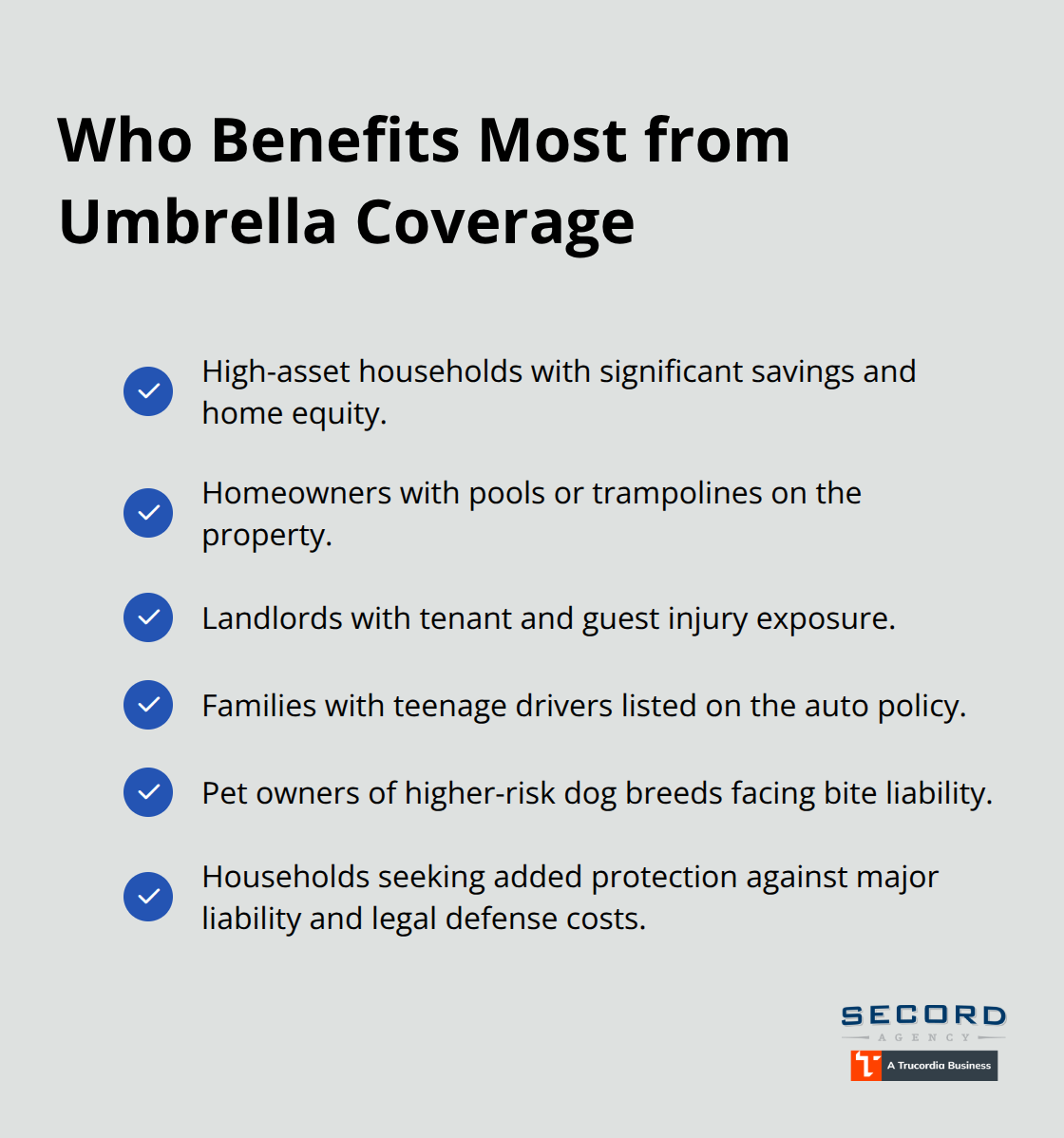
What umbrella does cover is the legal defense itself. If you face a lawsuit, the insurer pays your attorney fees, court costs, and expert witnesses before the policy limit is reached. This defense cost component alone justifies the modest annual premium for most Washington homeowners and property owners. High-asset households, homeowners with pools or trampolines, landlords, and families with teenage drivers benefit most from this protection. Understanding your current liability limits and identifying which scenarios pose the greatest risk to your assets helps you determine whether umbrella coverage fits your situation.
Who Really Needs Umbrella Coverage in Washington
Asset Protection Starts with Honest Assessment
If you own anything worth protecting, umbrella insurance matters. Washington homeowners with substantial assets face real exposure when liability claims exceed their standard policy limits. According to the Insurance Information Institute, high-asset households should seriously consider umbrella coverage because a single lawsuit can wipe out years of savings. Homeowners with pools, trampolines, or rental properties face elevated risk-a guest’s serious injury on your property can trigger claims well beyond your homeowners liability limit of $300,000 or $500,000.
Teen Drivers and Elevated Accident Risk
Parents with teenage drivers need this protection immediately. Teen drivers cause accidents at twice the rate of drivers aged 20 and up, according to the CDC, and a multi-car collision involving serious injuries can easily exceed standard auto liability limits of $25,000 or $50,000. The financial exposure from a single accident involving your teenager can devastate your family’s financial security without umbrella protection in place.
Business Owners Must Separate Coverage Types
Business owners and self-employed professionals operating from home or managing rental properties must separate personal umbrella coverage from commercial liability. The distinction matters legally and financially. If you run a consulting business, freelance, or manage rental units, commercial liability is a different product entirely-don’t assume your personal umbrella covers business activities because it typically doesn’t. Landlords managing even a single rental property need umbrella protection because tenant and visitor injuries on rental properties create separate liability exposure beyond your personal residence.
Pet Owners Face Specific Liability Gaps
Pet owners with dogs classified as higher-risk breeds should evaluate umbrella coverage seriously. Dog bite liability claims average $58,545 according to the Insurance Information Institute, and if your homeowners policy excludes certain breeds or has low limits, that gap becomes your personal responsibility. This exposure exists whether your insurer acknowledges it or not.
Coverage Limits and Life Changes
The right question isn’t whether you can afford umbrella insurance-at $150 to $300 annually for $1 million in coverage, most households can. The real question is whether you can afford not to carry it. Starting with $1 million in coverage makes sense for most Washington households; if your net worth exceeds $1 million or you have significant real estate holdings, try $2 million or $5 million limits. Most insurers require that you maintain minimum liability limits on your auto and homeowners policies before they’ll sell you umbrella coverage-typically $250,000 to $300,000 in homeowners liability and $100,000 to $300,000 in auto liability. Check those limits first, because if they’re too low, you’ll need to raise them before purchasing umbrella protection. Life changes trigger the need to reassess: marriage, children, purchasing rental property, or acquiring recreational vehicles all increase your liability exposure.
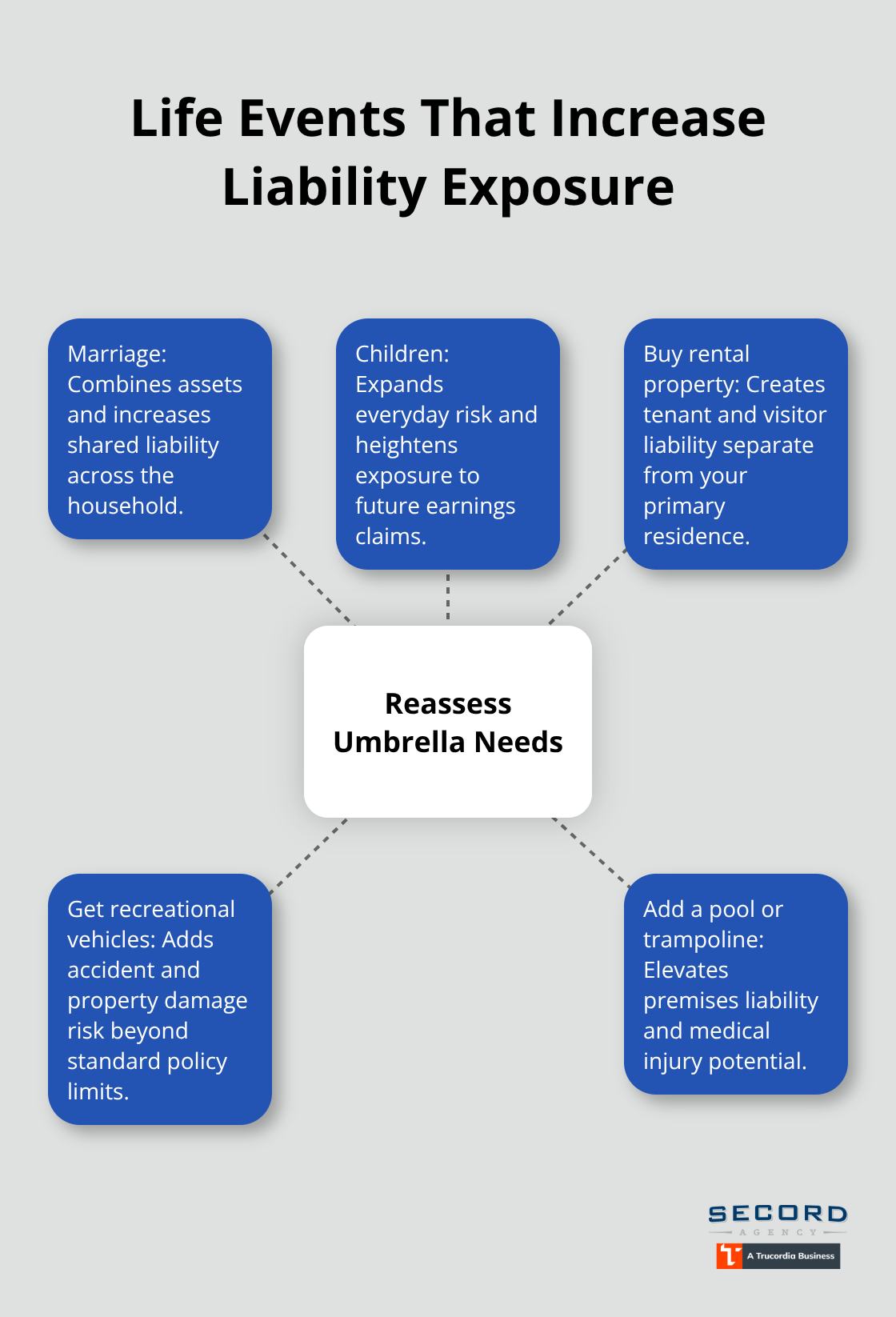
Review your limits annually or after major life events to confirm adequacy. Once you’ve identified your asset position and confirmed your underlying policy limits meet insurer requirements, the next step involves understanding how to actually select the right coverage amount for your specific situation.
How to Choose the Right Umbrella Policy
Identify Your Exact Coverage Gaps
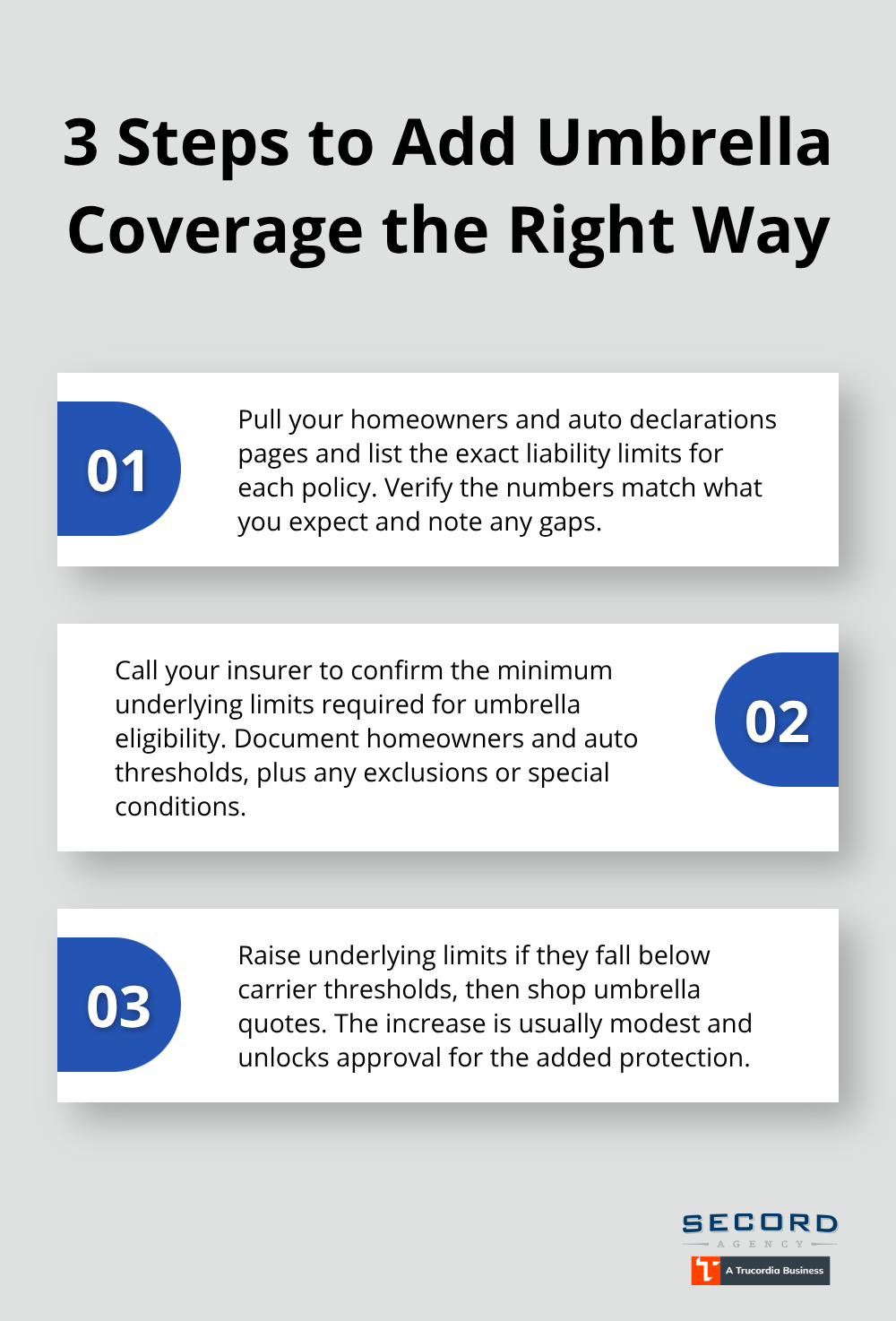
Start by pulling your current homeowners and auto policy declarations pages, then identify the exact liability limits listed. Most Washington homeowners carry $300,000 to $500,000 in homeowners liability and $100,000 to $300,000 in auto liability. The Insurance Information Institute notes that average personal injury settlements can reach significant amounts, meaning a single serious incident can exceed your underlying limits within minutes. Your gap isn’t theoretical-it’s the difference between what your current policies will pay and what a court might award.
Call your current insurer and ask them to specify three things: What is my homeowners liability limit? What is my auto liability limit? What is my umbrella requirement from this carrier? Most insurers require minimum underlying limits before approving umbrella coverage, typically $250,000 to $300,000 in homeowners liability and $100,000 to $300,000 in auto liability. If your limits fall below those thresholds, you’ll need to raise them first, which costs less than you think but must happen before umbrella shopping begins. This step eliminates guessing and forces you to see exactly where exposure lives.
Match Coverage Limits to Your Assets
The coverage limit you choose should reflect what you’d lose if someone sued successfully. If your net worth is $500,000, a $1 million umbrella policy protects that entire amount plus future earnings. If you own multiple properties, run a rental business, or have substantial investments, $2 million or $5 million coverage makes more sense. The Insurance Information Institute recommends that high-asset households consider umbrella limits matching or exceeding their total net worth.
Add up your home equity, retirement accounts, investment accounts, and vehicles. That number guides your coverage selection. A $1 million policy costs $150 to $300 annually according to the Insurance Information Institute, while $2 million typically runs $300 to $500 per year. The incremental cost to double your protection is minimal, making higher limits worth considering if you have any significant assets. Washington homeowners with pools, rental properties, or teenage drivers should try $2 million minimum because these situations generate claims that exceed $1 million more frequently than other scenarios.
Compare Quotes from Multiple Carriers
Never accept the first quote. Get quotes from at least three carriers because umbrella rates vary significantly based on how each insurer calculates risk. Some carriers bundle umbrella with auto and homeowners policies and offer substantial discounts-Bankrate notes that bundling can yield meaningful savings on the umbrella premium itself.
When you request quotes, ensure each one specifies who is protected under the policy, what specific incidents are covered, and where gaps exist between your underlying policies and the umbrella. Ask each carrier: Do you require minimum underlying limits? What are your specific exclusions? Will you cover rental properties or business exposure? Do you offer discounts for bundling? The answers differ dramatically between carriers, and some exclude coverage types that others include.
Compare the final quotes side by side, but don’t choose based on price alone-verify that each policy covers the exposures that matter most to your household. Secord Agency, an independent insurance agency based in Seattle’s Wallingford neighborhood, shops multiple carriers to deliver competitive rates paired with personalized advice, which means you receive quotes tailored to your actual situation rather than generic estimates.
Final Thoughts
Umbrella insurance for WA protects what matters most: your financial security and the assets you’ve built over decades. A single liability claim exceeding your homeowners or auto policy limits can force you to liquidate savings, refinance your home, or face wage garnishment. The modest annual cost of $150 to $300 for $1 million in coverage makes this protection accessible to virtually every Washington household with meaningful assets.
Adding umbrella coverage to your existing policies requires three concrete steps: pull your current homeowners and auto policy declarations and confirm your exact liability limits, contact your insurer to learn their minimum underlying coverage requirements before umbrella approval, and raise those underlying limits if they fall below the carrier’s thresholds (typically $250,000 to $300,000 in homeowners liability and $100,000 to $300,000 in auto liability). These steps take less than an hour and eliminate guesswork about your actual exposure. High-asset homeowners, parents with teenage drivers, landlords, and pet owners face the greatest exposure, but anyone with something to lose benefits from this straightforward risk management tool.
Getting a quote from a local insurance agent who shops multiple carriers ensures you receive competitive rates paired with personalized guidance. Contact Secord Agency to discuss your umbrella insurance needs and receive quotes that reflect your actual situation rather than generic estimates.